NARRATOR:
You will hear two students planning a presentation about the explorer Thor Heyerdahl.
NARRATOR:
First, you have some time to look at questions 21 to 24.
NARRATOR:
Now listen carefully and answer questions 21 to 24.
VICTOR:
Shall I begin our presentation with Thor Heyerdahl's early life?
OLIVIA:
Start by describing him as a boy, especially how keen he was on collecting things.
VICTOR:
He even created a small museum of his own.
VICTOR:
It's interesting that he formed his own interests instead of simply copying his parents.
VICTOR:
For instance, he refused to go hunting with his father.
OLIVIA:
He preferred learning about nature while his mother read aloud to him.
OLIVIA:
He also decided quite young that he wanted to be an explorer.
OLIVIA:
I think that ambition came from camping trips in Norway.
VICTOR:
Actually, climbing was the activity he devoted most of his time to as a young man.
OLIVIA:
After university, he married a fellow student.
OLIVIA:
They then chose to live on a small island because they wanted to experience isolation and study how severe weather affected people's way of life.
VICTOR:
Before leaving, they learned basic survival techniques such as constructing a shelter.
VICTOR:
They needed those skills for life in a remote place with very few inhabitants separated from others by the sea.
OLIVIA:
You should end your section with the radical theory Heyerdahl developed after discovering and examining mysterious ancient carvings on the island.
NARRATOR:
Before you hear the rest of the discussion, you have some time to look at questions 25 to 30.
NARRATOR:
Now listen and answer questions 25 to 30.
OLIVIA:
After your section, I'll cover his adult life, beginning with his theory about Polynesian migration.
OLIVIA:
Until then, academics believe that people at first reached Polynesia from Asia in the West.
VICTOR:
They considered migration from the East impossible because the nearest inhabited land was separated from the islands by an immense empty ocean.
OLIVIA:
Heyerdahl spent a long time analyzing clouds, currents, and winds to see whether such a journey could work.
OLIVIA:
Scholars also argued that communities east of Polynesia had no tradition of building large ships, although Heyerdahl knew they regularly made coastal journeys in locally constructed canoes or on rafts, as his later long-distance voyage demonstrated.
VICTOR:
It was exceptionally dangerous.
VICTOR:
Sometimes I wonder whether he wanted to prove his courage by having an extraordinary adventure.
OLIVIA:
I think his main purpose was simpler.
OLIVIA:
He wanted to test his theory and discover whether migration from the East was possible.
VICTOR:
Yes, that's more convincing.
VICTOR:
The war had interrupted his research for several years.
OLIVIA:
When he resumed the work and planned the voyage, was it important to complete it before anyone else?
VICTOR:
I haven't found evidence of that.
VICTOR:
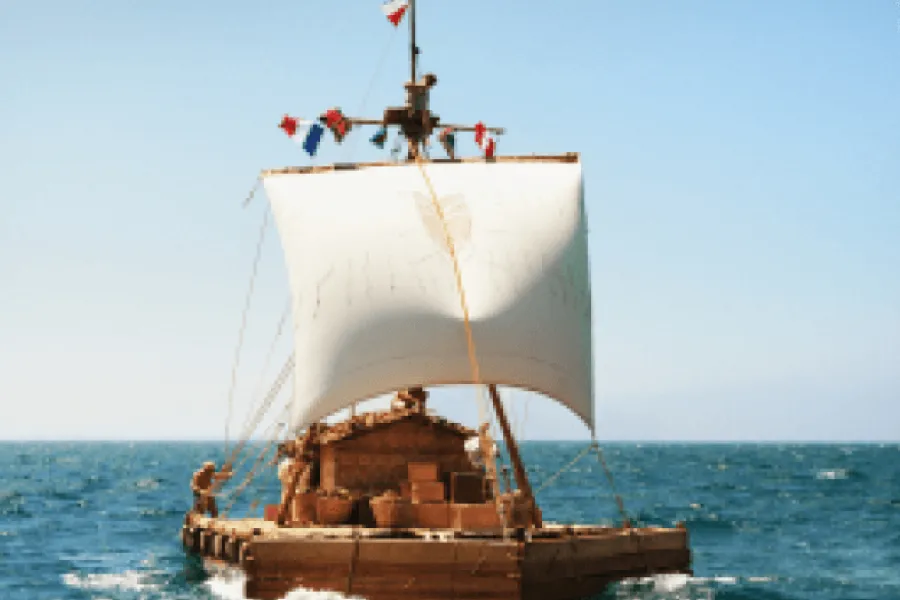
His priority was building the raft with authentic ancient techniques and materials available locally.
OLIVIA:
Do we know how fast it traveled?
VICTOR:
The crossing from South America to the Pacific Island lasted 97 days.
OLIVIA:
He later visited Easter Island.
OLIVIA:
We should explain why.
OLIVIA:
Did he sail there in a reed boat?
VICTOR:
No, the reed boat journey happened later in Egypt.
VICTOR:
On Easter Island, he spoke with residents about their old stone carvings and then made a statue himself to understand how the process worked.
OLIVIA:
What a remarkable life.
OLIVIA:
Although many of his theories were later disproved, he influenced several fields.
OLIVIA:
I think his greatest contribution was establishing the approach now called practical archaeology, recreating something from the past and the present, as he did with the raft.
VICTOR:
I'll include our sources on the final slide.
VICTOR:
I relied mainly on William Oliver's The Life and Work of Thor Heyerdahl.
VICTOR:
The research method seemed sound, but the writing style felt old-fashioned.
VICTOR:
A revised edition is needed.
OLIVIA:
The subject matter itself was difficult, though.
VICTOR:
Well, it is a complicated topic.
OLIVIA:
The book had many strengths.
OLIVIA:
What did you think of?
NARRATOR:
That is the end of part three.
NARRATOR:
You now have one minute to check your answers to part three.