IELTS Real Reading Test 2025 - Q1 Test 5 with Practice Test, Answers And Explanation
Luyện tập đề IELTS Real Reading Test 2025 - Q1 Test 5 được lấy từ cuốn sách Real Test 2025 - Q1 với trải nghiệm thi IELTS trên máy và giải thích đáp án chi tiết bằng Linearthinking, kèm answer key và list từ vựng IELTS cần học trong bài đọc.
IELTS Real Reading Test 2025 - Q1 Test 5 with Practice Test, Answers And Explanation
Passage
❓ Câu hỏi passage 1
Question 1 - 6
Do the following statements agree with the information given in the Reading Passage?
TRUE if the statement agrees with the information
FALSE if the statement contradicts the information
NOT GIVEN if it is impossible to say what the writer thinks about this
1
It is more effective to resolve poverty or food problem in large scale rather than in small scale.
2
Construction of gigantic dams costs more time in developing countries.
3
Green revolution failed to increase global crop production from the mid of 20th century.
4
Agricultural production in Bangladesh declined in last decade.
5
Farmer Abdul Rahman knew how to increase production himself.
6
Small pumps spread into big projects in Bangladesh in the past decade.
Question 7 - 10
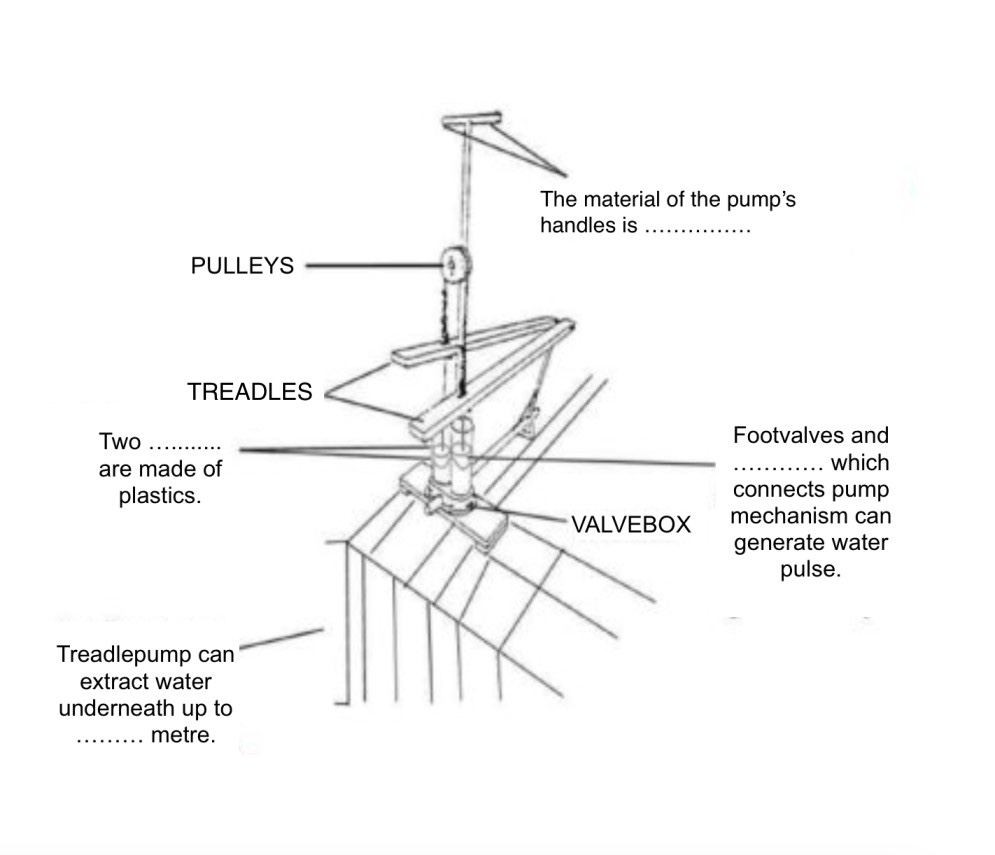
Filling the blanks in diagram of treadle pump’s each parts.
Choose NO MORE THAN THREE WORDS AND/OR A NUMBER from the passage for each answer.
Question 11 - 13
Answer the questions below.
Choose NO MORE THAN THREE WORDS AND/OR A NUMBER from the passage for each answer.
11
How large an area can a treadle pump irrigate at a low level of expense?
12
What is Abdul’s new roof made of?
13
How much did Bangladesh farmers invest by IDE’s stimulation?
Passage
❓ Câu hỏi passage 2
Question 14 - 19
The Reading Passage has six paragraphs A-F.
From the list of headings below choose the most suitable heading for each paragraph.
List of Headings
I
Objectives of the regeneration project
II
Architectural details of the station buildings
III
Features and facilities of the completed development
IV
The remains of a railway system
V
A positive evaluation of the finished project
VI
A way of controlling development costs
VII
Ways of crossing the site
VIII
Reasons why the area had become neglected
14
Paragraph A
15
Paragraph B
16
Paragraph C
17
Paragraph D
18
Paragraph E
19
Paragraph F
Question 20 - 21
Choose TWO letters, A-E.
Which TWO reasons are given for the choice of Gleisdreieck as a site for a park?
A
It was a habitat for some rare wildlife species.
B
It contained a particular tourist attraction.
C
It lay at the heart of the reunited city.
D
It was served by a major rail network.
E
It contained buildings which could be easily converted.
Question 22 - 23
Choose TWO letters, A-E.
The list below identifies some of the possible aims of urban redevelopment projects. Which TWO things did the State of Berlin hope to achieve with the Gleisdreieck development?
A
to bring people of different ages together
B
to encourage tourism
C
to improve transport links
D
to preserve industrial remains
E
to generate income for the city
Question 24 - 26
Choose ONE WORD ONLY from the passage for each answer.
Gleisdreieck Urban Park
In the middle of the new park is a , where there is a path for pedestrians and two railway lines. A slow train uses these lines to make a regular journey between its base and a . Benches have been provided on the north side, so that people can relax and enjoy the sunshine, and to the east is an area with mature trees of various kinds, as well as sets of swings. A range of sports and leisure areas are situated around the of the site.
Passage
❓ Câu hỏi passage 3
Question 27 - 32
Reading Passage has seven paragraphs A-G
Which paragraph contains the following information?
Write the correct letter, A-G
27
a description of how a contestant remembers complex sequences
28
an example of how one person’s memory was improved over time
29
a description of a memorizing competition
30
a commonly held belief about memory that many experts say is unproven
31
a reference to the first recorded use of memorizing through location
32
a reference to an unusual condition which results in improved memory
Question 33 - 36
Complete the summary below.
Choose NO MORE THAN THREE WORDS from the passage for each answer.
Using visual imagery and spatial navigation to remember numbers are investigated and explained. A , an action, and a thing are assigned to consecutive cards in the pack. Combining these images allows Cooke to memorise at a time. The mind pictures are then positioned on a . The pack of cards is remembered by going for a . While the pictures are converted back into cards.
Question 37 - 40
Complete each of the following statements with the best ending A-F from the box below.
List of Endings
A
used mainly for educational purposes.
B
activated brain areas associated with visual and spatial memory.
C
became widespread in ancient Greece for memorizing speeches and texts.
D
the result of techniques and extensive practice.
E
retaining a wide variety of tasks.
F
benefited from additional cognitive abilities.
Valentine, Wilding and Maguire’s experiment shows that the memory contestants
37
After Simonides discovered the loci method in 477 BC, it was
38
Ericsson finds out that natural memorisers are better than strategic memorisers at
39
According to K. Anders Ericsson, Shereshevski’s skills were
40
DOL IELTS Đình Lực
05/05/2026
📖 Bài đọc passage 1
Foot Pedal Irrigation
Until now, governments and development agencies have tried to tackle the problem through large-scale projects: gigantic dams, sprawling, irrigation canals and vast new fields of high-yield crops introduced during the Green Revolution, the famous campaign to increase grain harvests in developing nations. Traditional irrigation, however, has degraded the soil in many areas, and the reservoirs behind dams can quickly fill up with silt, reducing their storage capacity and depriving downstream farmers of fertile sediments. Furthermore, although the Green Revolution has greatly expanded worldwide farm production since 1950, poverty stubbornly persists in Africa, Asia and Latin America. Continued improvements in the productivity of large farms may play the main role in boosting food supply, but local efforts to provide cheap, individual irrigation systems to small farms may offer a better way to lift people out of poverty.
The Green Revolution was designed to increase the overall food supply, not to raise the incomes of the rural poor, so it should be no surprise that it did not eradicate poverty or hunger. India, for example, has been self-sufficient in food for 15 years, and its granaries are full, but more than 200 million Indians – one fifth of the country’s population – are malnourished because they cannot afford the food they need and because the country’s safety nets are deficient. In 2000, 189 nations committed to the Millennium Development Goals, which called for cutting world poverty in half by 2015. With business as usual, however, we have little hope of achieving most of the Millennium goals, no matter how much money rich countries contribute to poor ones.
The supply-driven strategies of the Green Revolution, however, may not help subsistence farmers, who must play to their strengths to compete in the global marketplace. The average size of a family farm is less than four acres in India, 1.8 acres in Bangladesh and about half an acre in China. Combines and other modern farming tools are too expensive to be used on such small areas. An Indian farmer selling surplus wheat grown on his one-acre plot could not possibly compete with the highly efficient and subsidized Canadian wheat farms that typically stretch over thousands of acres. Instead subsistence farmers should exploit the fact that their labor costs are the lowest in the world, giving them a comparative advantage in growing and selling high-value, intensely farmed crops.
Paul Polak saw firsthand the need for a small-scale strategy in 1981 when he met Abdul Rahman, a farmer in the Noakhali district of Bangladesh. From his three quarter-acre plots of rain-fed rice fields, Abdul could grow only 700 kilograms of rice each year – 300 kilograms less than what he needed to feed his family. During the three months before the October rice harvest came in, Abdul and his wife had to watch silently while their three children survived on one meal a day or less. As Polak walked with him through the scattered fields he had inherited from his father, Polak asked what he needed to move out of poverty. “Control of water for my crops,” he said, “at a price I can afford.”
Soon Polak learned about a simple device that could help Abdul achieve his goal: the treadle pump. Developed in the late 1970s by Norwegian engineer Gunnar Barnes, the pump is operated by a person walking in place on a pair of treadles and two handle arms made of bamboo. Properly adjusted and maintained, it can be operated several hours a day without tiring the users. Each treadle pump has two cylinders which are made of engineering plastic. The diameter of a cylinder is 100.5mm and the height is 280mm. The pump is capable of working up to a maximum depth of 7 meters. Operation beyond 7 meters is not recommended to preserve the integrity of the rubber components. The pump mechanism has piston and foot valve assemblies. The treadle action creates alternate strokes in the two pistons that lift the water in pulses.
The human-powered pump can irrigate half an acre of vegetables and costs only $25 (including the expense of drilling a tube well down to the groundwater). Abdul heard about the treadle pump from a cousin and was one of the first farmers in Bangladesh to buy one. He borrowed the $25 from an uncle and easily repaid the loan four months later. During the five-month dry season, when Bangladeshis typically farm very little, Abdul used the treadle pump to grow a quarter-acre of chili peppers, tomatoes, cabbage and eggplants. He also improved the yield of one of his rice plots by irrigating it. His family ate some of the vegetables and sold the rest at the village market, earning a net profit of $100. With his new income, Abdul was able to buy rice for his family to eat, keep his two sons in school until they were 16 and set aside a little money for his daughter’s dowry. When Polak visited him again in 1984, he had doubled the size of his vegetable plot and replaced the thatched roof on his house with corrugated tin. His family was raising a calf and some chickens. He told me that the treadle pump was a gift from God.
Bangladesh is particularly well suited for the treadle pump because a huge reservoir of groundwater lies just a few meters below the farmers’ feet. In the early 1980s IDE initiated a campaign to market the pump, encouraging 75 small private-sector companies to manufacture the devices and several thousand village dealers and tube-well drillers to sell and install them. Over the next 12 years one and a half million farm families purchased treadle pumps, which increased the farmers’ net income by a total of $150 million a year. The cost of IDE’s market-creation activities was only $12 million, leveraged by the investment of $37.5 million from the farmers themselves. In contrast, the expense of building a conventional dam and canal system to irrigate an equivalent area of farmland would be in the range of $2,000 per acre, or $1.5 billion.
7
8
9
10
7
8
9
10
🔥 Đáp án & giải thích 1
1
False
Giải thích chi tiết
Step 01: Read the question to understand (main idea + detail)
It is more effective to resolve poverty or food problemin large scale rather than insmall scale
Main idea: Giải quyết vấn đề nghèo đói/thiếu lương thực: quy mô lớn hiệu quả hơn quy mô nhỏ.
-------
Step 02: Locate relevant information
🔍 Từ khóa: “large-scale”, “small-scale”, “poverty”, “food supply”
→ Tìm đoạn văn nói về so sánh hiệu quả giữa giải pháp quy mô lớn và giải pháp quy mô nhỏ liên quan đến 2 vấn đề nghèo đói/thiếu lương thực --> Tìm thấy ở Đoạn 1.
📌 Trích dẫn: “Continued improvements in the productivity of large farms may play the main role in boosting food supply, but local efforts to provide cheap, individual irrigation systems to small farms may offer a better way to lift people out of poverty.”
-------
Step 03: Read relevant information to understand (main + detail)
Simplified:
Large farms may play role in boosting food supplybutlocal efforts ... small farms may offer better way to lift people out of poverty
Main idea: Quy mô lớn → tăng nguồn cung lương thực; Quy mô nhỏ → hiệu quả hơn để xóa nghèo.
-------
Step 04: Compare meaning with meaning
Trong bài đọc: Large-scale farms giúp tăng food supply, nhưng small-scale irrigation systems hiệu quả hơn trong việc giảm nghèo.
Trong câu hỏi: Large-scale effective hơn small-scale trong việc giải quyết poverty/food problem.
⇒ ❌ Mâu thuẫn → Chọn: FALSE
-------
Giải thích lí do các đáp án khác sai:
Nếu đáp án là TRUE: Bài đọc phải khẳng định large-scale projects hiệu quả hơn small-scale trong cả hai việc giải quyết poverty/food problem, nhưng thực tế ngược lại → small-scale irrigation systems hiệu quả hơn trong việc giảm nghèo.
Nếu đáp án là NOT GIVEN: Bài đọc không chỉ so sánh gián tiếp, mà khẳng định rõ small-scale “may offer a better way” → đủ dữ kiện để kết luận.
Urban Regeneration: an award-winning redevelopment project in Berlin
A
A. Just over a kilometer south of Berlin’s Potsdamer Platz, near the left bank of the Landwehr Canal, an extensive, triangular-shaped area of waste ground once separated the neighbourhoods of Kreuzberg to the east and Schõneberg to the west. Known as Gleisdreieck, meaning ‘triangle of rails’, it was formed by the intersection of different railway lines built in the mid-nineteenth century that entered Berlin from the south. Tracks, sheds and warehouses belonging to three old railway stations – Dresdner Bahnhof (1875-1882), Potsdamer Bahnhof (1838-1944) and Anhalter Bahnhof (1839-1952) – are situated on a raised area some twenty hectares in size, at a height of four metres above the surrounding ground level.
B
B.
As the railway infrastructure gradually ceased to be used, the whole area of Gleisdreieck became increasingly run down and abandoned, to the point of being used as a rubbish tip after 1945. Meanwhile, vegetation took over, turning it into a surprising, natural haven in the middle of built-up areas. The closeness of the wall which divided the city of Berlin between 1961 and 1990 also contributed to the fact that Gleisdreieck was for decades clearly identified as no-man’s-land. Only a station of the same name in Berlin’s underground railway system testified to its existence. Shortly before the fall of the Berlin Wall, however, the German Museum of Technology was established there, attracting large numbers of visitors and giving visibility to the site. More importantly, the unification of the formerly divided city gave the zone more centrality, at which point it became imperative to identify a purpose for it.
C
After 2006, the State of Berlin put forward the proposal of converting Gleisdreieck into a large urban park that would integrate the different urban zones which converged there. The decades-long isolation of the site, which had formerly presented a problem, now represented an opportunity for joining the southern area of Potsdamer Platz with Kreuzberg and Schõneberg. The creation of the park would trigger one of the biggest urban expansions inside Berlin, all within a framework of multiple uses, and social characteristics. It was necessary to stimulate the development of sixteen new hectares of local amenities that would be capable of integrating different generations and social groups in a sustainable way, and in harmony with nature. Following intense discussion with local proprietors and residents, the need to reconcile these goals with the conservation of railway heritage also emerged.
D
Once the area had been subjected to a process of undergrowth clearance and decontamination, it was then organized around a combination of existing and added elements. The project as a whole was planned around a large central meadow, intersected from east to west by a concrete footpath, and from north to south by a pair of railway lines. Once a month, a train slowly travels along these lines from its parking shed to the German Museum of Technology. The concrete footpath, which is a continuation of one of the main Kreuzberg boulevards, starts in the east, bridges the four-metre difference in ground level by means of a stairway, and suddenly ends in the west on reaching the underground lines.
E
North of the meadow, there is a large concrete slab with rounded edges. Being south-facing, this functions as a big sunny terrace, full of benches complete with footrests. In the south, the meadow overlooks Yorckstrasse, an underpass crossed by more than fifteen former railway bridges. To the east of the meadow there is quite a dense forest of pre-existing maples, oaks and birches, as well as newly planted tree of the same species. In this area, a couple of large metal frames each hold two swings. The edges of the park are finished with a collection of distinctive, functional spaces, for example a nursery, sports fields, concave surfaces for skateboards, stages for dancing, community gardens, or simply areas covered in gravel obtained from the site itself.
F
Although initially the regeneration of Gleisdreieck Park was the subject of disagreement between those who were in favour of safeguarding the railway heritage, and those who wanted to regenerate the adjacent neighbourhoods, it was opened to the public in September 2011. The heart of Berlin now has a new green lung, in which the atmosphere of various small, very different corners fits neatly into a large-scale, wide-ranging and robust general order. This has been possible precisely because the intervention was not limited to conserving industrial remains in order to promote railway history. And as a reminder of the six decades of human absence, during which nature took over, the park has been able to conserve to some extent the spirit of the non-place that preceded it.
🔥 Đáp án & giải thích 2
14
IV
Giải thích chi tiết
☺️ Ứng dụng Linearthinking để giải quyết dạng bài Matching Headings
✅ Paragraph A → Đáp án đúng: D. The remains of a railway system
-------
📍 Giải thích chi tiết
Step 01: Read to understand main idea
Dựa vào phần Simplify & Connection ở trên, có thể suy ra:
→ Đại ý toàn đoạn: Đoạn văn giới thiệu một khu đất từng là nút giao đường sắt, nhấn mạnh các dấu tích còn sót lại của hệ thống đường sắt cũ như đường ray, nhà kho và các nhà ga.
-------
Step 02: Compare meaning with meaning
– Đại ý của đoạn:Mô tả những tàn tích của một hệ thống đường sắt trong quá khứ.
=> Chọn đáp án đúng:The remains of a railway system
– Giải thích: Heading D khớp hoàn toàn với nội dung đoạn: toàn bộ thông tin đều xoay quanh các dấu tích vật chất (tracks, sheds, warehouses, stations) của một hệ thống đường sắt cũ, chưa đề cập đến công viên hay tái phát triển đô thị.
A. The Examinations School at Oxford University is where, last August, 34 contestants gathered at the World Memory Championships. It is an impressive historical venue, known for its austere yet grandiose setting of oak-paneled rooms, large Gothic windows, and looming portraits of eminent dukes and earls. It is here that generations of Oxford students have been tested in their final exams on their memory and knowledge, and it is here that these contestants were challenged to demonstrate their exceptional mnemonic abilities. Reciting poems, memorizing digit sequences, and recalling faces from photographs are just a few of the tasks that test the limits of human memory in this competitive setting.
B
They are using a technique known as the loci method, reportedly originating in 477 BC with the Greek poet Simonides of Ceos. He was able to memorize the guest list at a dinner by closing his eyes and recalling each individual around the table. The loci method, which was rediscovered and popularized by Simonides, has become an integral part of historical and modern memory training. This method involves associating items to be remembered with specific physical locations, creating a mental map that facilitates recall. After Simonides's discovery, the loci method became widely embraced across ancient Greece, serving as a fundamental technique for orators and scholars. It was so effective that it was incorporated into educational curricula and became a cornerstone of rhetorical training. Aristotle wrote favorably about it, recognizing its value and effectiveness. Later, a number of treatises on the art of memory were published in Rome, further cementing its importance and utility in memory training. This method not only aids in memorization but also enhances the ability to retrieve information by navigating through these mental loci, effectively walking through a structured memory palace.
C
One memory champion, Ed Cooke, can memorize the order of ten decks of playing cards in less than one hour or one deck of cards in less than one minute. Psychologists Elizabeth Valentine and John Wilding have teamed up with Eleanor Maguire to study how memory champions like Cooke operate differently from average individuals. Their collaboration aims to explore the neural underpinnings that might explain the exceptional memory skills exhibited by competitors in high-pressure environments such as memory championships. When the researchers analyzed the brain scans from the number memorization, they found that the memory champions were activating some brain regions that were different from those the control subjects were using. These regions are known to be involved in visual memory and spatial navigation.
D
To enable himself to memorize quickly, Ed Cooke has memorized a specific human being, verb, and object that he associates with every card in the deck. This detailed and highly personalized system allows him to rapidly encode and decode information during competitions. When Cooke commits a deck to memory, he does it three cards in one go, with every three-card group forming a composite picture of a person doing something to an object. This method not only enhances the memorization process but also makes the recall process faster and more efficient. He then places those images along a specific familiar path in his mind, creating a vivid mental journey that he can easily traverse. When it comes to recall, Cooke takes a mental walk along his route and translates the images into cards, effectively and efficiently converting his vivid mental images back into the specific order of the deck. This innovative approach to memory exercises showcases the extraordinary capabilities of mental athletes and the sophisticated strategies they employ to achieve their remarkable feats.
E
The term 'photographic memory' is frequently used to describe people with exceptional recall. Yet, most researchers agree there is no proof that such a memory truly exists. If it is indeed a myth, it highlights how learned strategies are often more effective than natural talent. The belief in 'photographic memory' remains a point of contention among the public and scientists alike. Despite the absence of solid scientific evidence, this myth endures, reflecting how society’s fascination with remarkable memory tends to ignore the practical techniques and training that genuinely drive mnemonic success.
F
The most renowned of the naturals was the Russian journalist S.V. Shereshevski, who could remember long sequences of numbers learned decades before, as well as poems, strings of meaningless syllables, and nearly anything else he was asked to recall. Shereshevski also experienced synesthesia, a rare sensory condition where the senses are interconnected, which significantly improved his memorization ability. His skills were not limited to these accomplishments; his remarkable memory covered an almost endless range of information, making him a figure of great interest and study. This synesthetic trait not only made his memorization tasks easier but also more vivid and long-lasting. His case has been extensively examined, as it offers deep insights into the potential of human memory when enhanced by neurological variations.
G
K. Anders Ericsson, a well-known psychologist, claims that anyone can develop memory abilities comparable to those of memory champions through consistent practice and proper techniques. During two years of experimentation, S.V. increased his ability to recall numbers from seven to over eighty. This study led Ericsson to conclude that there is no such thing as an innately superior memory. When he revisited original case reports of natural memorizers, he discovered that their remarkable abilities were actually based on the use of specific techniques — sometimes unconsciously — combined with extensive practice. Strategists are usually outstanding at remembering only certain kinds of material, whereas naturals exhibit strong memory across many types of tasks and can retain those memories more easily.
🔥 Đáp án & giải thích 3
27
D
Giải thích chi tiết
☺️ Ứng dụng Linearthinking để giải quyết dạng bài Matching Information
📌 Dạng Matching Information chúng ta nên làm cuối cùng, sau khi đã làm các dạng câu hỏi khác nhé DOLBIES, bởi vì lúc này mình đã đọc và hiểu nội dung của bài rồi, cộng thêm nghệ thuật Specify của Linearthinking → sẽ nhanh chóng tìm được vị trí đáp án hơn!!
-------
Step 01: Read the question to predict
Hiểu câu hỏi: a description of how a contestant remembers complex sequences
Specify & Predict: Tìm đoạn mô tả cách một thí sinh chia nhỏ thông tin, ví dụ: biến chúng thành hình ảnh, thước phim, lộ trình...
-------
Step 02: Khoanh vùng đoạn văn
🔍 Từ khóa: “remembers”, “sequence”, “contestant” (tên cụ thể)
→ Dựa vào các từ khoá trên, có thể khoanh vùng được đoạn D vì có xuất hiện các cụm như “three cards in one go”(ghi nhớ ba lá một lần), “forming a composite picture”(tạo thành hình ảnh tổng hợp), “places those images along a specific familiar path in his mind” (đặt những hình ảnh đó dọc theo một con đường quen thuộc cụ thể trong tâm trí anh ấy), “takes a mental walk along his route and translates the images into cards“ (đi lại lộ trình trong đầu và chuyển hình ảnh thành các lá bài) → Đây là phần mô tả cách một thí sinh ghi nhớ các chuỗi thông tin phức tạp.
Until now, governments and development agencies have tried to tackle the problem through large-scale projects: gigantic dams, sprawling, irrigation canals and vast new fields of high-yield crops introduced during the Green Revolution, the famous campaign to increase grain harvests in developing nations. Traditional irrigation, however, has degraded the soil in many areas, and the reservoirs behind dams can quickly fill up with silt, reducing their storage capacity and depriving downstream farmers of fertile sediments. Furthermore, although the Green Revolution has greatly expanded worldwide farm production since 1950, poverty stubbornly persists in Africa, Asia and Latin America. Continued improvements in the productivity of large farms may play the main role in boosting food supply, but local efforts to provide cheap, individual irrigation systems to small farms may offer a better way to lift people out of poverty.
The Green Revolution was designed to increase the overall food supply, not to raise the incomes of the rural poor, so it should be no surprise that it did not eradicate poverty or hunger. India, for example, has been self-sufficient in food for 15 years, and its granaries are full, but more than 200 million Indians – one fifth of the country’s population – are malnourished because they cannot afford the food they need and because the country’s safety nets are deficient. In 2000, 189 nations committed to the Millennium Development Goals, which called for cutting world poverty in half by 2015. With business as usual, however, we have little hope of achieving most of the Millennium goals, no matter how much money rich countries contribute to poor ones.
The supply-driven strategies of the Green Revolution, however, may not help subsistence farmers, who must play to their strengths to compete in the global marketplace. The average size of a family farm is less than four acres in India, 1.8 acres in Bangladesh and about half an acre in China. Combines and other modern farming tools are too expensive to be used on such small areas. An Indian farmer selling surplus wheat grown on his one-acre plot could not possibly compete with the highly efficient and subsidized Canadian wheat farms that typically stretch over thousands of acres. Instead subsistence farmers should exploit the fact that their labor costs are the lowest in the world, giving them a comparative advantage in growing and selling high-value, intensely farmed crops.
Paul Polak saw firsthand the need for a small-scale strategy in 1981 when he met Abdul Rahman, a farmer in the Noakhali district of Bangladesh. From his three quarter-acre plots of rain-fed rice fields, Abdul could grow only 700 kilograms of rice each year – 300 kilograms less than what he needed to feed his family. During the three months before the October rice harvest came in, Abdul and his wife had to watch silently while their three children survived on one meal a day or less. As Polak walked with him through the scattered fields he had inherited from his father, Polak asked what he needed to move out of poverty. “Control of water for my crops,” he said, “at a price I can afford.”
Soon Polak learned about a simple device that could help Abdul achieve his goal: the treadle pump. Developed in the late 1970s by Norwegian engineer Gunnar Barnes, the pump is operated by a person walking in place on a pair of treadles and two handle arms made of bamboo. Properly adjusted and maintained, it can be operated several hours a day without tiring the users. Each treadle pump has two cylinders which are made of engineering plastic. The diameter of a cylinder is 100.5mm and the height is 280mm. The pump is capable of working up to a maximum depth of 7 meters. Operation beyond 7 meters is not recommended to preserve the integrity of the rubber components. The pump mechanism has piston and foot valve assemblies. The treadle action creates alternate strokes in the two pistons that lift the water in pulses.
The human-powered pump can irrigate half an acre of vegetables and costs only $25 (including the expense of drilling a tube well down to the groundwater). Abdul heard about the treadle pump from a cousin and was one of the first farmers in Bangladesh to buy one. He borrowed the $25 from an uncle and easily repaid the loan four months later. During the five-month dry season, when Bangladeshis typically farm very little, Abdul used the treadle pump to grow a quarter-acre of chili peppers, tomatoes, cabbage and eggplants. He also improved the yield of one of his rice plots by irrigating it. His family ate some of the vegetables and sold the rest at the village market, earning a net profit of $100. With his new income, Abdul was able to buy rice for his family to eat, keep his two sons in school until they were 16 and set aside a little money for his daughter’s dowry. When Polak visited him again in 1984, he had doubled the size of his vegetable plot and replaced the thatched roof on his house with corrugated tin. His family was raising a calf and some chickens. He told me that the treadle pump was a gift from God.
Bangladesh is particularly well suited for the treadle pump because a huge reservoir of groundwater lies just a few meters below the farmers’ feet. In the early 1980s IDE initiated a campaign to market the pump, encouraging 75 small private-sector companies to manufacture the devices and several thousand village dealers and tube-well drillers to sell and install them. Over the next 12 years one and a half million farm families purchased treadle pumps, which increased the farmers’ net income by a total of $150 million a year. The cost of IDE’s market-creation activities was only $12 million, leveraged by the investment of $37.5 million from the farmers themselves. In contrast, the expense of building a conventional dam and canal system to irrigate an equivalent area of farmland would be in the range of $2,000 per acre, or $1.5 billion.
Large farms
may play role in boosting food supply
local efforts ... small farms
may offer better way to lift people out of poverty
As the railway infrastructure gradually ceased to be used, the whole area of Gleisdreieck became increasingly run down and abandoned, to the point of being used as a rubbish tip after 1945. Meanwhile, vegetation took over, turning it into a surprising, natural haven in the middle of built-up areas. The closeness of the wall which divided the city of Berlin between 1961 and 1990 also contributed to the fact that Gleisdreieck was for decades clearly identified as no-man’s-land. Only a station of the same name in Berlin’s underground railway system testified to its existence. Shortly before the fall of the Berlin Wall, however, the German Museum of Technology was established there, attracting large numbers of visitors and giving visibility to the site. More importantly, the unification of the formerly divided city gave the zone more centrality, at which point it became imperative to identify a purpose for it.
C. After 2006, the State of Berlin put forward the proposal of converting Gleisdreieck into a large urban park that would integrate the different urban zones which converged there. The decades-long isolation of the site, which had formerly presented a problem, now represented an opportunity for joining the southern area of Potsdamer Platz with Kreuzberg and Schõneberg. The creation of the park would trigger one of the biggest urban expansions inside Berlin, all within a framework of multiple uses, and social characteristics. It was necessary to stimulate the development of sixteen new hectares of local amenities that would be capable of integrating different generations and social groups in a sustainable way, and in harmony with nature. Following intense discussion with local proprietors and residents, the need to reconcile these goals with the conservation of railway heritage also emerged.
D. Once the area had been subjected to a process of undergrowth clearance and decontamination, it was then organized around a combination of existing and added elements. The project as a whole was planned around a large central meadow, intersected from east to west by a concrete footpath, and from north to south by a pair of railway lines. Once a month, a train slowly travels along these lines from its parking shed to the German Museum of Technology. The concrete footpath, which is a continuation of one of the main Kreuzberg boulevards, starts in the east, bridges the four-metre difference in ground level by means of a stairway, and suddenly ends in the west on reaching the underground lines.
E. North of the meadow, there is a large concrete slab with rounded edges. Being south-facing, this functions as a big sunny terrace, full of benches complete with footrests. In the south, the meadow overlooks Yorckstrasse, an underpass crossed by more than fifteen former railway bridges. To the east of the meadow there is quite a dense forest of pre-existing maples, oaks and birches, as well as newly planted tree of the same species. In this area, a couple of large metal frames each hold two swings. The edges of the park are finished with a collection of distinctive, functional spaces, for example a nursery, sports fields, concave surfaces for skateboards, stages for dancing, community gardens, or simply areas covered in gravel obtained from the site itself.
F. Although initially the regeneration of Gleisdreieck Park was the subject of disagreement between those who were in favour of safeguarding the railway heritage, and those who wanted to regenerate the adjacent neighbourhoods, it was opened to the public in September 2011. The heart of Berlin now has a new green lung, in which the atmosphere of various small, very different corners fits neatly into a large-scale, wide-ranging and robust general order. This has been possible precisely because the intervention was not limited to conserving industrial remains in order to promote railway history. And as a reminder of the six decades of human absence, during which nature took over, the park has been able to conserve to some extent the spirit of the non-place that preceded it.
B. They are using a technique known as the loci method, reportedly originating in 477 BC with the Greek poet Simonides of Ceos. He was able to memorize the guest list at a dinner by closing his eyes and recalling each individual around the table. The loci method, which was rediscovered and popularized by Simonides, has become an integral part of historical and modern memory training. This method involves associating items to be remembered with specific physical locations, creating a mental map that facilitates recall. After Simonides's discovery, the loci method became widely embraced across ancient Greece, serving as a fundamental technique for orators and scholars. It was so effective that it was incorporated into educational curricula and became a cornerstone of rhetorical training. Aristotle wrote favorably about it, recognizing its value and effectiveness. Later, a number of treatises on the art of memory were published in Rome, further cementing its importance and utility in memory training. This method not only aids in memorization but also enhances the ability to retrieve information by navigating through these mental loci, effectively walking through a structured memory palace.
C. One memory champion, Ed Cooke, can memorize the order of ten decks of playing cards in less than one hour or one deck of cards in less than one minute. Psychologists Elizabeth Valentine and John Wilding have teamed up with Eleanor Maguire to study how memory champions like Cooke operate differently from average individuals. Their collaboration aims to explore the neural underpinnings that might explain the exceptional memory skills exhibited by competitors in high-pressure environments such as memory championships. When the researchers analyzed the brain scans from the number memorization, they found that the memory champions were activating some brain regions that were different from those the control subjects were using. These regions are known to be involved in visual memory and spatial navigation.
D. To enable himself to memorize quickly, Ed Cooke has memorized a specific human being, verb, and object that he associates with every card in the deck. This detailed and highly personalized system allows him to rapidly encode and decode information during competitions. When Cooke commits a deck to memory, he does it three cards in one go, with every three-card group forming a composite picture of a person doing something to an object. This method not only enhances the memorization process but also makes the recall process faster and more efficient. He then places those images along a specific familiar path in his mind, creating a vivid mental journey that he can easily traverse. When it comes to recall, Cooke takes a mental walk along his route and translates the images into cards, effectively and efficiently converting his vivid mental images back into the specific order of the deck. This innovative approach to memory exercises showcases the extraordinary capabilities of mental athletes and the sophisticated strategies they employ to achieve their remarkable feats.
E. The term 'photographic memory' is frequently used to describe people with exceptional recall. Yet, most researchers agree there is no proof that such a memory truly exists. If it is indeed a myth, it highlights how learned strategies are often more effective than natural talent. The belief in 'photographic memory' remains a point of contention among the public and scientists alike. Despite the absence of solid scientific evidence, this myth endures, reflecting how society’s fascination with remarkable memory tends to ignore the practical techniques and training that genuinely drive mnemonic success.
F. The most renowned of the naturals was the Russian journalist S.V. Shereshevski, who could remember long sequences of numbers learned decades before, as well as poems, strings of meaningless syllables, and nearly anything else he was asked to recall. Shereshevski also experienced synesthesia, a rare sensory condition where the senses are interconnected, which significantly improved his memorization ability. His skills were not limited to these accomplishments; his remarkable memory covered an almost endless range of information, making him a figure of great interest and study. This synesthetic trait not only made his memorization tasks easier but also more vivid and long-lasting. His case has been extensively examined, as it offers deep insights into the potential of human memory when enhanced by neurological variations.
G. K. Anders Ericsson, a well-known psychologist, claims that anyone can develop memory abilities comparable to those of memory champions through consistent practice and proper techniques. During two years of experimentation, S.V. increased his ability to recall numbers from seven to over eighty. This study led Ericsson to conclude that there is no such thing as an innately superior memory. When he revisited original case reports of natural memorizers, he discovered that their remarkable abilities were actually based on the use of specific techniques — sometimes unconsciously — combined with extensive practice. Strategists are usually outstanding at remembering only certain kinds of material, whereas naturals exhibit strong memory across many types of tasks and can retain those memories more easily.
Until now, governments and development agencies have tried to tackle the problem through large-scale projects: gigantic dams, sprawling, irrigation canals and vast new fields of high-yield crops introduced during the Green Revolution, the famous campaign to increase grain harvests in developing nations. Traditional irrigation, however, has degraded the soil in many areas, and the reservoirs behind dams can quickly fill up with silt, reducing their storage capacity and depriving downstream farmers of fertile sediments. Furthermore, although the Green Revolution has greatly expanded worldwide farm production since 1950, poverty stubbornly persists in Africa, Asia and Latin America. Continued improvements in the productivity of large farms may play the main role in boosting food supply, but local efforts to provide cheap, individual irrigation systems to small farms may offer a better way to lift people out of poverty.
The Green Revolution was designed to increase the overall food supply, not to raise the incomes of the rural poor, so it should be no surprise that it did not eradicate poverty or hunger. India, for example, has been self-sufficient in food for 15 years, and its granaries are full, but more than 200 million Indians – one fifth of the country’s population – are malnourished because they cannot afford the food they need and because the country’s safety nets are deficient. In 2000, 189 nations committed to the Millennium Development Goals, which called for cutting world poverty in half by 2015. With business as usual, however, we have little hope of achieving most of the Millennium goals, no matter how much money rich countries contribute to poor ones.
The supply-driven strategies of the Green Revolution, however, may not help subsistence farmers, who must play to their strengths to compete in the global marketplace. The average size of a family farm is less than four acres in India, 1.8 acres in Bangladesh and about half an acre in China. Combines and other modern farming tools are too expensive to be used on such small areas. An Indian farmer selling surplus wheat grown on his one-acre plot could not possibly compete with the highly efficient and subsidized Canadian wheat farms that typically stretch over thousands of acres. Instead subsistence farmers should exploit the fact that their labor costs are the lowest in the world, giving them a comparative advantage in growing and selling high-value, intensely farmed crops.
Paul Polak saw firsthand the need for a small-scale strategy in 1981 when he met Abdul Rahman, a farmer in the Noakhali district of Bangladesh. From his three quarter-acre plots of rain-fed rice fields, Abdul could grow only 700 kilograms of rice each year – 300 kilograms less than what he needed to feed his family. During the three months before the October rice harvest came in, Abdul and his wife had to watch silently while their three children survived on one meal a day or less. As Polak walked with him through the scattered fields he had inherited from his father, Polak asked what he needed to move out of poverty. “Control of water for my crops,” he said, “at a price I can afford.”
Soon Polak learned about a simple device that could help Abdul achieve his goal: the treadle pump. Developed in the late 1970s by Norwegian engineer Gunnar Barnes, the pump is operated by a person walking in place on a pair of treadles and two handle arms made of bamboo. Properly adjusted and maintained, it can be operated several hours a day without tiring the users. Each treadle pump has two cylinders which are made of engineering plastic. The diameter of a cylinder is 100.5mm and the height is 280mm. The pump is capable of working up to a maximum depth of 7 meters. Operation beyond 7 meters is not recommended to preserve the integrity of the rubber components. The pump mechanism has piston and foot valve assemblies. The treadle action creates alternate strokes in the two pistons that lift the water in pulses.
The human-powered pump can irrigate half an acre of vegetables and costs only $25 (including the expense of drilling a tube well down to the groundwater). Abdul heard about the treadle pump from a cousin and was one of the first farmers in Bangladesh to buy one. He borrowed the $25 from an uncle and easily repaid the loan four months later. During the five-month dry season, when Bangladeshis typically farm very little, Abdul used the treadle pump to grow a quarter-acre of chili peppers, tomatoes, cabbage and eggplants. He also improved the yield of one of his rice plots by irrigating it. His family ate some of the vegetables and sold the rest at the village market, earning a net profit of $100. With his new income, Abdul was able to buy rice for his family to eat, keep his two sons in school until they were 16 and set aside a little money for his daughter’s dowry. When Polak visited him again in 1984, he had doubled the size of his vegetable plot and replaced the thatched roof on his house with corrugated tin. His family was raising a calf and some chickens. He told me that the treadle pump was a gift from God.
Bangladesh is particularly well suited for the treadle pump because a huge reservoir of groundwater lies just a few meters below the farmers’ feet. In the early 1980s IDE initiated a campaign to market the pump, encouraging 75 small private-sector companies to manufacture the devices and several thousand village dealers and tube-well drillers to sell and install them. Over the next 12 years one and a half million farm families purchased treadle pumps, which increased the farmers’ net income by a total of $150 million a year. The cost of IDE’s market-creation activities was only $12 million, leveraged by the investment of $37.5 million from the farmers themselves. In contrast, the expense of building a conventional dam and canal system to irrigate an equivalent area of farmland would be in the range of $2,000 per acre, or $1.5 billion.