IELTS CAM Inspired 11 - Reading Test 1 with Practice Test, Answers And Explanation
Luyện tập đề IELTS Online CAM Inspired 11 - Reading Test 1 được lấy từ cuốn sách IELTS CAM Inspired 11 với trải nghiệm thi IELTS trên máy và giải thích đáp án chi tiết bằng Linearthinking, kèm answer key và list từ vựng IELTS cần học trong bài đọc.
IELTS CAM Inspired 11 - Reading Test 1 With Practice Test, Answers And Explanation
Passage
❓ Câu hỏi passage 1
Question 1 - 7
Complete the sentences below.
Choose NO MORE THAN TWO WORDS from the passage for each answer.
1
Certain crops, such as
, have long been raised under cover.
2
Placed within
themselves, vertical farms would shorten the journeys food makes to reach buyers.
3
Waste matter from crops and livestock could be converted into methane, enabling a vertical farm to produce
.
4
With farm machinery no longer needed, much less
would be burned.
5
One drawback is that the plants cannot do without
light.
6
In one approach, crops are set out on movable
.
7
The likeliest outcome, many think, is that crops will be raised on the
of urban buildings.
Question 8 - 13
Do the following statements agree with the information given in the Reading Passage?
TRUE if the statement agrees with the information
FALSE if the statement contradicts the information
NOT GIVEN if it is impossible to say what the writer thinks about this
8
If today's farming methods were kept up, the extra land needed to feed everyone would exceed the area of Brazil.
9
At the moment, under half of the land fit for growing crops is being farmed.
10
Of all these forms of extreme weather, drought is the one that ruins the most crops.
11
Even in vertical farms, pests would go on causing losses among the crops.
12
Crops standing nearest the windows would take in more sunlight than the others.
13
Vertical farms would get by on less water than farms out in the fields.
Passage
❓ Câu hỏi passage 2
Question 14 - 19
Do the following statements agree with the information given in the Reading Passage?
TRUE if the statement agrees with the information
FALSE if the statement contradicts the information
NOT GIVEN if it is impossible to say what the writer thinks about this
14
The two waterways had been linked to each other at some point before the Wheel existed.
15
Only a handful of proposals were put forward for reconnecting the canals.
16
The steel used in the Wheel was produced specially for this project.
17
The sections of the Wheel were welded together to give it greater strength.
18
A gondola's weight is unaffected by whether or not it is carrying a boat.
19
The Wheel turns more slowly today than it did when it first opened.
Question 20 - 26
Complete the flow-chart below. Choose ONE WORD from the passage for each answer.
Passage
❓ Câu hỏi passage 3
Question 27 - 29
Reading Passage 3 has eight paragraphs, A-H.
Which paragraph contains the following information?
Write the correct letter, A-H.
27
an explanation of how rebuilding polar ice could lower the temperature of the oceans
28
a claim that one proposed method could change where rain falls
29
an account of several separate techniques suggested for a single polar region
Question 30 - 36
Complete the table below.
Choose ONE WORD from the passage for each answer.
GEO-ENGINEERING PROJECTS
Procedure
Aim
launch huge numbers of very small craft into a distant orbit
to form a
30
that cuts how much light gets to the Earth
add
31
to the ocean
so that
32
will develop
spray aerosols high into the stratosphere
to produce a
33
that blocks some of the incoming light
attach powerful
34
to the ice sheets of Greenland
to stop icebergs from drifting out to sea
grow trees in the Russian Arctic that shed their leaves in the cold season
so the
35
can bounce radiation back
redirect the course of the
36
to send extra cold water to places where ice forms
Question 37 - 40
Look at the following statements and the list of scientists below.
Match each statement with the correct scientist, A-D.
Write the correct letter, A-D.
List of Findings
A
Theo Brandt
B
Viktor Halloran
C
Anya Sorensen
D
Simone Vance
37
The gains from geo-engineering could prove short-lived.
38
The subject is one that deserves serious study.
39
Certain projects might have to be run below full power.
40
Geo-engineering cannot take the place of efforts to develop clean energy.
DOL IELTS Đình Lực
21/10/2026
📖 Bài đọc passage 1
Crop-growing skyscrapers
By 2050, close to 80% of the world's inhabitants are expected to live in urban areas. Even on the most cautious reading of today's demographic trends, the global population will have grown by roughly three billion over the same span. Should farming carry on as it is practised now, feeding them all would demand about a billion hectares of new land - a territory some 20% larger than Brazil. The trouble is that, worldwide, upwards of 80% of the soil well suited to crops is already under cultivation, and careless management has ruined perhaps 15% of it over time. What, then, can be done to secure enough food for everyone on the planet?
Growing food indoors is hardly a fresh idea - glasshouses have been turning out cucumbers and similar crops for many years. What has changed is the sudden pressure to expand the method far enough to feed an extra three billion mouths. Meeting that demand, many argue, will take a completely rethought form of indoor cultivation, built on the latest technology. The 'Vertical Farm' is one such scheme. Picture a tall, many-floored building whose interior is kept under tight environmental control and given over to crops. Sitting right inside cities, such buildings would slash the distances food must be carried before reaching the people who eat it. A vertical farm would have to be productive, cheap to put up and safe to run. Get it right, its backers argue, and the payoff is considerable: districts renewed, a steady and varied supply of wholesome food produced in every season, and, in time, the healing of the natural systems that ordinary field agriculture has worn away.
Learning to cultivate most of the crops we now regard as commonplace took our species something like 10,000 years. In the process, much of the ground we farmed was spoiled, and lush natural landscapes were often reduced to near-desert. Over the same stretch we became a city-based species: today around 60% of all people are stacked up in urban housing. So while most of us enjoy a roof over our heads, the plants that feed us are left at the mercy of the open air, and all we can do is trust that the weather holds. More and more often, though, a fast-shifting climate ensures it does not. Each year great floods, prolonged dry spells, hurricanes and fierce monsoons exact their price, wiping out crops by the millions of tonnes.
Those who back vertical farming point to a whole range of possible benefits. Harvests, for one, could come the whole year through, since the plants would sit in precisely regulated conditions tuned for ideal growth. Nothing would be lost to the weather - no ruined crops from drought, flood or pests. Because everything could be raised organically, there would be no call for herbicides, pesticides or fertilisers of any kind. Many of the infectious illnesses people pick up where farming and humans meet would become far less common. And though running it would draw a certain amount of power, the farm could feed electricity back into the grid, generating methane from the composting of plant and animal parts that no one eats. The need for tractors, ploughs and long shipping routes would vanish too, cutting the use of diesel dramatically.
One serious weakness, though, is the crops' dependence on electric light. Deprived of it, the plants closest to the windows would catch more of the sun and shoot up faster than the rest, so the whole operation would lose efficiency. A single-storey greenhouse at least enjoys daylight falling straight from overhead, yet plenty of them still call for lamps to top it up.
In a building of many floors, where no daylight reaches from overhead, the demand climbs far higher still. Producing that much light could prove ruinously costly, at least until cheap renewable power becomes available - and for now that looks more like a distant hope than anything we can expect soon.
One version already worked out sets the plants on stacked shelves running along rails, so that shifting the shelves brings each plant enough sunlight. In a single-storey greenhouse lit from above, the arrangement is up and running and performs well; whether it could work at all without that overhead daylight, however, remains an open question.
What vertical farming represents is a bid to tackle the very real difficulty of feeding a population that keeps growing. For now, though, much more work is needed before its environmental cost - above all its hunger for energy - can be brought to an acceptable level. Our food may well be grown inside skyscrapers one day, yet most specialists hold at present that we are far likelier simply to use the roofs that city buildings already offer.
Scotland's Falkirk Wheel is the only rotating boat lift anywhere in the world. Since its opening in 2004, it has served as the centrepiece of the £79.2m Waterway Revival scheme, an ambitious effort to make the country navigable once more by joining two long-separated waterways, the Kinnaird Canal and the Strathavon Canal.
What made the undertaking so difficult was the gap in height between the two: the Kinnaird Canal lies some 32 metres beneath the Strathavon. In earlier times a chain of nine locks — walled stretches of canal whose water level can be raised or lowered — had carried vessels between them, descending over 1.8 km near the town of Falkirk. Once these were taken out of service in 1928, the link between the waterways was lost. On launching the scheme in 1996, the waterway authority was determined to produce a bold modern landmark, one that would at once mark the new century and stand as a lasting emblem of the region's economic renewal.
Proposals of every kind poured in, from tilting basins and rolling drums to enormous seesaws and monorails suspended overhead. What finally won out was the design for the colossal revolving steel lift now known as the Falkirk Wheel. Those behind it have traced its distinctive form to a blend of natural and manufactured origins — a Celtic brooch above all, though also the curved blade of a scythe and the slowly unfurling frond of a fern.
Every component of the Wheel was fabricated and test-fitted, much like the pieces of an enormous construction kit, at Rennox Engineering's yard in Lanarkshire, roughly 350 km from the site. Workers there brought together some 1,400 tonnes of steel, aligning each part to within 8 mm so that the finished structure would fit flawlessly. It was then taken apart in the summer of 2003 and carried to Falkirk on forty lorries, where it was put back together on the ground and, in six large sections, hoisted into place by crane. Because the Wheel has to cope with huge and constantly shifting loads as it turns, its sections were fastened with bolts rather than welds; more than 50,000 holes were matched to their bolts, each one tightened by hand.
Rising from a fixed central spine are two opposing pairs of axe-shaped arms, set roughly 22 metres apart, and slung between their tips are two water-filled 'gondolas', each holding 300,000 litres. Whether loaded or empty, a gondola weighs exactly the same — a result of Archimedes' principle, under which a floating body pushes aside a volume of water equal to its own weight. The instant a boat floats in, the water forced out of the gondola matches that boat in weight. Kept in this way in perfect balance, the Wheel's great bulk swings through 180° in about six minutes on strikingly little power: one rotation uses roughly 1.2 kilowatt-hours, no more than is needed to boil six household kettles.
To be raised, a boat first moves into the basin, which sits at the level of the Kinnaird Canal, and floats on into the Wheel's lower gondola. Two hydraulic steel seals then rise to shut the gondola off from the basin water, after which whatever is trapped between them is drained away by pump. Holding the arms motionless during docking is a hydraulic brake; once this is let off, the Wheel is free to swing. The turning is driven from the central machine room, where ten hydraulic motors set the main shaft in motion and, through it, the outer arms, which come round at a tenth of a revolution each minute. To stop the gondolas from tipping as all this happens, a simple arrangement of gears is used: a set of large gears circles a fixed central gear of equal size, with smaller gears between them spinning the other way, so each gondola stays level throughout. The boat, on reaching the top, glides straight off onto an aqueduct perched 22 metres above the basin.
The final 10 metres up to the Strathavon Canal are managed by a pair of locks, since the Wheel itself could not be built to bridge the whole 32-metre difference. What stood in the way was the Callendar earthworks, which dated from the Iron Age and had to be left undisturbed. Boats accordingly pass beneath them through a tunnel, climb the locks, and come out at last on the upper canal.
20
21
22
23
24
25
26
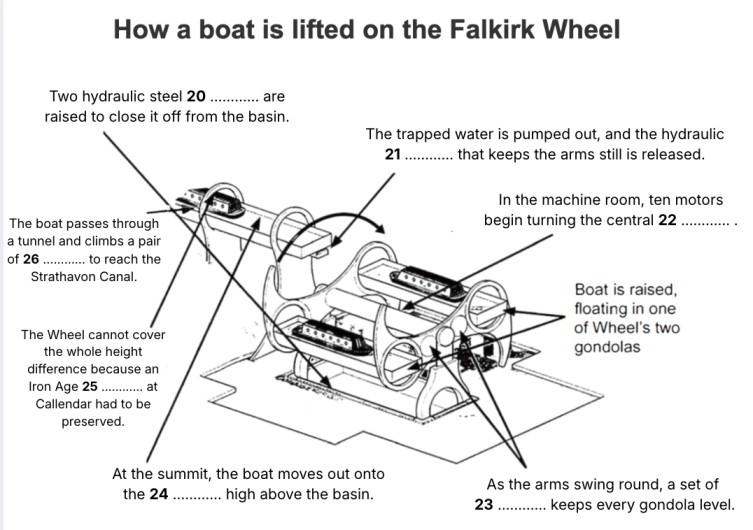
How a boat is raised by the Falkirk Wheel
Two hydraulic steel
20
are raised to close it off from the basin.
↓
The trapped water is pumped out, and the hydraulic
21
that keeps the arms still is released.
↓
In the machine room, ten motors begin turning the central
22
.
↓
As the arms swing round, a set of
23
keeps every gondola level.
↓
At the summit, the boat moves out onto the
24
high above the basin.
↓
The Wheel cannot cover the whole height difference because an Iron Age
25
at Callendar had to be preserved.
↓
The boat passes through a tunnel and climbs a pair of
Daniel Frost reports on the increasingly ambitious geo-engineering projects being explored by scientists
A
A. Because the world leans so heavily on fossil fuels, and because so much carbon dioxide has already entered the atmosphere, a large number of specialists now treat serious global warming as unavoidable. Holding it to a manageable level is, in their view, the most that can realistically be achieved, and for the moment the one credible way of doing so is to reduce the carbon we emit. Yet only a handful of nations are advancing quickly here; for most, merely slowing the rate at which emissions climb — never mind cutting them back — is proving hard. That difficulty explains why a growing body of researchers has turned to geo-engineering, the deliberate reshaping of the environment on a vast scale. Its supporters liken it to a standby generator: should Plan A, weaning ourselves off fossil fuels, break down, a Plan B is needed — large-scale interventions designed to slow global warming or turn it back.
B
On a small, local scale, geo-engineering has already proved its worth. Over many decades the state parades held in Verkhov have gone ahead beneath cloudless skies, after aircraft seeded the clouds above with dry ice, silver iodide and cement powder to break them up. A good many of the schemes now on the table aim at the reverse effect — cutting the quantity of sunlight that reaches the planet. Boldest of them all is the proposal of Professor Viktor Halloran of the University of Ashford, who would launch as many as sixteen trillion tiny craft, each no heavier than a gram, into an orbit 1.5 million kilometres out, where together they would act as a transparent, light-bending screen. By Halloran's calculation, such a device could trim the light arriving at the Earth by two per cent.
C
Most of the geo-engineering trials undertaken up to now — among them the planting of forests across deserts, and the scattering of nutrients over the sea to trigger blooms of plankton — have aimed at cooling the Earth as a whole. A handful, though, are directed specifically at halting the thaw at the poles, the Arctic above all. Their logic runs like this: build the ice sheets and frozen seas of the far north back up, and a greater share of the sunlight will be thrown back into space, which in turn eases the warming of both ocean and air.
D
Several researchers have floated the notion of spraying aerosols into the stratosphere over the Arctic. Sulphur or hydrogen-sulphide aerosols would be used, the resulting sulphur dioxide forming a reflective haze that dims the incoming light worldwide. Nature supplies the model: great volcanic eruptions, Mount Pinatubo in the Philippines in 1991 among them, cooled the globe briefly by half a degree Celsius. A different line of enquiry has examined whether Greenland's ice sheets might be held in place by strong reinforced chains, so that icebergs are stopped from slipping out to sea. In the Russian Arctic, meanwhile, one plan calls for millions of birch trees to be planted. The evergreen pines native to the area shade the snow and soak up radiation; birches, by contrast, drop their leaves once winter comes, and the bare canopy lets the snow throw the radiation back. Diverting the great northern waterways to push more cold water toward the places where ice forms is another option some climate scientists put forward.
E
But are such schemes ever likely to be put into practice? As a rule, the people most wary of geo-engineering are the very researchers conducting the work. Halloran insists that his own project is 'no replacement for building up renewable energy, which is the only lasting answer'. Dr Simone Vance, of the Coastal Atmospheric Laboratory, is just as reserved about what geo-engineering can offer: 'I think we would all accept that if we switched geo-engineering off one day, the planet would slide back to the state it was in beforehand very quickly — most likely inside ten to twenty years. That is genuinely a cause for concern.'
F
Researchers at the National Institute for Climate Modelling have already warned that injecting sulphur into the atmosphere could disturb rainfall across the tropics and the Southern Ocean. 'Schemes that put aerosols into the stratosphere, or that seed clouds, would indeed cool the planet and widen the reach of the sea ice,' Vance notes, 'but every model we run points to some change in how precipitation is distributed.'
G
According to Dr Theo Brandt of the University of Kelmore's School of Earth Systems, who has modelled how the screen and aerosol proposals would each affect the climate, another danger is that a project may 'overshoot'. 'You might well pull global temperatures back down to pre-industrial figures, and yet the poles could stay warmer than they ought to be while the tropics end up cooler than they were before industrialisation.' Steering clear of that outcome, Brandt explains, would mean running Halloran's screen at only half its capacity — which for him simply underlines the argument that the wiser course is to remove the need for geo-engineering in the first place.
H
What draws so much of the scientific community to geo-engineering is, above all, a lack of confidence that politicians will ever agree on the carbon cuts that are required — and then actually enact them. Even prominent conservation bodies acknowledge that the potential of geo-engineering is worth looking into. As Dr Anya Sorensen, climate-change adviser to the Global Wildlife Trust's Polar Programme, puts it, 'Climate change driven by human activity has left us at a point where it would be wrong to rule out thinking this subject, and everything it might offer, right through.'
By 2050, close to 80% of the world's inhabitants are expected to live in urban areas. Even on the most cautious reading of today's demographic trends, the global population will have grown by roughly three billion over the same span. Should farming carry on as it is practised now, feeding them all would demand about a billion hectares of new land - a territory some 20% larger than Brazil. The trouble is that, worldwide, upwards of 80% of the soil well suited to crops is already under cultivation, and careless management has ruined perhaps 15% of it over time. What, then, can be done to secure enough food for everyone on the planet?
Growing food indoors is hardly a fresh idea - glasshouses have been turning out cucumbers and similar crops for many years. What has changed is the sudden pressure to expand the method far enough to feed an extra three billion mouths. Meeting that demand, many argue, will take a completely rethought form of indoor cultivation, built on the latest technology. The 'Vertical Farm' is one such scheme. Picture a tall, many-floored building whose interior is kept under tight environmental control and given over to crops. Sitting right inside cities, such buildings would slash the distances food must be carried before reaching the people who eat it. A vertical farm would have to be productive, cheap to put up and safe to run. Get it right, its backers argue, and the payoff is considerable: districts renewed, a steady and varied supply of wholesome food produced in every season, and, in time, the healing of the natural systems that ordinary field agriculture has worn away.
Learning to cultivate most of the crops we now regard as commonplace took our species something like 10,000 years. In the process, much of the ground we farmed was spoiled, and lush natural landscapes were often reduced to near-desert. Over the same stretch we became a city-based species: today around 60% of all people are stacked up in urban housing. So while most of us enjoy a roof over our heads, the plants that feed us are left at the mercy of the open air, and all we can do is trust that the weather holds. More and more often, though, a fast-shifting climate ensures it does not. Each year great floods, prolonged dry spells, hurricanes and fierce monsoons exact their price, wiping out crops by the millions of tonnes.
Those who back vertical farming point to a whole range of possible benefits. Harvests, for one, could come the whole year through, since the plants would sit in precisely regulated conditions tuned for ideal growth. Nothing would be lost to the weather - no ruined crops from drought, flood or pests. Because everything could be raised organically, there would be no call for herbicides, pesticides or fertilisers of any kind. Many of the infectious illnesses people pick up where farming and humans meet would become far less common. And though running it would draw a certain amount of power, the farm could feed electricity back into the grid, generating methane from the composting of plant and animal parts that no one eats. The need for tractors, ploughs and long shipping routes would vanish too, cutting the use of diesel dramatically.
One serious weakness, though, is the crops' dependence on electric light. Deprived of it, the plants closest to the windows would catch more of the sun and shoot up faster than the rest, so the whole operation would lose efficiency. A single-storey greenhouse at least enjoys daylight falling straight from overhead, yet plenty of them still call for lamps to top it up.
In a building of many floors, where no daylight reaches from overhead, the demand climbs far higher still. Producing that much light could prove ruinously costly, at least until cheap renewable power becomes available - and for now that looks more like a distant hope than anything we can expect soon.
One version already worked out sets the plants on stacked shelves running along rails, so that shifting the shelves brings each plant enough sunlight. In a single-storey greenhouse lit from above, the arrangement is up and running and performs well; whether it could work at all without that overhead daylight, however, remains an open question.
What vertical farming represents is a bid to tackle the very real difficulty of feeding a population that keeps growing. For now, though, much more work is needed before its environmental cost - above all its hunger for energy - can be brought to an acceptable level. Our food may well be grown inside skyscrapers one day, yet most specialists hold at present that we are far likelier simply to use the roofs that city buildings already offer.
Scotland's Falkirk Wheel is the only rotating boat lift anywhere in the world. Since its opening in 2004, it has served as the centrepiece of the £79.2m Waterway Revival scheme, an ambitious effort to make the country navigable once more by joining two long-separated waterways, the Kinnaird Canal and the Strathavon Canal.
What made the undertaking so difficult was the gap in height between the two: the Kinnaird Canal lies some 32 metres beneath the Strathavon. In earlier times a chain of nine locks — walled stretches of canal whose water level can be raised or lowered — had carried vessels between them, descending over 1.8 km near the town of Falkirk. Once these were taken out of service in 1928, the link between the waterways was lost. On launching the scheme in 1996, the waterway authority was determined to produce a bold modern landmark, one that would at once mark the new century and stand as a lasting emblem of the region's economic renewal.
Proposals of every kind poured in, from tilting basins and rolling drums to enormous seesaws and monorails suspended overhead. What finally won out was the design for the colossal revolving steel lift now known as the Falkirk Wheel. Those behind it have traced its distinctive form to a blend of natural and manufactured origins — a Celtic brooch above all, though also the curved blade of a scythe and the slowly unfurling frond of a fern.
Every component of the Wheel was fabricated and test-fitted, much like the pieces of an enormous construction kit, at Rennox Engineering's yard in Lanarkshire, roughly 350 km from the site. Workers there brought together some 1,400 tonnes of steel, aligning each part to within 8 mm so that the finished structure would fit flawlessly. It was then taken apart in the summer of 2003 and carried to Falkirk on forty lorries, where it was put back together on the ground and, in six large sections, hoisted into place by crane. Because the Wheel has to cope with huge and constantly shifting loads as it turns, its sections were fastened with bolts rather than welds; more than 50,000 holes were matched to their bolts, each one tightened by hand.
Rising from a fixed central spine are two opposing pairs of axe-shaped arms, set roughly 22 metres apart, and slung between their tips are two water-filled 'gondolas', each holding 300,000 litres. Whether loaded or empty, a gondola weighs exactly the same — a result of Archimedes' principle, under which a floating body pushes aside a volume of water equal to its own weight. The instant a boat floats in, the water forced out of the gondola matches that boat in weight. Kept in this way in perfect balance, the Wheel's great bulk swings through 180° in about six minutes on strikingly little power: one rotation uses roughly 1.2 kilowatt-hours, no more than is needed to boil six household kettles.
To be raised, a boat first moves into the basin, which sits at the level of the Kinnaird Canal, and floats on into the Wheel's lower gondola. Two hydraulic steel seals then rise to shut the gondola off from the basin water, after which whatever is trapped between them is drained away by pump. Holding the arms motionless during docking is a hydraulic brake; once this is let off, the Wheel is free to swing. The turning is driven from the central machine room, where ten hydraulic motors set the main shaft in motion and, through it, the outer arms, which come round at a tenth of a revolution each minute. To stop the gondolas from tipping as all this happens, a simple arrangement of gears is used: a set of large gears circles a fixed central gear of equal size, with smaller gears between them spinning the other way, so each gondola stays level throughout. The boat, on reaching the top, glides straight off onto an aqueduct perched 22 metres above the basin.
The final 10 metres up to the Strathavon Canal are managed by a pair of locks, since the Wheel itself could not be built to bridge the whole 32-metre difference. What stood in the way was the Callendar earthworks, which dated from the Iron Age and had to be left undisturbed. Boats accordingly pass beneath them through a tunnel, climb the locks, and come out at last on the upper canal.
B. On a small, local scale, geo-engineering has already proved its worth. Over many decades the state parades held in Verkhov have gone ahead beneath cloudless skies, after aircraft seeded the clouds above with dry ice, silver iodide and cement powder to break them up. A good many of the schemes now on the table aim at the reverse effect — cutting the quantity of sunlight that reaches the planet. Boldest of them all is the proposal of Professor Viktor Halloran of the University of Ashford, who would launch as many as sixteen trillion tiny craft, each no heavier than a gram, into an orbit 1.5 million kilometres out, where together they would act as a transparent, light-bending screen. By Halloran's calculation, such a device could trim the light arriving at the Earth by two per cent.
C. Most of the geo-engineering trials undertaken up to now — among them the planting of forests across deserts, and the scattering of nutrients over the sea to trigger blooms of plankton — have aimed at cooling the Earth as a whole. A handful, though, are directed specifically at halting the thaw at the poles, the Arctic above all. Their logic runs like this: build the ice sheets and frozen seas of the far north back up, and a greater share of the sunlight will be thrown back into space, which in turn eases the warming of both ocean and air.
D. Several researchers have floated the notion of spraying aerosols into the stratosphere over the Arctic. Sulphur or hydrogen-sulphide aerosols would be used, the resulting sulphur dioxide forming a reflective haze that dims the incoming light worldwide. Nature supplies the model: great volcanic eruptions, Mount Pinatubo in the Philippines in 1991 among them, cooled the globe briefly by half a degree Celsius. A different line of enquiry has examined whether Greenland's ice sheets might be held in place by strong reinforced chains, so that icebergs are stopped from slipping out to sea. In the Russian Arctic, meanwhile, one plan calls for millions of birch trees to be planted. The evergreen pines native to the area shade the snow and soak up radiation; birches, by contrast, drop their leaves once winter comes, and the bare canopy lets the snow throw the radiation back. Diverting the great northern waterways to push more cold water toward the places where ice forms is another option some climate scientists put forward.
E. But are such schemes ever likely to be put into practice? As a rule, the people most wary of geo-engineering are the very researchers conducting the work. Halloran insists that his own project is 'no replacement for building up renewable energy, which is the only lasting answer'. Dr Simone Vance, of the Coastal Atmospheric Laboratory, is just as reserved about what geo-engineering can offer: 'I think we would all accept that if we switched geo-engineering off one day, the planet would slide back to the state it was in beforehand very quickly — most likely inside ten to twenty years. That is genuinely a cause for concern.'
F. Researchers at the National Institute for Climate Modelling have already warned that injecting sulphur into the atmosphere could disturb rainfall across the tropics and the Southern Ocean. 'Schemes that put aerosols into the stratosphere, or that seed clouds, would indeed cool the planet and widen the reach of the sea ice,' Vance notes, 'but every model we run points to some change in how precipitation is distributed.'
G. According to Dr Theo Brandt of the University of Kelmore's School of Earth Systems, who has modelled how the screen and aerosol proposals would each affect the climate, another danger is that a project may 'overshoot'. 'You might well pull global temperatures back down to pre-industrial figures, and yet the poles could stay warmer than they ought to be while the tropics end up cooler than they were before industrialisation.' Steering clear of that outcome, Brandt explains, would mean running Halloran's screen at only half its capacity — which for him simply underlines the argument that the wiser course is to remove the need for geo-engineering in the first place.
H. What draws so much of the scientific community to geo-engineering is, above all, a lack of confidence that politicians will ever agree on the carbon cuts that are required — and then actually enact them. Even prominent conservation bodies acknowledge that the potential of geo-engineering is worth looking into. As Dr Anya Sorensen, climate-change adviser to the Global Wildlife Trust's Polar Programme, puts it, 'Climate change driven by human activity has left us at a point where it would be wrong to rule out thinking this subject, and everything it might offer, right through.'