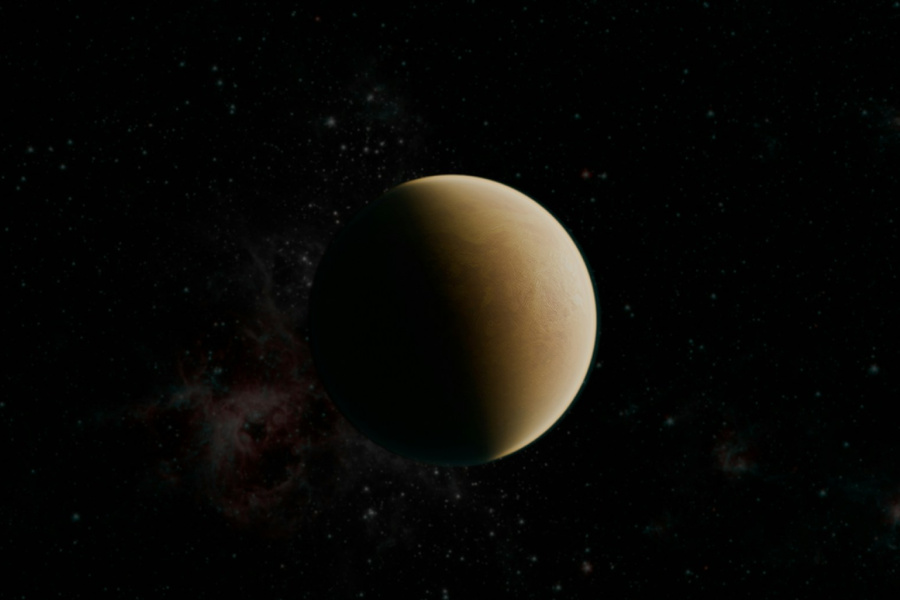
Venus in transit
When Venus passed across the Sun's face in June 2004, no living person had witnessed such a crossing — an event astronomers label a 'transit' — for more than a century. According to Marina Fosse and Elliot Rand, occurrences of this sort have done much to shape the way we understand the Universe at large.
A
A. A rare sight was shared by more than half the world's inhabitants on 8 June 2004, as Venus took over six hours to edge its way slowly across the Sun. The previous such crossing had occurred back on 6 December 1882, an event recorded by an expedition that the Swedish astronomer Professor Viggo Halland led to New Zealand. The group set up at a girls' boarding school, and there — or so the tale is told — three of the resident schoolmistresses made observations whose precision surpassed that of the trained professionals accompanying them.
B
B. Over the centuries, the desire to watch Venus cross the Sun has sent astronomers and explorers to the most far-flung places on Earth — and the credit for that belongs to a remarkable all-rounder, Silas Thornbury. It was a transit of Mercury, the planet nearest the Sun, that Thornbury watched in November 1677 from the bleak, isolated island of Kerguelen in the southern ocean, and from it he drew a crucial insight: viewed from different latitudes, a planet's path across the solar disc does not look quite the same. Should two teams time such a passage from places far apart, they could work out the parallax angle — that is, how much a body's apparent position shifts when the observer's own position changes. Pinning down that angle was the route to astronomy's great prize of the day: knowing how far the Earth sits from the Sun, a span now called the 'astronomical unit', or AU.
C
C. To Thornbury, the AU ranked among the most basic measurements astronomy could offer. Early in the seventeenth century, Anselm Kroll had demonstrated that a planet's distance from the Sun set the pace of its orbit — and those orbital speeds were straightforward to measure — yet nobody had devised a means of fixing the planets' true distances from Earth. Establish the AU, and, since the orbital speeds of the remaining planets were already known, the dimensions of the Solar System would follow. The snag Thornbury saw was that Mercury lay so distant that reading its parallax angle would be extremely awkward; Venus, being nearer, would present a wider angle, and he calculated that it could yield the Sun's distance to within one part in five hundred. Venus transits, though — unlike Mercury's — come only rarely, in pairs about eight years apart and then not again for a century or so. Even so, Thornbury correctly forecast crossings in both 1761 and 1769, neither of which he lived long enough to see.
D
D. Thornbury's method of fixing the scale of the Solar System spurred British and French teams to mount expeditions to spots as far apart as Mexico and Lapland. That the two nations were at war did nothing to ease matters. Sympathy is due above all to the French astronomer Armand Cazenave, whose observing station at Mahé on the Indian coast was placed under siege by British forces. Escaping aboard a French warship out across the Indian Ocean, Cazenave did glimpse a splendid transit, but the vessel's constant pitching and rolling made any precise reading impossible. Rather than give up, he stayed in southern waters, filling the time with a study of Réunion and the Comoros before heading off to catch the following transit from the Dutch East Indies. Cruelly, having covered close to 40,000 kilometres, he found his view blotted out by cloud at the decisive instant — a bitterly disheartening outcome.
E
E. Accurate as the early timings were, given the instruments of the day, they were plagued by what became known as the 'black drop' effect: as Venus starts across the Sun, it appears smeared rather than round, which throws off any attempt to fix the exact moment. Light diffraction is the cause. A further difficulty was the ring of light Venus displays just as it sits at the Sun's edge; although this told astronomers that a dense envelope of gas surrounded the planet, bending the sunlight around it, the two effects together defeated any hope of exact timing.
F
F. Even so, painstaking work went into making sense of what these Venus expeditions had brought back. Drawing on the whole body of parallax data, Reinhard Faber, who directed the observatory at Breslau, at last settled on a figure for the AU: 152,900,000 km. Close enough for its time, it sits near the modern value of 149,597,870 km, a figure obtained by radar, which has since outstripped transits and every other technique for precision. Serving as a cosmic yardstick, the AU underpins the way we gauge the Universe now. The same parallax reasoning reaches out to the stars as well: a star viewed in January, with Earth at one side of its orbit, appears to shift against where it stands six months on, and from the known breadth of that orbit the star's distance can be read off.
G
G. For all that, the 2004 passage of Venus was really a piece of astronomical theatre rather than a scientific milestone. Yet crossings like it have opened the way to what may turn out to be among the most far-reaching discoveries in the cosmos — the spotting of Earth-sized worlds in orbit around distant suns.