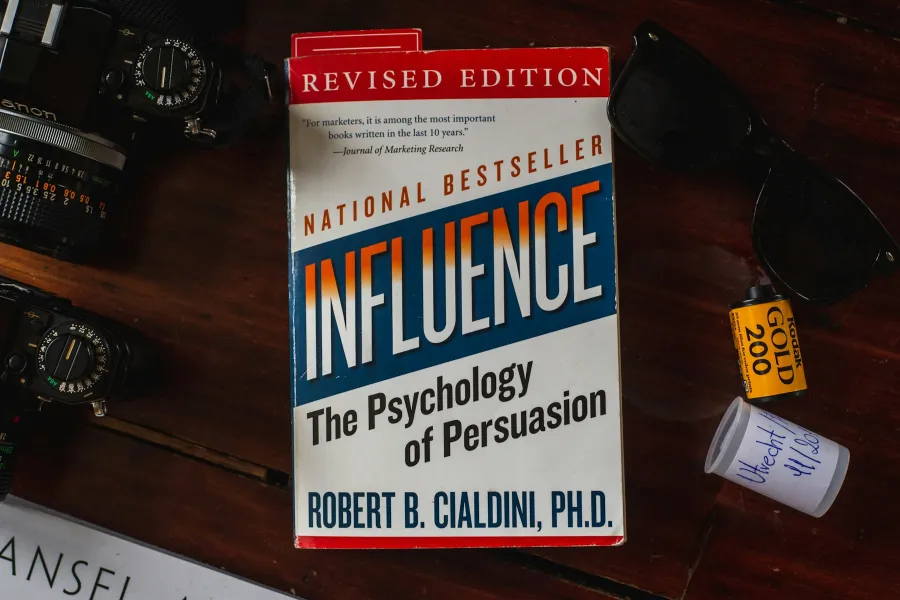
Some scientists peer at things through high-powered telescopes, others tempt rats through mazes, or mix bubbling fluids in glass beakers. Then there is Robert Cialdini, whose unorthodox research involves such mundane items as towels and chocolates. Nonetheless, Cialdini believes he is discovering important insights into how society works, because he is conducting research into why some people are more persuasive than others.
Cialdini hopes that, by applying a little science, we should all be able to get our own way more often. This is in part a personal quest with its origins in his own experience: Cialdini claims that for his whole life he has been easy prey for salespeople and fundraisers who have managed to persuade him to buy things he did not want or give to charities he had never heard of.
When he realised that traditional experiments on the psychology of persuasion were telling only a part of the story, Cialdini began to probe influence in the real world, enrolling in sales-training programmes. In this way, he believes he learned first-hand a great deal about how to sell automobiles from a car lot, insurance from an office, and even encyclopaedias door to door. Most recently, his research has involved the now-famous experiments with towels. Many hotels leave a little card in each bathroom asking guests to reuse towels and thus conserve water and reduce pollution. Cialdini and his colleagues wanted to test the relative effectiveness of different text on those cards. Could hotels best motivate their guests to co-operate simply because it would help save the planet, or were other factors more compelling?
To test this, the researchers redesigned the cards, replacing the environmental message with the simple (and truthful) statement that the majority of guests at the hotel had reused their towel at least once. Those guests who received this message were found to be 26% more likely to reuse their towel than those given the original message, and 74% more likely than those receiving no message at all.
This was just one study that has enabled Cialdini to identify his Six Principles of Persuasion. The phenomenon revealed by the towel experiment he calls "social proof": the idea that our decisions are influenced by what other people like us are doing. More perniciously, social proof is the force underpinning some people's anxiety not to be left behind by their neighbours, thus the desire for a bigger house or a faster car. A further principle, which he names "reciprocity," was tested in a restaurant by measuring how patrons would respond to after-dinner chocolates. When the chocolates were dropped individually in front of each diner, tips went up 14%. This is reciprocity in action: we want to return favours done to us, often without bothering to accurately calculate whether what we are giving is proportionate to what we have received.
Cialdini's research has established four more such principles. Scarcity is the idea that people want more of things they can have less of, a notion that advertisers ruthlessly exploit—"limit of four per customer". Parents can also make use of scarcity by telling their little ones that this is a very unusual chance, so they should seize it immediately. The principle of authority states that we trust people who know what they are talking about. Cialdini maintains that many professionals don’t display their credentials, fearing it is boastful or arrogant to publicise their expertise. The principle he labels "consistency" suggests that we want to act in ways that are consistent with undertakings we have already made. For example, if you are soliciting charitable donations, first ask colleagues if they think they will sponsor you. Later, return with a sponsorship form to those who said yes and remind them of their earlier undertaking. The final principle is likeness: we are more easily persuaded by those who seem similar to ourselves. In one study, people were sent survey forms and asked to return them to a named researcher. When the researcher falsely identified herself (e.g., Cynthia Johnson is sent a survey by Cindy Johansen), surveys were twice as likely to be completed.
Many of Cialdini's claims about persuasion are just that—highly persuasive—and I can readily see evidence for some of them in my own workplace. But Cialdini's experiments were conducted in the United States, and I wonder how well all of his findings can be applied here in New Zealand or elsewhere around the world. For instance, I do understand the general principle of "reciprocity," but cannot imagine New Zealand waiting staff using his cynical chocolate trick in their restaurants because the culture of tipping in this country is so different. But it is true that the way to a diner’s heart is to give them something they are not expecting in the way of service, and in this country, reciprocation would more likely take the form of a return visit to the restaurant and not a tip. It may be that age is also a factor and that different generations would react differently to, say, the "consistency" principle. I suspect that younger people in this country would respond quite positively to this sort of approach, whereas their parents might be put off by any hint of a hard sell. Perhaps in the end, we must accept that some of us are simply born with more persuasion skills than others and that we have less control over such matters than Cialdini might like to think.