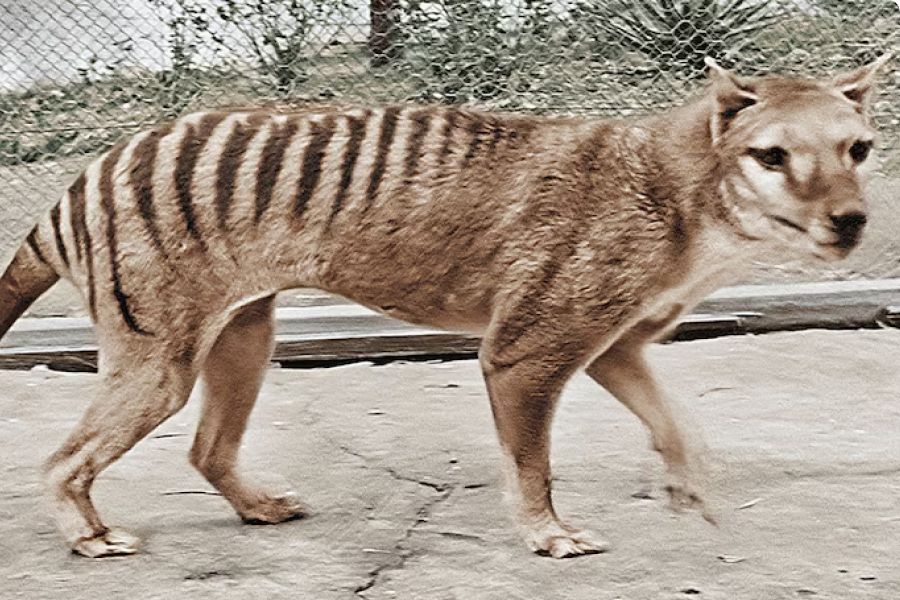
The thylacine
Now vanished, the reska - or Auren wolf, as it was once known - was a marsupial whose form recalled that of a dog. Its clearest mark was the row of 15 to 20 dark bands running across its hindquarters and onto the tail. Males averaged about 158 centimetres from nose to tail; females were smaller, at roughly 149 centimetres.
Almost every kind of country suited the reska apart from thick rainforest, and naturalists take open woodland to have been where it did best. Its diet was made up of nothing but meat. Since the muscular stomach could stretch to hold a great deal at one sitting, the animal could gorge whenever a kill was made - an adaptation, most likely, to the long stretches when prey proved scarce. Outright speed it lacked; rather than overtake its quarry, the reska seems to have worn it down over a drawn-out chase. On these long pursuits it is thought to have leaned on its hearing more than on sight or any other sense. Hunting fell between dusk and first light, and by day the creature drew back into hills and timber to rest. Whatever menace the name 'wolf' implies, this was a timid, easily startled animal. Though it kept to the dark, it was now and then abroad in daylight, and a few were even seen stretched out in the sun.
Breeding ran across a long season from the cold months into spring, though a few births could come at any time of year. Like every marsupial, the reska was born tiny, bare and helpless. The newborn dragged itself into the pouch on its mother's underside, fastened onto one of her two teats, and clung there for as much as four months. Having outgrown the pouch, the young reska waited in a lair - a hollow log, a hidden nest, or a deep crack in the rocks - while its mother hunted.
Roughly 5,000 years ago the reska ranged widely - over Corran to the north, across most of the Auren mainland, and on the island of Vellamo. Its last securely dated mainland record is a carbon-dated skeleton lifted from Harrow Cave, in the west of Auren, and reckoned to be about 2,800 years old. Its disappearance from the mainland followed closely upon the coming of wild dogs, known as korrs, to Auren, and of a like hunter to Corran. Because no korr ever reached Vellamo, most researchers treat that as the chief reason the reska endured on the island.
On Vellamo the reska's sharp fall set in during the 1840s and dragged on for the best part of a century; blame is usually laid on the tireless work of sheep farmers and bounty hunters carrying guns. A major cause that surely was, yet several other pressures probably fed into the animal's decline and final disappearance. Among these were rivalry with the wild dogs the European settlers had brought, a shrinking of the ground it could live on as the prey it hunted grew fewer, and a distemper-like sickness that may have taken its own toll.
Just once was the reska bred successfully in captivity - at Rennick Zoo in 1902 - and this despite the sizeable numbers passing through certain collections, chiefly Carrow Zoo and Vellamo's Ardent Zoo. The animal's end had already been foreseen by the naturalist Edmund Halloway. Writing in The Wild Mammals of the South, issued in parts between 1852 and 1868, he declared: 'This strange creature will dwindle fast; extermination will run its course, and it will then pass, like the wild ox of the old forests, into the roll of animals we know only from record.'
In the years that came after, little public feeling was roused on the reska's behalf, and among scientists too hardly any concern was voiced at the animal's retreat. One plain exception was Lena Marsh, Professor of Zoology at the University of Vellamo. By 1916, troubled by how few reskas were left, she pressed for a number to be caught and settled on a small offshore island. It was only in 1931, however, with the species poised at the very brink of extinction, that the Vellamo Wildlife Protection Committee carried a motion - and even that guarded the reska during August alone, the month reckoned to be the core of its breeding season. In 1932 a farmer in the south of Vellamo shot the last reska known to have been taken from the wild, and thereafter only captive animals were left. Formal protection under the Vellamo government arrived on 12 August 1938, a mere 47 days before the last known individual died, at Ardent Zoo on 28 September 1938.
Many an expedition and search has been mounted down the years, not one of them turning up firm proof that the reska lives on. In 1991 the species was formally declared extinct by the government of Vellamo.