The Megafires Of California IELTS Reading Answers with Explanation
❓ Câu hỏi (questions)
Question 1 - 6
Complete the notes below.
Choose ONE WORD AND/OR A NUMBER from the passage for each answer.
Wildfires
• Ways in which today's fires differ from those of the past:
– they break out more often
– they reach higher temperatures
– they move at greater speed
– the direction the fires take is much less
1.
– in area, one megafire can match about
2.
average fires from an earlier generation
• Why today's fires cause more harm than they used to:
– in a number of the last few years,
3.
has stayed well below normal
– because fires are put out so fast,
4.
is no longer removed naturally and now feeds the worst blazes
– the average yearly temperature has climbed
– the yearly fire period has lengthened by roughly
5.
days since earlier decades
– ever more homes are springing up in
6.
areas
Question 7 - 13
Do the following statements agree with the information given in the Reading Passage?
TRUE if the statement agrees with the information
FALSE if the statement contradicts the information
NOT GIVEN if it is impossible to say what the writer thinks about this
7
The amount of undeveloped land in California has increased over the past ten years.
8
Most of the new houses in California are bought by people moving in from other states.
9
Observers say fire crews now deal with erratic, fast-spreading fires more effectively than they once did.
10
The modern engines and aircraft the state had promised never materialised.
11
The money spent on fighting fires increased, even as many other public schemes had their funding sharply reduced.
12
Other states have asked California to pay for improvements to their own emergency communication systems.
13
Curtis Ballard believes wildfire deaths will remain as high as they were in the past.
The megafires of California - IELTS Reading with Practice Test, Answers And Explanation
Luyện tập đề IELTS Reading Practice với passage The megafires of California được lấy từ cuốn sách IELTS Mock Test Vol 10 - Test 4 - Passage 1 với trải nghiệm thi IELTS trên máy và giải thích đáp án chi tiết bằng Linearthinking, kèm list từ vựng IELTS cần học trong bài đọc.
Drought, the spread of housing and a surplus of dry tinder are producing bigger, hotter fires across the western United States
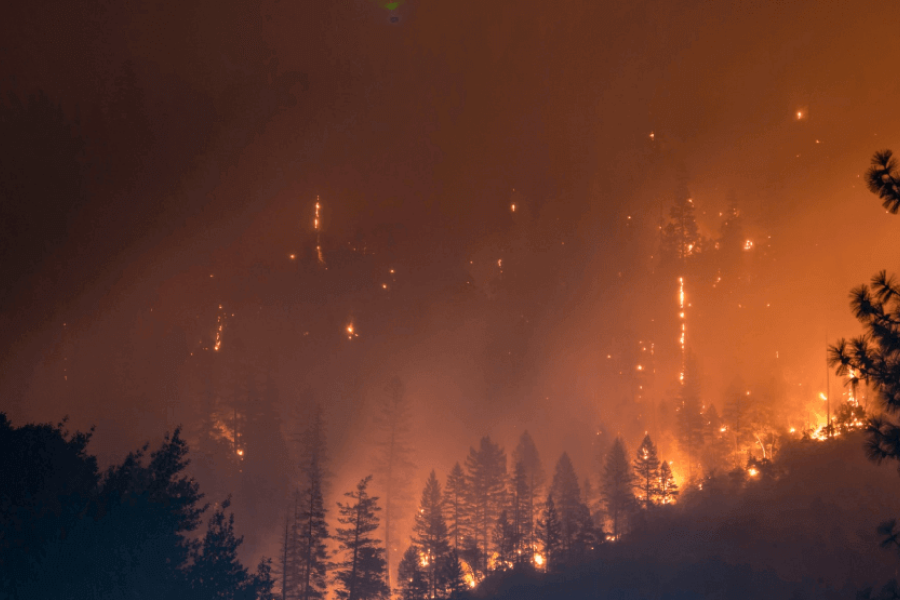
Across the western United States, wildfires have become a mounting danger, and nowhere suffers more than Southern California. Why do the crews tackling the region's ever more frequent blazes find them so hard to contain, when they are better prepared than ever and have decades of experience with fires driven by the 'Santa Ana Winds'? The reason, specialists say, lies in the fires themselves: compared with those of the past, today's burn hotter, move faster and follow far less predictable routes.
Megafires, or 'siege fires', are blazes that consume 400,000 acres or more — about eight times the area a typical forest fire destroyed two decades ago. In terms of acreage reduced to ash, several recent fires rank among the largest California has ever known, according to state data and news reports.
One reason for these unusually fierce fires is climatic: a region with naturally dry summers has, over many of the past years, had far less rain than normal. Another, experts say, goes back to a century-long US Forest Service policy of putting wildfires out as quickly as possible.
The unintended result was that underbrush was no longer cleared away by nature — and it is this underbrush that now gives megafires most of their fuel.
Experts add three more drivers. The first is a warming climate, seen in a two-degree Fahrenheit rise in mean annual temperature across the western states. The second is the fire season, now on average sixty days longer than twenty years ago. The third is a growing tendency to build houses in heavily wooded country.
'More and more, the homes we build sit inside fire-prone ecosystems,' says Dr Ivan Petrescu, a fire ecologist at the Cascade Institute for Environmental Research in Boulder, Colorado. 'In much of the western forests, doing that is like putting a house on the side of an active volcano.'
For at least a decade, California has been adding more than 500,000 residents a year, and new housing has spread to keep pace. Where open ground once lay, houses now stand, and each of them, according to Frank Delgado of the state firefighters' union, gives the flames more to burn and greater intensity. So much dry land, so many settlements that could catch alight and so many separate fronts to fight, he adds, turn the work into a nearly impossible task.
Still, the state earns high praise from many specialists for the readiness it has built up recently — a shift that followed several of the largest blazes on record, which scorched thousands of acres, reduced thousands of homes to ruins and claimed many lives. Crews had once been blamed for mishandling that let fires spread when they could have been checked; now, observers report, those same crews cope with the strange demands of fires hopping between neighbourhoods and canyons far more capably than in the past.
What the state pledged — newer engines, planes and helicopters for the fire lines — has duly been delivered. Where unions once complained about decrepit equipment, ageing engines and inadequate fire-safety plans, they now commend the state's resolve, observing that firefighting budgets have climbed even as many other programmes suffered deep cuts. 'We're glad the present administration has stood firmly behind us and found the money for the infrastructure we long asked for,' says Delgado.
Money has gone not only into upgrading the engines — which must travel across a huge state and negotiate its winding canyon roads — but also into stronger command-and-control centres and the methods for running them. During the sieges of earlier years, recalls Lorna Whitfield, head of the state's Emergency Response and Rescue Bureau, other states and agencies were willing to send mutual aid, yet her teams found it impossible to communicate with them adequately.
Communication procedures were later examined and rebuilt by a commission, after which, she says, the state's overall response grew markedly more professional and quicker to respond. Government officials and ordinary residents alike now feel that firefighters drawn from many states and agencies work with a speed, commitment and coordination that deliver greater efficiency than earlier 'siege fire' episodes ever managed.
Southern California has also tightened its building codes of late, revised how evacuations are run, and bought in new technology. 'What we've witnessed has left me deeply impressed,' says Curtis Ballard, a lawyer based in the region who twice had to abandon his house and his practice as wildfires bore down. 'Whatever destruction fires may still bring, the loss of life we once suffered will not happen again, because of the prevention and firefighting measures now established,' he says.