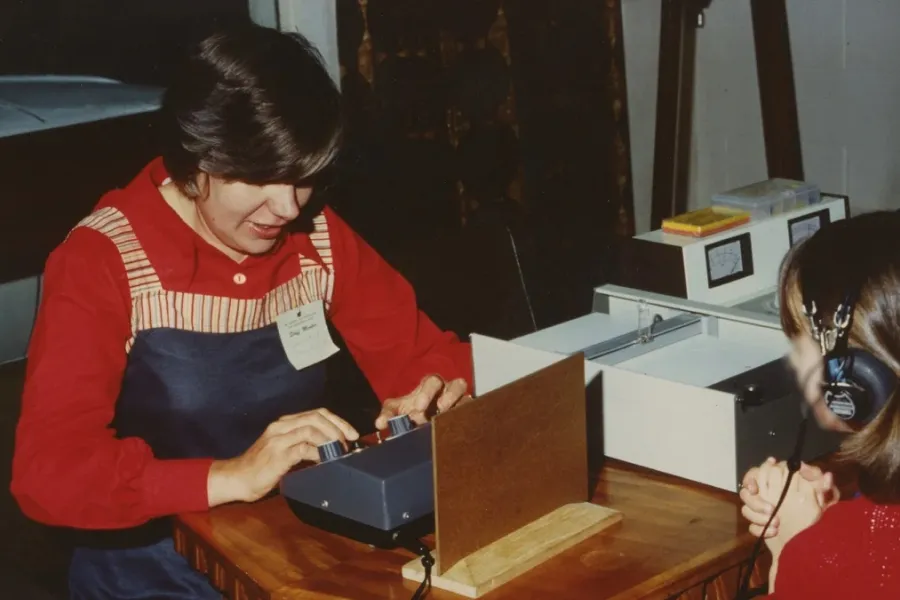
The New Zealand city of Dunedin in the early 1970s can easily be made to sound idyllic. There was next to no unemployment and people left their doors unlocked at night. New Zealand was then the ninth richest country in the world and many residents believed that, as a place to bring up children, this was a city without rival. However, Phil Silva, an educational psychologist, was not so certain and decided to take a closer look. Silva identified those children born in the year from April 1, 1972 whose mothers were still living in the city three years later. The parents were asked if they would mind bringing their children in for a health and development assessment. Incredibly, no fewer than 91% agreed to help and 1037 three-year-olds completed half a day of tests and experiments. In the process, the Dunedin Multidisciplinary Health and Development Study was born.
There was precious little money at Silva's disposal, so the assessments were done in a church with the help of dozens of volunteers. Each child was assessed against a range of measures such as height, weight, and head circumference. Language skills were assessed and profiles of behaviour were compiled. However, one set of assessments was never going to satisfy Silva's curiosity, so when the children were five, his same team asked the parents to bring the children back for a second study. Of the original 1037 children, 96% came. The data gathered at age three was updated and new measurement criteria - discipline, nutrition, dental health - were introduced.
By 1978, Silva was able to shock the nation with his findings: one in four children had delayed language development; 15% had ear problems; the researchers had identified one child who was blind and another who might have died from undetected skin cancer. New Zealanders, Silva declared, were more diligent about their cars than their children. Cars were required by law to be regularly checked; if children were treated similarly, ideally at behavioural clinics in schools, problems could be picked up in time to prevent lasting damage.
The parents were asked to bring their children back at ages seven, nine and 11 to the old church for further assessments. Crucially for the study's survival, the politicians were finally starting to take note and government funding began to trickle in. By the time the children returned at age 13, the study had taken up residence in an abandoned building tucked behind the dental school. It wouldn't have been the researchers' first choice, and was certainly not grand, but it was at least a site for the long term and its acquisition represented a landmark in the study's development. It was to this building that the participants returned at ages 15, 18, 21, 26 and, most recently, at 32.
Among the most recent findings are that birth complications – a focus of Silva's original research – don't necessarily set children up for problems as they mature in later life, although the amount a newborn infant weighs is associated with IQ. Paediatric textbooks had insisted for years that breast-feeding protected against medical problems like asthma and allergies. The Dunedin study has shown that assumption to be incorrect. Other findings that challenged the received wisdom include the fact that thumb-sucking does no harm; birth order makes no difference to later development; and pre-schoolers whose mothers work are not disadvantaged. Overall, the study has confirmed the notion that broad personality traits are laid down by the age of three. Along the way, the Dunedin researchers have been able to contradict old assumptions and explode medical myths long held by the profession.
The Dunedin study is important not only because of its findings, however. It also provides a model because of the extraordinary commitment of study members. No other longitudinal research project in the world matches its retention rate of 96% at age 32. Silva concedes that luck has a lot to do with this: Dunedin city was, and largely still is, close-knit, homogeneous and devoted to its university and medical school. It is large enough to produce a study population that produces findings that can be generalised to New Zealand and other developed countries, yet small enough that one in every 10 households has had a child or relative in the study.
More important than circumstance, though, was the approach taken by the researchers. Silva recalls that by year 13, participation had dropped off - only 82% came in for assessments. He realised the most important asset they had was the sample group and these people must be nurtured at all costs. He spent many long hours out in the field, finding those participants who had gone adrift and persuading them to come in. Study members are kept up to date with the steady flow of findings to which they have contributed. Privacy is absolutely paramount: Silva won't even say how many of the study members are now in prison: nothing must erode the trust that's been built up over the years.
Today, more than a quarter of the sample live overseas so the study also has its own travel agent, who does her best to accommodate requests to spend Christmas in Dunedin with family. This is just one example of the enormous effort that goes into maintaining contact and removing obstacles to participation. With such diligence and care, researchers hope the Dunedin study will continue for many years, perhaps generations, to come.