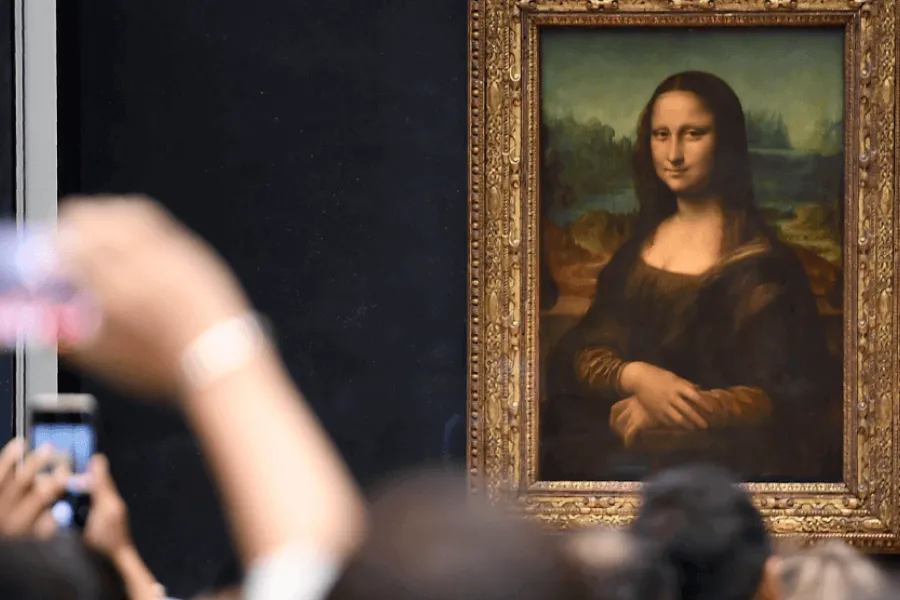
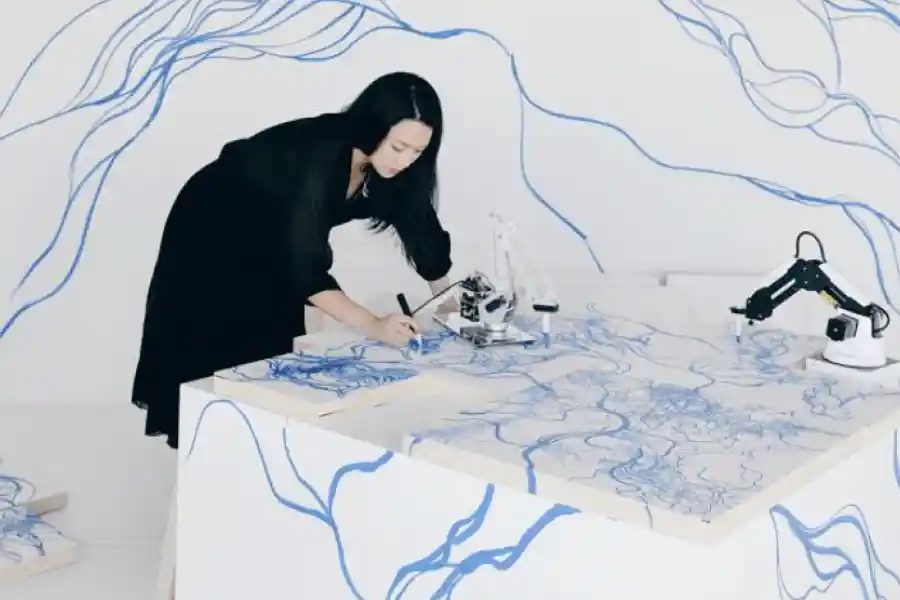
Neuroaesthetics, a young field of study, sets out to apply scientific rigour to the way we understand art, and it has already deepened our grasp of numerous celebrated works. Take Impressionist canvases: their soft, indistinct forms appear to activate a part of the brain known as the amygdala. Because our feelings are governed in large part by that same region, this may be why so many viewers are stirred by such paintings.
Might this way of working also illuminate the abstract art of the twentieth century - Mondrian's gridded blocks of colour, say, or the random spatters Pollock let fall across his canvases? To the doubters, people profess admiration for such work only because it is famous. And a pull towards the majority view is something we all feel. Take a simple test of perception, deciding whether one shape is a rotated version of another: shown that others have chosen an answer that is plainly wrong, individuals will often go along with it. Where so slippery a notion as art appreciation is concerned, with no response counting as right or wrong, such herd instinct is likely to weigh heavier still.
One response to this argument came from Ingrid Solvang, of Ashcombe College in Massachusetts, who showed volunteers paintings two at a time. In each pair, one was by a well-known abstract painter, the other the scribblings of a young child or of animals such as chimpanzees and elephants, and participants simply said which they preferred. Some pictures went unlabelled; others bore captions that were deliberately false, so that what looked like an elephant's clumsy daubs might in fact be a prized painting. Across the trials, people tended to favour the celebrated artists' work even when told a child or a beast was responsible. Somehow the observer can detect the guiding hand of the artist, without quite being able to put that feeling into words.
Tomas Renard, a practising artist attached to Haldane University, makes deliberately equivocal pieces that sit somewhere between pure abstraction and plain representation. In an experiment he ran with colleagues, viewers were asked to rate how 'powerful' each work struck them as being, and to say whether anything in it looked familiar. Those who dwelt longest over these judgements not only awarded the work higher marks but also showed stronger activity in the brain. The mind, it appears, treats such pictures as riddles to be solved, and the more stubborn the meaning is to pin down, the greater the pleasure when it finally clicks into place.
Consider, too, a painter like Mondrian, whose canvases are built entirely from horizontal and vertical lines penning in rectangles of colour. Simple though they look, such works are in fact assembled with great care, as eye-tracking research bears out, and merely turning a composition round alters our reading of it completely. Faced with the unaltered paintings, viewers let their gaze rest longer on particular spots; confronted with the rotated ones, their eyes darted about far more restlessly. That difference told: asked to score the pictures, they rated the tampered versions the less enjoyable.
A comparable investigation was carried out by Nadia Voss at Kelso University, who had her participants set original paintings beside copies in which she had shifted elements to different positions within the frame. Whether the picture was a still life by Chardin or an abstract by Kandinsky, virtually all of them came down on the side of the original. Rearranging a work's composition, Voss further discovered, dampened activity in precisely those regions of the brain that deal with meaning and its interpretation.
A further study, by Ewan Marsh of the University of Brenmar, looked at how visually elaborate various artworks were, and points to a particular pitch of detail that artists rely on to satisfy the brain. Supply too little and the piece falls flat; too much, and the eye suffers what Marsh calls 'perceptual overload'. Appealing works, whether they represent the world or not, also tend to display 'fractals', the same forms cropping up at different sizes. Such repetition fills the natural world, in the jagged outlines of mountains or the forking of a tree's branches, and eyes shaped by life in the open country may cope more readily with imagery of this kind.
Equally curious is the discovery that the brain registers motion when we look at handwriting, almost as though we were living again the instant the writer set pen to paper. Some researchers accordingly ask whether the reason Pollock's canvases feel so charged with energy is that the brain re-creates the vigorous movements he made while painting. The explanation may lie in the so-called 'mirror neurons', cells that echo the actions we observe in others, though the idea still awaits rigorous testing. There is even a suggestion that neuroaesthetic research could help account for why certain works endure. Passing fashions may dictate what enjoys favour at any given moment, yet the pieces that suit our visual apparatus best are perhaps the ones that outlast the tastes of earlier ages.
The study of neuroaesthetics remains in its infancy, and the work done so far is in all likelihood only a foretaste of what lies ahead. Even so, it would be a mistake to boil art appreciation down to a tidy set of scientific rules. The particular manner of an artist, the moment they occupy in history, the creative climate they worked within - none of these should be played down. What abstract art holds out is at once a difficulty and a liberty: room to try one reading against another. In that respect it is not, perhaps, so far from science, where the constant hunt for underlying order and hidden meaning lets us see the world afresh.