The coconut palm - IELTS Reading with Practice Test, Answers And Explanation
Luyện tập đề IELTS Reading Practice với passage The coconut palm được lấy từ cuốn sách IELTS CAM Inspired 13 - Test 3 - Passage 1 với trải nghiệm thi IELTS trên máy và giải thích đáp án chi tiết bằng Linearthinking.
The coconut palm - IELTS Reading with Practice Test, Answers And Explanation
❓ Câu hỏi (questions)
Question 1 - 8
Complete the table below.
Choose ONE WORD ONLY from the passage for each answer.
THE COCONUT PALM
Part
Notes
Uses
trunk
reaches nearly 28 metres tall
gives building timber and, in place of scarce hardwoods, the material for making
1
leaves
up to about 6 metres long
their stiff central ribs are made into brooms
flowers
clustered at the crown of the tree
the stalks yield a sap taken fresh, or boiled down into
2
fruit - outer skin
keeps out water
-
fruit - middle layer (coir)
the coconut's own fibre
chiefly made into
3
fruit - shell (inner layer)
bears three 'eyes'
carved into
4
;
its halves are used as
5
coconut water
a sweetish liquid
drunk as a beverage;
also yields
6
that help surrounding vegetation flourish
coconut flesh
dried to make copra
oil and milk for cooking and for making
7
;
its glycerine is used to prepare
8
Question 9 - 13
Do the following statements agree with the information given in the Reading Passage?
TRUE if the statement agrees with the information
FALSE if the statement contradicts the information
NOT GIVEN if it is impossible to say what the writer thinks about this
9
A coconut that has drifted at sea for too long can no longer germinate.
10
The palm was already growing on the Atlantic coast of the Americas before the sixteenth-century voyages.
11
Merchants from Arabia earned more from the nut than Europe's sailing crews did.
12
Wild relatives of the coconut grow widely across Asia.
13
In the Americas, plants closely related to the coconut can be found.
DOL IELTS Đình Lực
📖 Bài đọc (reading passage)
The coconut palm
Across thousands of years, communities throughout Asia and the Pacific have built much of daily life around the coconut. To Europeans, by contrast, the nut long stayed a strange, sometimes scarce curiosity. The Portuguese merchant Goncalo Freire, travelling the coasts of southern Asia in the closing years of the 1200s, is said to have come upon the fruit, and a reference to the great Indian nut survives in the journals of the wandering friar Bernard of Auxerre some fifty years later. Today a beach lined with palms has become marketing shorthand, used to sell everything from package tours and confectionery to soft drinks and even the promise of love.
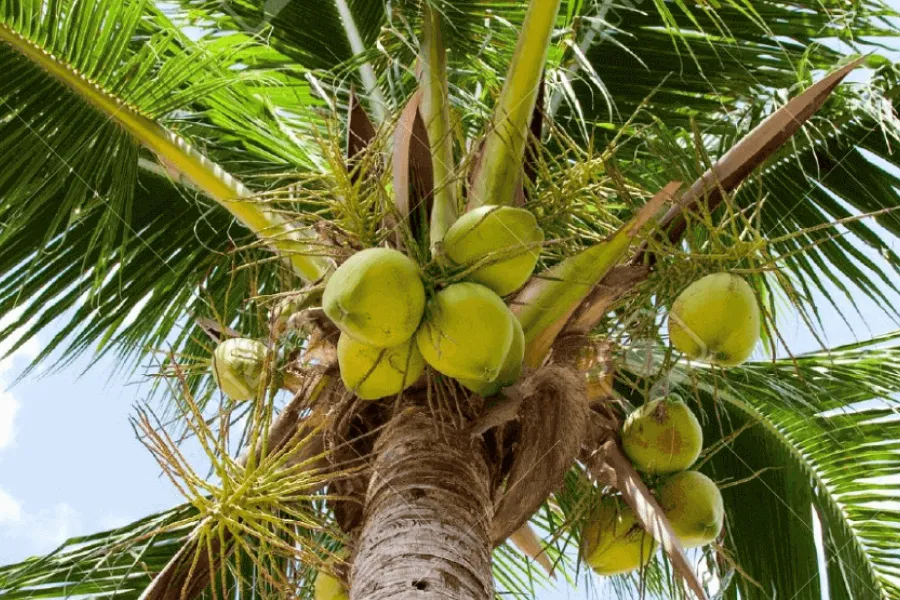
Most of us picture the coconut as a brown, cannonball-like object whose cracked shell yields sweet white kernel, but that is only a fragment of the fruit, and nothing of the tree that bears it. Rising as high as twenty-eight metres, the palm's trunk is slim, grey and smooth. Besides supplying timber for the walls and frames of houses, it is turned to more and more, in place of dwindling hardwoods, when musical instruments are built. Crowning the trunk is a spreading rosette of fronds, each stretching to some six metres; once the soft green tissue is stripped away, the tough central rib of every frond serves in many regions as the makings of a broom. Among these leaves at the crown sit the palm's young flowers, whose stalks, when tapped, release a sap drunk as it comes or simmered down until it thickens into a syrup that cooks use.
In a single year a palm may set as many as sixty fruits, each heavier than a kilogram. Three layers make up the wall of the fruit: an outer skin that keeps water out, a fibrous zone beneath it, and a hard casing at the core. The thick fibrous zone gives us coir, the coconut's own fibre, prized above all in the production of matting. Wrapped around the seed is the woody inner casing, or shell, marked by its three familiar eyes. Out of this shell craftsmen fashion buttons, and, split into halves, the pieces are pressed into use as cups across much of Asia.
Within the shell sits the endosperm, the store of nourishment on which the growing seed depends. At first it is a faintly sweet fluid, coconut water, which people drink with pleasure and which also carries the enzymes that spur neighbouring plants to grow faster and crop more heavily. As the fruit ripens, the liquid firms into the dazzling white, oil-laden flesh we eat. Dried, this flesh is copra, from which coconut oil and coconut milk are pressed; both travel into the world's kitchens and, beyond cooking, into the making of soap. Glycerine, drawn from the fruit's fat, came to matter in a separate field when the physician Anton Keller took it as the base for the soothing ointments he prepared.
Almost everything about the coconut's biology seems to fit it for crossing oceans and settling fresh coasts, a rare talent among plants. Buoyant and salt-tolerant, the big, energy-packed fruits drift for long stretches, though not for ever: researchers reckon that after something like four months adrift they forfeit the power to sprout. Thrown up onto a bare shore, with little but sand around them and the tropical sun blazing down unshaded, the seeds still take root and shoot. What shields the embryo is the pocket of air that forms within the seed as the endosperm sets, while the same fibrous husk that had kept the fruit afloat holds a reserve of moisture on which the young seedling's roots can draw.
Where the coconut first came from is a question scholars have quarrelled over for centuries. Along the western coast of Africa, in the Caribbean and on the Atlantic shore of the Americas, the palm was unknown until the sea voyages of the navigators Duarte Vaz and Cristobal Leon around the turn of the sixteenth century. Trade routes and movements of people that century point to Arab merchants and European crews as those who most likely carried the nut out of southern and south-eastern Asia into Africa, and on over the Atlantic to the eastern seaboard of the Americas. Far harder to explain are the palms that sixteenth-century sailors met on the Pacific side of the Americas, a riddle that has kept scholars talking ever since. Two opposed accounts have been put forward, that the trees reached the region from Asia, or that they had belonged to the Americas all along, and neither escapes difficulty. Asia holds a great range of coconut variety, along with signs that people have drawn on the palm for thousands of years, yet nowhere on that continent does a wild relative grow. With the Americas it is the reverse: close kin of the coconut are present, but nothing shows the palm itself to be native. Boxed in by this deadlock, some have floated the tantalising notion that the coconut began on the coral atolls of the Pacific and spread outward from there.