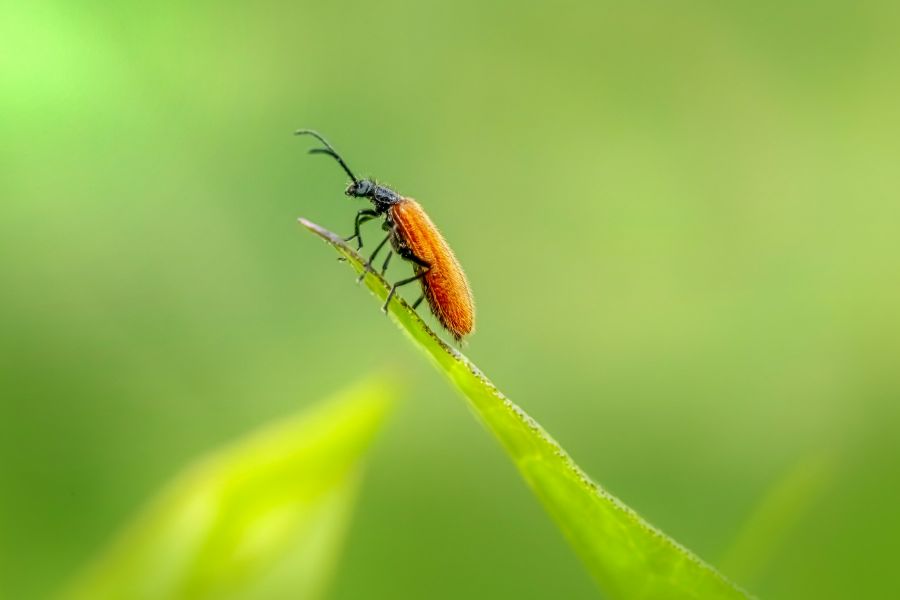
Saving bugs to find new drugs
Zoologist Dr Marek Dvořák looks at the potential of insects in pharmaceutical research
A
A. A surprising share of the medicines we use are either taken directly from the chemistry of living organisms or modelled on it. Turning to the natural world to ease and treat our illnesses is hardly a modern habit; humans have relied on it for tens of thousands of years. Nor are we alone in this. Black lemurs, for instance, smear toxin-oozing millipedes across their fur to keep biting insects at bay, while certain songbirds weave strongly scented, medicinal plants into their nests to shield their chicks from parasites — hints that a rough understanding of medicine was probably within reach of our distant ancestors as well.
B
B. On top of these age-old foundations, chemistry and pharmaceutical science refined the business of extracting, identifying, altering and testing such natural products. For a time, though, the field turned its back on nature and retreated into the laboratory, where compounds were designed entirely from scratch. What prompted that retreat was a practical difficulty: nature is full of promising molecules, but tracking them down is anything but simple. Collecting enough of the relevant organism, working out the structure of the compounds it contains, and then manufacturing those compounds in bulk each present a serious obstacle.
C
C. Because drug discovery based in the laboratory has proved only patchily successful, researchers have begun devising fresh strategies that once more look to natural products. Now that genomes can be mined for valuable molecules, it has become clear just how little of nature's chemical variety we have so far explored. That realisation, coupled with a set of gathering health emergencies — the spread of antibiotic resistance among them — has returned bioprospecting, the hunt for useful compounds in the wild, to prominence.
D
D. On land, no group rivals the insects, which fill virtually every niche available to them. Their dealings with other organisms are correspondingly varied, and it is precisely these countless interactions that have pushed them to evolve a vast repertoire of intriguing compounds, some for attack and some for defence. Every other animal group on Earth, taken together, cannot match their diversity. And yet, for all that they out-number and out-vary every competitor, insects remain almost untapped as a source of therapeutic chemistry.
E
E. So why have insects drawn comparatively little interest from bioprospectors? One reason is sheer numbers: with so many species to weigh up, sifting through them without a focused strategy is a forbidding prospect. Another is size — insects are small, and the glands within them that release potentially useful substances are smaller still, so gathering enough of a compound to test it can be hard. A third is that the insect world's apparent abundance is deceptive; what it really amounts to is enormous populations of a few very common species. A great many kinds are seldom come across and stubbornly resist being reared in captivity, which, once again, tends to leave researchers short of material.
F
F. Even the handful of insects examined so far has yielded several compounds worth pursuing. Theriacin, for instance — an antimicrobial substance secreted by the maggots of a certain carrion-feeding fly — is already prescribed as an antiviral and anti-tumour treatment in Estonia and Uruguay. A few other insect larvae are currently under study for the powerful antimicrobial agents they manufacture, while, separately, a peptide drawn from the sting venom of a Brazilian paper wasp is showing early promise against cancer.
G
G. Working alongside colleagues at Thornwood University, I have devised a method that draws on our understanding of insect behaviour to decide where to concentrate. What fascinates us most are the many insects that release potent toxins to subdue and then preserve their quarry for eating later. More numerous still are the species that flourish in the foulest of surroundings — dung and decaying carcasses — where they face relentless assault from thousands of micro-organisms. To hold their own there, these insects are equipped with an array of antimicrobial compounds active against harmful bacteria and fungi, a strong sign that they could yield, or inspire, a fresh generation of antibiotics.
H
H. Helpful though this steer is, it does not by itself solve the problem of getting usable compounds out of insects. Fortunately, researchers can now cut out the stretches of an insect's DNA that encode the compounds of interest and splice them into cell lines capable of producing the substances in far larger amounts. The path from isolating and describing a promising compound to launching a commercial product remains long and strewn with pitfalls; nonetheless, the many animal-derived medicines already on the market prove that the precedent is there and worth pursuing.
I
I. Every patch of wilderness we lose takes a store of possible medicines with it. Much as I would relish a hand in creating some breakthrough insect-derived drug, what really drives my work is conservation. It is my firm conviction that every species, no matter how tiny or unremarkable it may appear, is entitled to exist in its own right. By throwing light into the dimmest corners of nature's medicine cabinet — examining the valuable chemistry of the planet's most varied animals — we can, I believe, change the way people think about what nature is worth.