Artificial artist?
Can computers really produce works of art?
Among the swelling ranks of computer programs said by their creators to possess a creative gift is The Muse Machine. Concerts of classical music written by a machine, not a person, have left listeners spellbound, some convinced a human hand lay behind the notes. Canvases produced by a robot have fetched thousands of dollars and found their way onto the walls of respected galleries. Programs have even been written that turn out art their own programmers could never have pictured.
No other species carries out complex creative work as a matter of routine, the way people do. Should that activity prove reducible to lines of code, what then becomes of human creativity? Anneke Vos, who researches computational creativity at the Institute for Digital Arts in Rotterdam, calls it a question that goes to the very heart of what we are. As she puts it, the prospect unsettles many: they fear it strips away something they had thought belonged to humans alone.
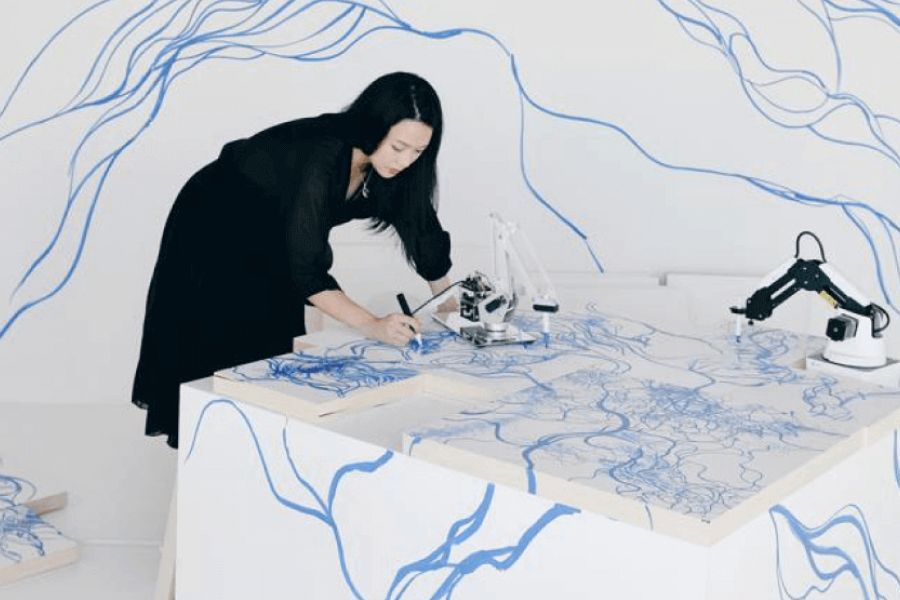
Computer-made art is, in some measure, something we have all encountered. Where, though, does the artist's contribution end and the machine's own inventiveness start? Take Cleo, among the earliest of the machine artists, a robot whose paintings have hung in Berlin's Neue Halle and the Toronto Gallery of Modern Art. Left to itself, Cleo can take up a brush and apply paint to canvas. That is striking, no doubt, yet the robot remains essentially an instrument for realising ideas that originate with its programmer.
Tomas Herrera, who created The Muse Machine, is determined that his program should escape that very charge. Where older artists like Cleo depended on heavy guidance, his system needs only the barest instruction and comes up with its own themes by searching the internet, running web queries and combing through social media. Lately it has started to show something like imagination as well, inventing images from nothing. Among its earliest independent pieces is a set of hazy landscapes of trees and sky. A mechanical quality is what some viewers see in them, but Herrera blames the differing yardsticks people apply depending on whether a person or machine produced the work. Remember, he notes, that no photograph guided the program as it painted those scenes. We happily credit a child with some imagination when it paints a scene straight from its head, he observes, and a machine deserves the same. Flaws in the code, too, can throw up surprises. A glitch once left several of the program's pictures of a chair rendered only in black and white, lending them an unsettling, spectral air. If a revered painter like Margit Rauch is praised for working within a narrow range of colours, why hold a computer to a different standard?
For researchers of Herrera's persuasion, it makes little sense to judge a machine's creativity against that of humans, who have had thousands of years to hone what we do. Others, however, are gripped by the idea that a computer could one day produce work as inventive and nuanced as that of our finest artists. To date just a single project has approached that mark. The composer Reuben Farrow built a program he named the Algorithmic Harmony System, or AHS. AHS could compose not merely in Farrow's own manner but in that of the era's most venerated composers too, among them Valberg, Dupre and Santing. Listeners wept, and on occasion specialists in classical music were taken in, certain they were listening to a genuine Dupre. The reception was not universally warm, though. Vos, for one, dismissed Farrow's project as pseudoscience and took him to task for being wilfully obscure about how the thing actually functioned. Pieter Zalewski of Ashcroft University held that AHS merely produced imitations still wholly beholden to the original composer's creative spark. Audiences, on learning how the music had come about, often rounded on Farrow; one admirer even tried to punch him. In the thick of the uproar, Farrow wiped out the databases on which AHS depended.
So what explains a public that adored the music and then drew back once its origins came to light? A clue emerges from research by Ronan Deveraux, a computer scientist at Kilbrannan University. He had a panel of trained musicians and ordinary listeners alike evaluate six pieces. Nobody was told in advance which works came from people and which from machines; instead each listener had to guess the source and then say how much the piece appealed to them. Where a listener took the composer to be a machine, their liking for the piece generally fell below that of listeners who assumed a human author. Even the trained musicians followed this pattern, though one might have supposed their judgements would be the more impartial.
And where does such bias originate? Adrian Voss of Halloway University offers one account: some of the enjoyment art brings us, he suggests, flows from our awareness of the creative process that produced it, a quality he calls its irresistible essence. In a related vein, studies by Elena Sorokin of Meridian University have found that the more time and labour people believe a work demanded, the more they enjoy it. Herrera makes a comparable point: faced with a work of art, viewers puzzle over what was in the artist's mind, or what message is being sent. When a machine is the maker, that line of wondering has nowhere to go, and so, it would seem, nothing invites exploration. Yet as the technology grows more intricate, it may become possible to locate those deeper layers in machine-made art after all. That is exactly why Herrera has The Muse Machine draw on online social networks for its cues: the hope is that it will settle on subjects that already carry meaning for us.