NARRATOR:
You will hear two students, Ed and Gemma, discussing theatre productions of Romeo and Juliet, for an assignment.
NARRATOR:
First, you have some time to look at questions 21 and 22.
NARRATOR:
Now listen carefully and answer questions 21 and 22.
ED:
Did you manage to take notes while we were watching those performances of Romeo and Juliet Gemma?
GEMMA:
I did, although it wasn't easy.
GEMMA:
I kept becoming absorbed in the play.
ED:
The same happened to me, so I stopped writing and recorded my impressions once I got home.
ED:
Could I compare a few points with you, in case I've left something out?
ED:
I also want to clarify what the assignment requires.
GEMMA:
Talking it over will help, because I may have missed things as well.
ED:
To begin with, I'm uncertain how much material our reviews ought to contain.
GEMMA:
Well, I don't think we need to retell the story, particularly since Romeo and Juliet is so widely known.
ED:
If this were an essay, we'd analyze the verse and Shakespeare's imagery, but that isn't the purpose of a review.
ED:
We need to judge how successful this particular staging was.
GEMMA:
Yes, we should explain what made the production work, or why it didn't.
ED:
That includes describing our own emotional response to the performance.
ED:
We definitely need that.
GEMMA:
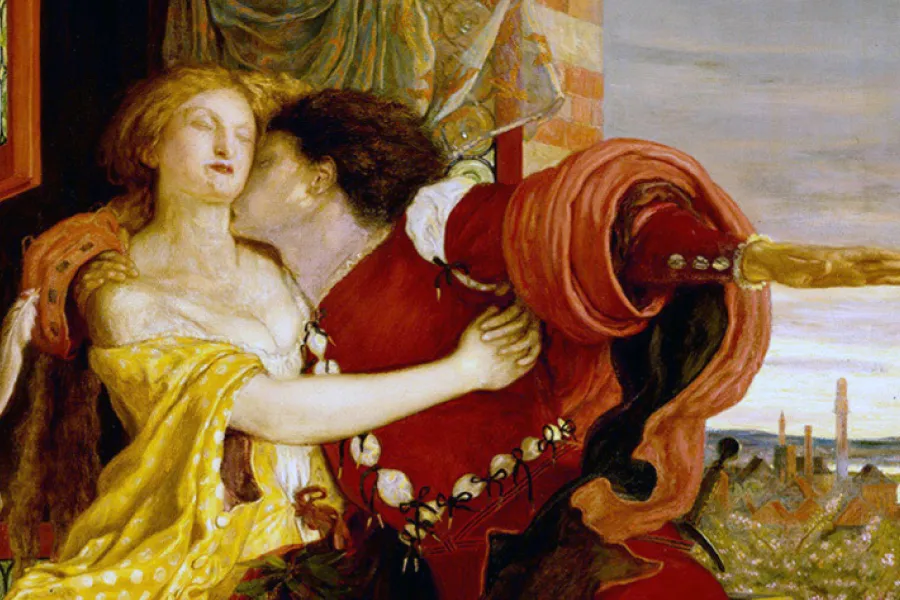
And we ought to refer to the director's treatment of specific moments, such as Romeo reaching Juliet's balcony.
ED:
Or the duel involving Mercutio and Tybalt.
GEMMA:
It could be useful to discuss the theater itself and the way the space was used, but with only eight hundred words, there probably isn't room.
ED:
Okay, that seems clear enough.
NARRATOR:
Before you hear the rest of the discussion, you have some time to look at questions twenty-three to thirty.
NARRATOR:
Now listen and answer questions twenty-three to thirty.
ED:
Shall we move on to the Emporium Theatre's version?
GEMMA:
Several elements were very effective, though others caused problems.
ED:
Let's start with the set.
GEMMA:
Visually it was remarkable.
GEMMA:
For me it was probably the outstanding feature of the whole production.
ED:
I agree that the design was impressive, even if I've come across comparable ideas in other stageings.
GEMMA:
How did you feel about the lighting?
GEMMA:
A few scenes were so dark that I struggled to see.
ED:
In the quieter passages it helped establish a different, more suitable mood.
GEMMA:
Yes, I can see that.
ED:
And the I'd been expecting a more traditional treatment.
GEMMA:
The opening music was excellent, and the musicians were very good.
GEMMA:
But later, especially in acts two and three, the music hardly contributed, so their talent felt underused.
ED:
That was disappointing.
GEMMA:
The actors' handling of the lines was another weakness.
GEMMA:
For me they spoke too quickly.
ED:
I agree there was a problem, but I put it down to insufficient volume, particularly at crucial moments.
GEMMA:
Their volume wasn't an issue for me.
ED:
Seeing several different versions has been quite revealing, hasn't it?
GEMMA:
It's shown me how contemporary the play can still feel.
ED:
Yes, society has changed enormously since Shakespeare's day, but conflict between teenagers and their parents is still familiar.
GEMMA:
Young audiences can recognize that family tension more readily than the extreme violence and passion.
ED:
What was it like seeing the play performed in translation?
GEMMA:
I'd expected it to be hard to follow, yet I understood the action without much trouble.
ED:
Once I stopped worrying about every unfamiliar word, I concentrated on the actors' faces.
ED:
The ending had a strong effect on me.
GEMMA:
In fact, that made the emotion feel even more intense.
ED:
Apparently Shakespeare has been translated into more languages than any other author.
GEMMA:
Why do you think his work appeals so widely?
ED:
I read that the plays deal with fundamental themes understood by people everywhere.
GEMMA:
Yes, and they can be read at several different levels.
GEMMA:
The characters are also remarkably complex, which means directors can keep exploring them and offer fresh interpretations.
GEMMA:
And that's essential because...
NARRATOR:
That is the end of part three.
NARRATOR:
You now have one minute to check your answers to part three.