NARRATOR:
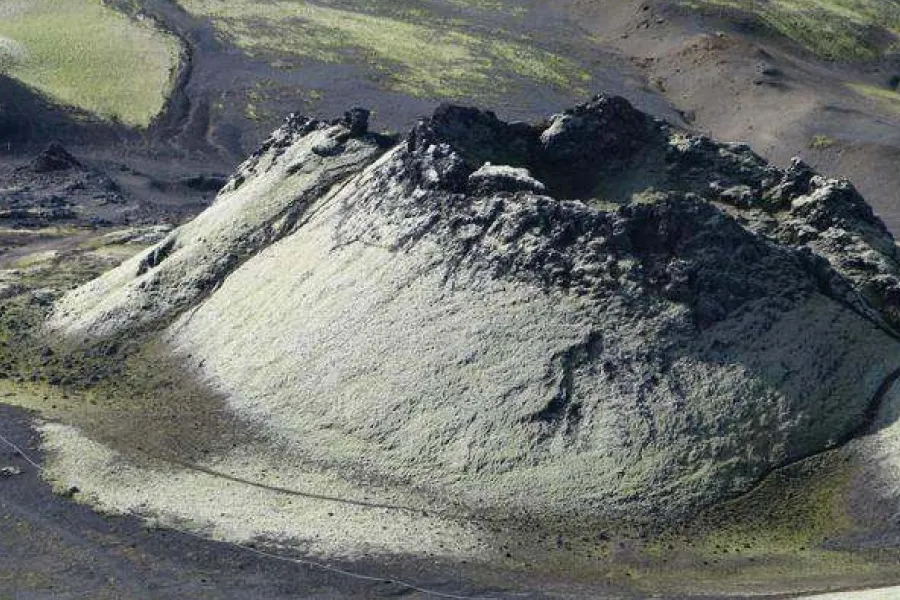
You will hear two students preparing a presentation about the lucky eruption.
NARRATOR:
First, you have some time to look at questions 21 to 26.
NARRATOR:
Now listen carefully and answer questions 21 to 26.
ADAM:
Shall we get started on the presentation, Michelle?
ADAM:
We haven't got much time left.
MICHELLE:
At least we finished all the background reading.
MICHELLE:
I found it fascinating.
MICHELLE:
I hadn't even heard of the lucky eruption before this.
ADAM:
Still, 1783 was a very long time ago.
MICHELLE:
It was, but the eruption was enormous and its consequences were devastating.
ADAM:
I liked having so many first-hand accounts to study.
ADAM:
They really show how disastrous the volcano was, and how people were beginning to work out the science behind events like this.
MICHELLE:
But for me, the more important point was the way it influenced political developments, both directly and indirectly, as well as having major social and economic effects.
ADAM:
That ought to be the central theme of our presentation.
MICHELLE:
The records made at the time were useful too, weren't they?
MICHELLE:
The descriptions were remarkably consistent, even though the writers didn't always use identical terms.
ADAM:
What amazed me was how many weather observation stations already existed.
ADAM:
Their records let us see changes in the weather, sometimes hour by hour.
MICHELLE:
Contemporary writers used the expression, Locky Haze, for the volcanic mist that moved across Europe.
MICHELLE:
They knew it wasn't ordinary fog.
MICHELLE:
This was before industrial pollution, so a fog that smelled of sulfur was completely unfamiliar.
ADAM:
Yes, that's a good point.
MICHELLE:
Accounts from the period connected the haze with more headaches, breathing difficulties, and asthma attacks.
MICHELLE:
They also said it veiled the sun and turned it an unusual red color.
ADAM:
That must have looked extraordinary.
MICHELLE:
Benjamin Franklin wrote about the haze as well.
MICHELLE:
Did you see that?
MICHELLE:
He was serving as the American ambassador in Paris then.
ADAM:
At first, nobody understood that the haze had come from the volcanic eruption in Iceland.
MICHELLE:
And Franklin was the first person to identify its cause.
ADAM:
He's often given credit for that, but it isn't quite right.
ADAM:
A French naturalist reached the conclusion before him, I'll need to check the man's name.
ADAM:
Several other naturalists then arrived at the same explanation independently.
MICHELLE:
We should cover the eruption's immediate effects, of course, particularly the huge number of deaths in Iceland.
ADAM:
You'd expect severe loss of life there, and you might also expect the ash cloud to travel rapidly.
ADAM:
What I didn't anticipate was how long the effects lasted, or that unusual weather was still being recorded two years later as far away as North America and North Africa.
MICHELLE:
I found the scale of that hard to believe, too.
MICHELLE:
It must have been terrifying, and people were powerless even when they knew the ash cloud was heading towards them.
NARRATOR:
Before you hear the rest of the discussion, you have some time to look at questions 27 to 30.
NARRATOR:
Now listen and answer questions 27 to 30.
MICHELLE:
We should go through the terrible consequences in individual countries.
MICHELLE:
The effects were surprisingly varied.
ADAM:
Let's begin with Iceland, where farming was hit extremely hard.
MICHELLE:
One of the most striking effects was on livestock grazing in the fields.
MICHELLE:
The animals became ill after eating plants contaminated with fluorine from the volcanic fallout.
ADAM:
In Egypt, the abnormal weather brought a serious drought.
ADAM:
The Nile failed to flood, so the crops were ruined.
MICHELLE:
And Egypt was so far from the volcano.
MICHELLE:
Yet the famine there caused a greater loss of life than in any other country.
MICHELLE:
More people died than during the plague.
ADAM:
Next, the death rate in the UK rose sharply, probably because of respiratory disease.
ADAM:
One account suggests it was roughly twice the normal level, with an unusually large proportion of the victims under 25.
MICHELLE:
People may also be surprised by the weather in the USA.
MICHELLE:
George Washington recorded in his diary that Virginia remained snowbound until March.
MICHELLE:
This was before he became president.
ADAM:
Yes, and chunks of ice were floating down the Mississippi, something that had never been seen before.
MICHELLE:
It's remarkable.
MICHELLE:
Anyway, what do you think we should— That is the end of part three.