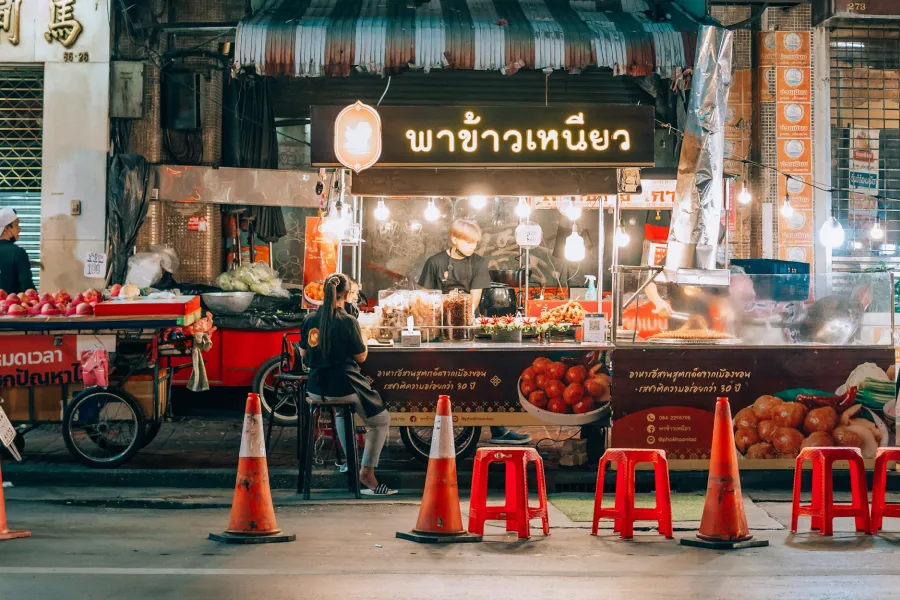
You will hear a street food business owner giving advice to people who are considering starting a similar business.
First you have some time to look at questions 11 to 14.
Now listen carefully and answer questions 11 to 14.
I'm John and I own VEGOUT, a mobile business specializing in vegan food.
Since 2012 I've traveled around the country in a converted van cooking at outdoor events of many kinds.
This evening, I'd like to pass on some lessons from that experience.
This is an excellent time to enter the industry because public interest in street food is still increasing.
In my view, there are two main reasons.
Street food offers an alternative to conventional fast food.
Fast food may be inexpensive and widely available, but it tends to be unhealthy and almost identical wherever you buy it.
Street food stalls by contrast can offer everything from premium burgers to vegan curries.
Customers enjoy discovering something unusual that isn't available everywhere else.
They also value freshness.
They can watch their meal being made in front of them rather than receiving food taken directly from a freezer.
Choosing the right selling location is essential.
Beginners often assume a music festival is the natural choice, yet pitches there can be extremely expensive and competition is intense.
A food market is much more suitable.
The visitors are already interested in what they eat and they often give useful comments about new dishes.
A space in a local park is another very good option.
The atmosphere is relaxed, while the number of people walking past can provide a steady flow of customers.
After your business develops a reputation, you may be invited to cater for parties.
These are enjoyable, but demanding.
Street food is fashionable at weddings as well, though I wouldn't suggest starting there because every detail has to be right.
Before you hear the rest of the talk, you have some time to look at questions 15 to 20.
Now listen and answer questions 15 to 20.
Opening a mobile food business is cheaper than launching a restaurant or cafe, but you still need basic appliances.
My advice is to buy used hobs and fridges at first.
If the business succeeds, you can replace them later with higher-quality models.
Hiring equipment may appear economical, but over time it usually costs more.
You probably already know what kind of food you want to sell.
You may have checked whether a similar product is available nearby and considered allergies to ingredients such as eggs or nuts.
One detail that beginners sometimes overlook is presentation.
Will customers receive the food on a plate or in a bag?
Can the packaging be recycled or reused?
The product must be simple to eat and visually attractive if you want people to return.
Even with careful planning, every new operation encounters difficulties.
I'll describe four examples from businesses I know.
The friends who established High Basil continued working in a restaurant while launching their food truck.
They finished at the restaurant around midnight throughout the week, then spent their days off selling at markets.
As a result, the hours they worked were enormous and they had almost no personal time.
Basque depended on fish for several dishes, but the ingredient became so expensive that the owners struggled to make a profit.
Customers would not accept a large price increase, so the menu had to shift away from fish and include more vegetarian choices.
Lou's kitchen prepared salads individually inside its van, and some recipes involved several stages.
At one early event, orders took so long that the queue lasted more than 15 minutes.
Many customers became impatient and left.
Whatever you sell must therefore be assembled and served efficiently.
Chip Chop identified an ideal position close to a beach with no other food vans nearby.
Unfortunately, the owners discovered that selling there required a special permit, unlike operating at a market or festival.
Securing it involved such a complicated procedure that they eventually abandoned the location.
I hope those examples have given you a realistic sense of both the opportunities and the practical challenges involved in running a street food business.
That is the end of part two.
You now have one minute to check your answers to part two.