You will hear a museum guide describing several collections.
First, you have some time to look at questions 11 to 16.
Now listen carefully and answer questions 11 to 16.
Good morning, and welcome to our museum, which contains an extraordinary range of exhibits.
I'm Greg, and I'll describe the collections as we tour the building.
Before we set off, though, let me give you an idea of what you can see.
First, the museum owns an excellent group of 20th and 21st century paintings, including works by many famous artists.
You will probably recognize a number of them.
This gallery contains the museum's most popular exhibits and attracts more visitors than any other, so come early before it becomes crowded.
We also display 19th century paintings.
When the museum opened in the middle of that century, several individual artists donated one work each to help establish the collection.
Those personal gifts give the paintings particular significance for us.
The sculpture gallery contains several outstanding pieces, but it is temporarily closed for renovation.
You'll need to return next year to see the whole collection together.
For now, some sculptures have been transferred to other areas of the museum.
Around the World is a temporary exhibition that has recently received coverage on television and in newspapers.
It has attracted considerable attention by presenting objects from every continent and many different nations, along with explanations of their social context.
Why each object was produced and who used it.
Next is our specialist coin collection.
Every coin comes from this country and dates from between one and two thousand years ago.
Many were found by members of the public while digging in their gardens and were subsequently donated to the museum.
Finally, the entire porcelain and glass collection was left by the museum's founder when he died in 1878.
His will prevents us from adding any further items because he considered the collection complete and we agree with him.
Before you hear the rest of the talk, you have some time to look at questions 17 to 20.
Now listen and answer questions 17 to 20.
That gives you an overview of the collections.
I'll now provide some practical information.
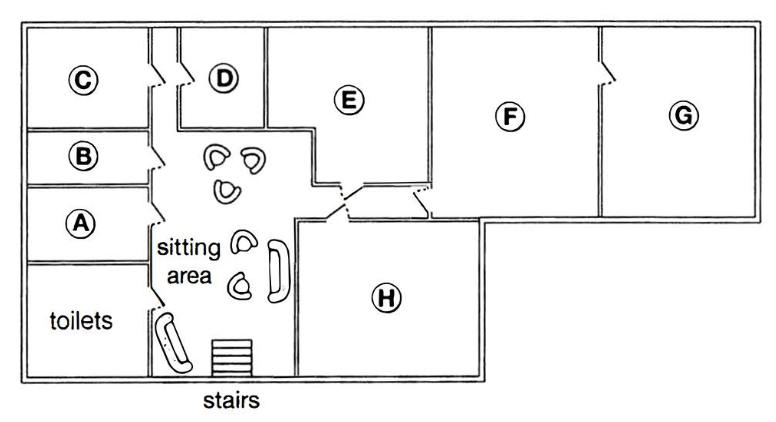
Most visitor facilities are in the basement.
At the foot of these stairs you enter a sitting area furnished with chairs and sofas where you can rest during your visit.
Our restaurant offers high quality meals throughout the day in a calm setting.
From the bottom of the stairs walk straight across to the far side of the sitting area and turn right into the corridor.
The restaurant entrance will be directly in front of you.
For a snack or somewhere better equipped for children there is also a cafe.
Again, walk across the sitting area and turn right into the corridor.
The cafe is the first door immediately on your right.
The basement also contains baby changing facilities.
Cross the sitting area and continue into the corridor on the left.
The facilities are located on the left hand side.
Please leave coats, umbrellas, and large bags in the cloak room.
It is on the left of the sitting area through the final door before the corridor.
Toilets are available on every floor.
In the basement they are the first rooms on your left after you come down the stairs.
If you need to use the cloak room please do so now and then we'll begin the tour.
That is the end of part two.
You now have one minute to check your answers to part two.