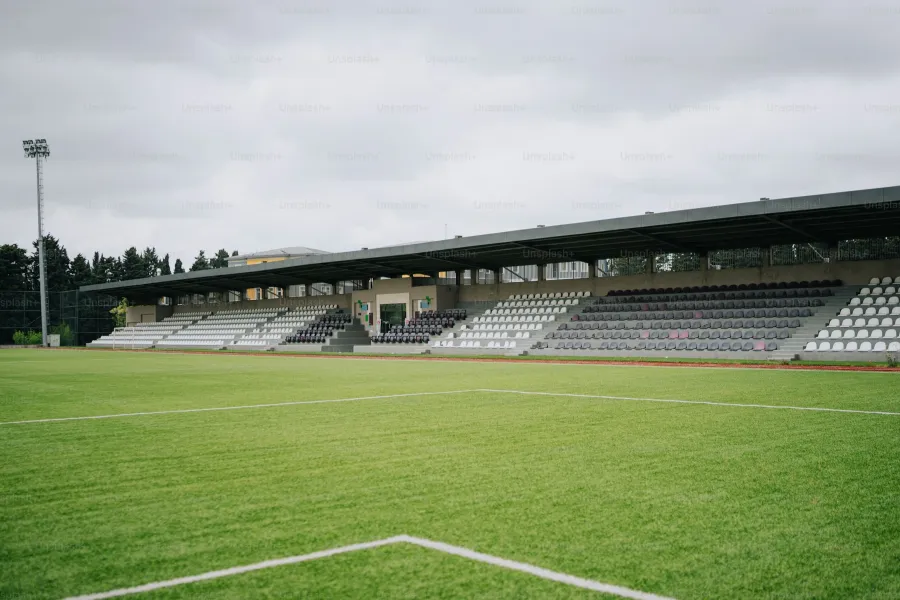
You will hear a guide speaking to members of the public during a visit to a football stadium in the UK.
First, you have some time to look at questions 11 to 14.
Now listen carefully and answer questions 11 to 14.
Good morning, everyone, and welcome to City Football Club.
Before we begin the tour, I'll explain a few things about today's visit and the parts of the stadium you'll be able to see.
There are quite a few children in the group, so I'd like parents to bear a couple of points in mind.
We have a lot of steps here, and the tunnel used by the players is poorly lit.
Please keep your children with you throughout the visit and don't allow them to go off alone, even briefly.
That will help us avoid accidents and stop anyone becoming frightened.
You're welcome to use cameras anywhere in the stadium.
Later, your child can try taking a penalty and you'll be able to photograph them doing it.
Our assistants will manage that activity, so with luck you won't be waiting in line for too long.
The weather is very hot and bright on the pitch today.
Food and cold drinks are available from the cafe, where I'd particularly recommend the nutritious lunch boxes made for children.
While you're in the cafe, children can also enter today's football drawing competition.
We'll choose the winning picture late this afternoon.
Please write your name and contact information on the back, because if you've already gone home, we can post the prize to you.
I'm afraid we aren't able to send the drawings back.
Let me now describe some of the tour itself.
We'll begin with the 360-degree cinema which visitors have enjoyed for several years.
After that, I'll show you the players' changing rooms, and then we'll continue outside to the stands and the pitch.
If you'd rather explore independently, you can now borrow headphones at reception and follow recorded commentary at your own pace.
That audio service was launched this year, and we'd be grateful to hear what you think of it.
We may provide tours in additional languages at some point, so comments on that idea would also be useful, and if you come back in the future, you could reserve one of our VIP tours online.
Those tours are another service we've introduced this year.
Before you hear the remainder of the talk, you have some time to look at questions 15-20.
Now listen and answer questions 15-20.
The stadium standing here now dates from 1989 and was completed during a redevelopment program lasting three years.
While the work was underway, the team played its home fixtures at another club's ground.
With that one exception, this club has occupied the same site since 1870.
That year marked the beginning of a particularly important period for football in Britain.
It was in 1870 that teams first included a player specifically responsible for protecting the goal.
It's difficult now to picture a match without someone performing that role.
A number of new clubs appeared in 1872 and 1873, not only in this country but overseas as well.
Then in 1874, referees gained the authority to dismiss players for particular offenses.
A second rule introduced in the same year required the two teams to change ends at halftime.
In the earliest games, a goal was scored by sending the ball between two flags.
Later, the flags gave way to upright posts with tape stretched across the top.
The familiar solid crossbar replaced that tape in 1875.
More clubs were founded in 1877 and that was also when they collectively agreed that a match would last no more than 90 minutes.
Previously, the finishing time had been informal.
This sometimes led to serious disputes or even fights when one team wanted to stop but the other hoped to continue and score a winner.
The football league contained more teams by 1878.
Referees also began using whistles that year and electric lighting was fitted at some grounds.
As a result, matches could take place in the evening and every season.
In 1880, clubs started asking supporters to pay to enter matches.
The players, however, were still amateurs with ordinary jobs, so they weren't receiving wages for playing.
That contrasts sharply with today's professional game in which leading players earn large amounts both on the field and through commercial work.
That is the end of part two.
You now have 30 seconds to check your answers to part two.