You will hear an archaeologist involved in a community excavation, explaining the site to a group of visitors.
First, you have some time to look at questions 11 to 16.
Now, listen carefully and answer questions 11 to 16.
Hello, I'm Hayden, one of the archaeologists working here at Bidcaster.
This is the project's third summer, and nearly everyone carrying out the excavation is a volunteer.
My permanent post is with the town council, but it was NHA that invited me to take part.
It's a charity that organises projects of this kind throughout the country.
Being beside Bidcaster Castle is useful too, since the castle's owners allow us to use their facilities.
You may be wondering how the work began.
Archaeological investigations often start after someone comes across an old object, and here the first discovery was a gold coin.
People sometimes locate coins with metal-detecting equipment, while rabbits and other animals can expose them by disturbing the ground.
A walker noticed this one lying on the surface after a heavy downpour had carried away a layer of soil and sand.
Once the coin was reported in the local news, an amateur historian called Peter Swift got in touch.
He thought a settlement had stood here long before the castle was constructed.
Then, quite unexpectedly, our team came across maps and papers in the library.
They included drawings made five centuries ago of ruined buildings on the grass between the river and the castle's outer walls.
At that point, we knew the theory was right.
During our three seasons on the site, we've uncovered the remains of several buildings and an enormous quantity of broken, everyday pottery.
What still hasn't appeared is a brooch or any other piece of jewelry.
We have, however, found tools shaped from animal bone, and you'll be able to see those in the exhibition.
There are also signs of activity on the bank opposite the castle.
We haven't located any houses or small huts there, but the boundaries of an old system of fields can be traced.
We initially took one long section of wall to be part of a palace.
Further investigation showed that it was actually modern.
This season's excavation is nearly over, though the team will return next summer.
Before then, we're arranging guided visits for school groups in the autumn.
You may already have watched the television documentary about us.
It claimed our finds would go to the town museum, but that hasn't been decided.
Before you hear the rest of the talk, you have some time to look at questions 17 to 20.
Now listen and answer questions 17 to 20.
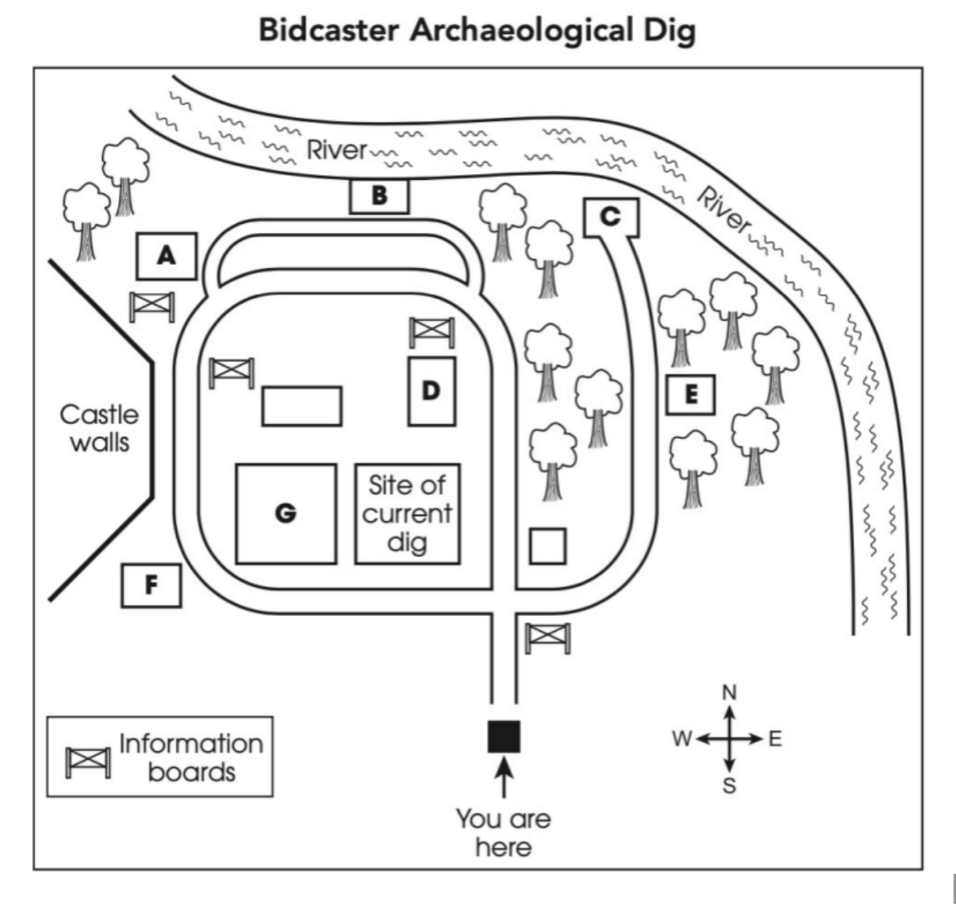
As you walk around, please remain on the marked paths.
Let me point out several of the site's main features.
Your current position is shown at the bottom of the map.
This year we have established where an ancient bridge once stood.
Divers are in the river today, looking for objects that may have been lost there.
To reach its foundations, follow the main path straight ahead until it curves left.
At that bend, take the narrower track on your right.
It leads directly to the river and the diving team.
Another feature worth seeing is the refuse pit, close against the castle walls at the northwest corner.
It belongs to the castle period rather than the earlier village.
The oyster shells and fish bones inside were probably discarded from the castle kitchen above.
In our first summer, we located a communal hall.
Two parallel lines of deep postholes told us that it had supported a substantial roof.
It's the biggest building in the central part of the site, immediately beside the area we're excavating now.
We found the village's fish pond last year.
Such ponds were generally placed close to a river, whereas this one is some distance away, perhaps because the river's course has shifted.
From here, turn right when you reach the first information board, then stay on the path into the trees.
The pond is on your right before the path leaves the wooded area.
If you arrive at the river, you've passed it.
So, are there any...? That is the end of part two.
You now have 30 seconds to check your answers to part two.