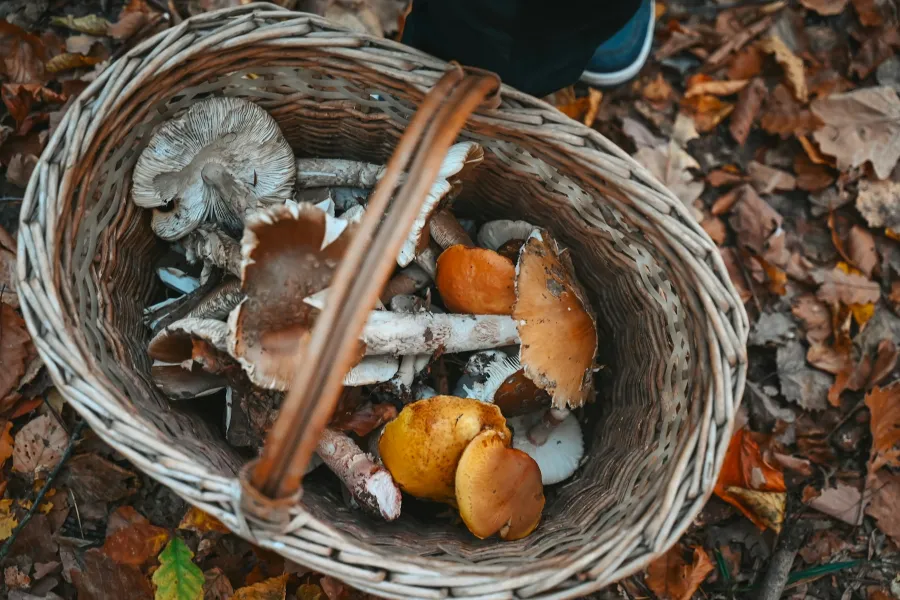
You will hear a radio presenter introducing an author, introducing an author who gives advice about collecting wild mushrooms.
First, you have some time to look at questions 11 to 14.
Now listen carefully and answer questions 11 to 14.
We're very pleased to have Dan Beagle with us this evening.
He has recently published a book about finding food that grows in the wild, and tonight he'll explain what people need to know before they go out collecting wild mushrooms.
I should begin with safety because it's essential to be certain about what you're doing.
Several types of mushroom are highly poisonous.
Once you learn to identify them properly, though, collecting them is well worth the effort.
As there's an extraordinary range that you simply won't find in shops, even so, you must take care.
I always advise people never to eat mushrooms gathered by friends or neighbors.
Poisonous varieties can look remarkably similar to edible ones, so mistakes are easy to make.
You should also stay away from mushrooms growing alongside roads with heavy traffic.
As for flavor, freshly collected mushrooms are hard to beat.
The ones sold in shops may already be a few days old and no longer at their best.
There are also several common beliefs about wild mushrooms that need correcting.
Some people claim that only pale or plain-looking ones are safe.
But that isn't true at all.
Certain edible varieties are bright red.
I normally prefer mushrooms cooked, although eating suitable ones raw in a salad is harmless, and there's no need to peel them.
Smell is not a reliable safety test, either.
Some of the deadliest kinds apparently have almost no smell and may even taste pleasant.
And if you see deer or squirrels eating a particular mushroom, don't assume it is safe for people.
Before you hear the rest of the talk, you have some time to look at questions 15 to 20.
Now listen and answer questions 15 to 20.
Mushroom collecting is usually linked with the countryside, but anyone without a car could begin in a nearby park.
Parks often contain several suitable habitats, including open plain fields and wooded sections.
The important thing is to arrive first thing in the morning because you'll face competition from wildlife as well as other collectors.
In my local park, the deer often reach the best mushrooms before anyone else.
If you're completely new to this, I wouldn't suggest going by yourself or depending on photographs in a guidebook, even mine.
Some phone apps are excellent for identifying mushrooms, but in the middle of woodland, you may not get a reliable signal.
The best approach, if you can arrange it, is to join a group led by an expert.
That keeps you safe and helps you learn quickly.
Conservation matters greatly, so there are a few simple rules to follow.
Never clear every mushroom from one place.
Take only what you actually need.
Watch where you step so that you don't damage young mushrooms or nearby plants and leave any endangered species protected by law untouched.
Several wild mushroom varieties have become less common in this region.
Restaurants are showing more interest in locally sourced ingredients such as these, but the main cause is the large number of houses constructed here during the past decade.
The development has increased demand for water from rivers and reservoirs while also destroying mushroom habitats.
Let me add something about storage.
Put the mushrooms into a brown paper bag while collecting them, then place them in the fridge as soon as you get home.
They should remain usable for about two days, although cooking them sooner is preferable.
Wash them thoroughly just before you cook them.
Most people think they already know what mushrooms taste like, but wild varieties differ enormously.
Be willing to experiment.
They work well in all sorts of dishes, including stir-fries, risottos, and pasta.
Remember, however, that some varieties can cause a bad reaction in certain people, so begin with a small quantity.
Right, now I'm going to show you.
That is the end of part two.
You now have one minute to check your answers.