...:
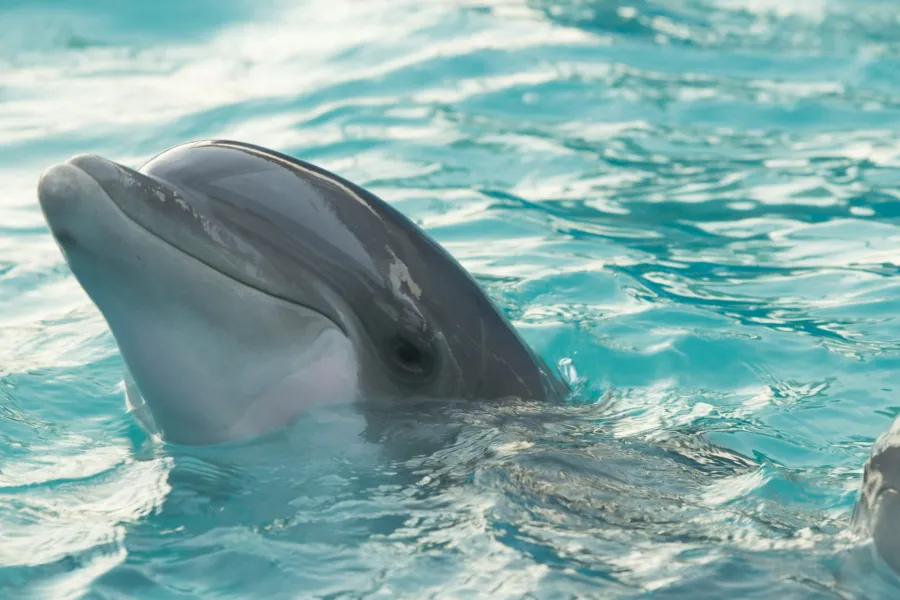
You will hear an interview with the representative of the Dolphin Conservation Trust.
...:
First, you have some time to look at questions 11 to 15.
...:
Now listen carefully and answer questions 11 to 15.
...:
Today, we welcome Alice Bussell from the Dolphin Conservation Trust.
...:
Alice, could you describe the organization?
...:
Its purpose is to protect dolphins in seas around the world.
...:
We raise awareness of the pollution and other threats these animals face.
...:
The Trust began 10 years ago and is among the country's fastest growing animal charities, although it remains small beside the largest conservation groups.
...:
We're particularly proud of our educational work.
...:
Last year, we visited many schools and spoke to young people aged 5 to 18.
...:
Children make up about 35% of our membership.
...:
We use donations to support campaigns, including efforts to change fishing policies.
...:
We hope to employ our first full-time dolphin biologist soon to monitor populations.
...:
At present, many people volunteer their time in observation work, administration and several other roles.
...:
Last year, the Charity Commission gave us an award for education.
...:
It didn't provide much additional money, but it made our work far more widely known and understood.
...:
We hope this publicity may eventually increase membership.
...:
Can people see dolphins in British waters?
...:
Yes, in several places.
...:
We run a major project in eastern Scotland, an area that has long sheltered dolphins because there is little shipping.
...:
Oil companies now want to expand exploration there.
...:
We oppose the plan because the exploration produces intense underwater noise, even though serious oil pollution is unlikely.
...:
That noise prevents dolphins from resting and socialising.
...:
That issue first sparked my interest in dolphin conservation.
...:
I had never seen a dolphin and hadn't been especially interested at school.
...:
Then I found a book about dolphins forced from their Moray Firth home by oil companies and about a child who campaigned to protect them.
...:
I couldn't stop reading it.
...:
Before you hear the rest of the interview, you have some time to look at questions 16 to 20.
...:
Now listen and answer questions 16 to 20.
...:
Listeners will want to know how they can help.
...:
Could you explain the adopt a dolphin scheme?
...:
Sponsors choose a dolphin and receive its photograph and regular news.
...:
Four dolphins currently feature in the scheme.
...:
Moondancer, Echo, Kiwi and Samson.
...:
Echo has been difficult to find and our observers haven't seen him at all this year, though we hope he'll appear soon.
...:
The other three have been very visible.
...:
Samson and Moondancer are often photographed together, but Kiwi approaches cameras so frequently that she has been photographed hundreds of times.
...:
More than any of the others, each has a distinct personality.
...:
Moondancer moves through the water with elegant curves, while Samson is remarkably energetic and constantly leaps above the surface.
...:
Kiwi is actually the youngest dolphin, but Samson is the most recent addition to the adoption scheme.
...:
Kiwi is noisy so we can identify her quickly.
...:
Echo and Moondancer also make plenty of sound.
...:
Moondancer, however, is particularly easy to recognise because her back fin is unusually large.
...:
They certainly sound fascinating.
...:
That is the end of part two.
...:
You now have one minute to check your answers to part two.