Can the planet's coral reefs be saved?
A
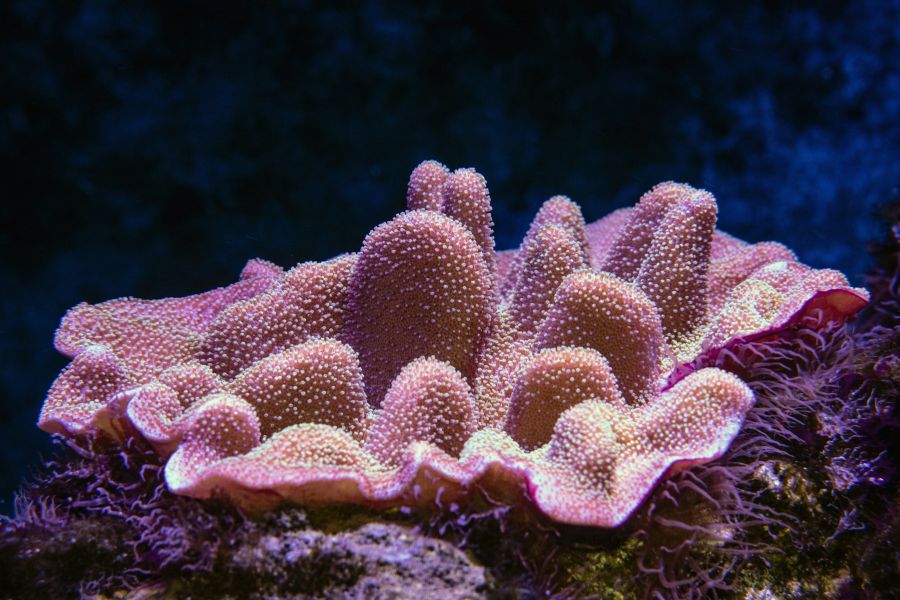
A. At the Tyrrhenian Marine Institute in Naples, researchers have just completed a vast artificial reef, assembled piece by piece over many months. Into the enormous tank they have introduced samples of some of the sea's most striking corals - branching staghorn, brain coral, delicate sea fans and plate coral among them - together with the kinds of fish that flourish alongside such corals, damselfish, wrasse and cardinalfish included. Housing the reef is the institute's newly opened gallery, Hidden Multitudes, which celebrates the tiny invertebrate animals on which so much of the planet's life depends. At the heart of the display stands the reef tank, fronted by a viewing window fully seven metres across. 'Nowhere on Earth supports more varied life than a coral reef, and we want visitors to grasp just how remarkable these places are,' said Lucia Marchetti, the institute's lead curator of marine invertebrates. 'But we are just as keen to draw attention to the scientific and conservation work now under way to rescue reefs from the dangers posed by a warming climate.' The aim is for the public to see the efforts being made to preserve these marvels.
B
B. A coral is really a colony of minute creatures called polyps, each fitted with tentacles that seize the small animals drifting past in the water. The polyps themselves are colourless; the vivid pinks, oranges, blues and greens we link with coral in fact come from algae lodged inside their tissues. The relationship serves both sides. The algae are offered protection by the coral that houses them, and in exchange the nutrients they produce as they photosynthesise in sunlight flow back to the polyps. It is this convenient partnership that has let reefs build up - structures that, while they cover well under a tenth of a per cent of the seabed, still shelter more than a quarter of all marine species, among them molluscs, sponges, shellfish and fish.
C
C. This variety explains why reefs are so often called 'the rainforests of the sea' - a description that not every naturalist accepts. Among the doubters is the veteran wildlife broadcaster Gethin Rowe. 'People tell you nothing surpasses the rainforest,' Rowe has remarked, 'but I disagree. The moment you arrive, you find yourself asking where all the birds and animals have got to - up in the trees, naturally, out of sight. If it is beauty and abundant life you are after, a coral reef is the place. Slip on a mask, lower your face beneath the surface, and what you see is astonishing.'
D
D. These wonderful sights, sadly, are now in grave danger, and the most pressing hazard is heat. As sea temperatures climb, they set off bleaching episodes that drain reefs of colour and, in time, destroy them. Nor is that the whole story. The seas are also turning more acidic and steadily losing their oxygen; sea levels are creeping upward; currents are shifting; and human pollution adds to the burden, even as a warming world eats away at reef habitats. Enormous stretches of reef - among them large portions of Australia's Great Barrier Reef - have already gone, and researchers warn that, without swift action against greenhouse gases and rising temperatures, in excess of 70% of reefs may vanish by 2040. Marchetti points out that corals must already endure punishing conditions, from wave battering to much else besides. 'Whenever something begins to go awry in the oceans, corals are the first to respond, and that is precisely what we are witnessing today. The reefs are dying, and in doing so they are warning us that our planet is not in good health.'
E
E. Even so, scientists are working to identify tougher strains of coral capable of withstanding our overheated seas, and part of that work will take place at the Naples institute. 'Laboratories have been built directly behind the reef tank, and there our scientists will examine different coral species,' Marchetti explained. One goal is to discover which corals cope best in warm, acidic water. A second is to raise the rate at which corals reproduce. 'A coral will normally spawn only once in a year,' she noted, 'yet research in aquariums has already coaxed some corals into spawning artificially, which can support efforts to rebuild reefs. Were this achievable for every species, we might set up spawning programmes that run several times a year - a real boost to reef recovery.'
F
F. Work of this kind is going on in laboratories across the globe, and the Naples centre is tied into that international web of research. A finding made at one site can then be checked at others, and the young corals that result can be put on show in the Hidden Multitudes tank. 'What matters most is that the advances we achieve in helping coral cope with a warming world can be placed before the public, giving people reason to believe reefs can still be saved,' said Marchetti. 'Rescuing the world's coral reefs is now an ecological priority of the highest order.'