THE STEAM CAR
How the Reyburn brothers rose and fell with their steam-powered motor cars
A
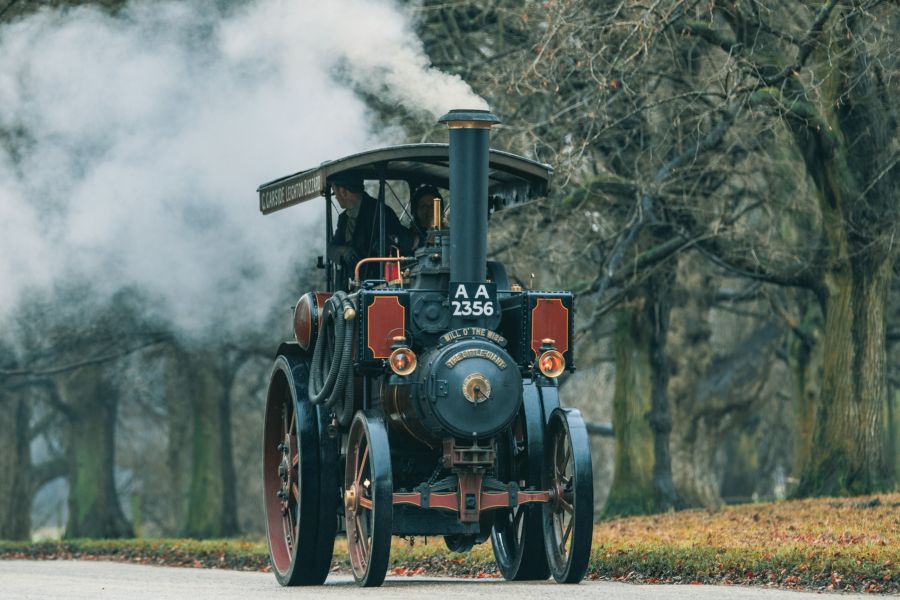
A. The earliest motor cars, which took to the roads during the nineteenth century, drew their power from steam. Steam had already proved itself over decades on the railways, so shrinking that technology into a road-going machine, detached from any train, seemed a logical next step. What the new vehicles gained from steam, though, came bundled with its drawbacks. A driver had to light the boiler by hand and then wait roughly twenty minutes while pressure built up, and even once the car was moving, its water tanks ran dry after about thirty miles and needed topping up. Even so, the cars caught on: they carried people at a decent pace, and by the opening years of the twentieth century the sight of one ferrying a well-to-do passenger through the streets was hardly unusual.
B
B. Yet steam's moment in the sun did not last. Before long a rival had arrived, the internal combustion engine, whose great advantage was that a car fitted with one could be driven away within seconds of starting. Petrol cars did not win people over at once: they were loud, fiddlier to handle, and the hand cranks used to start them were known to snap drivers' arms whenever an engine backfired. That objection fell away around 1911, when a leading manufacturer brought out the electric self-starter, and from then on steam was slowly squeezed out of the market.
C
C. With the industry already in retreat, four brothers set out to breathe life back into steam. Cornelius Reyburn and his three siblings, still schoolboys, put together their first steam car between 1903 and 1906 in the cellar of the family home in Yorkshire. It was assembled from parts salvaged from a scrapped early steamer, rebuilt to power an engine of the brothers' own design. This first attempt ran poorly, but the Reyburns pressed on, producing a second and then a third prototype over the next few years. That third car, which they called the Mark II, still could not match the convenience of a petrol engine; even so, the many advances it showed over earlier steam vehicles earned it write-ups in the motoring trade press. In several respects it simply outdid its petrol-driven rivals. Where combustion engines rattled and gave off the smell of burnt fuel, the Reyburns' high-pressure steam turned the pistons almost soundlessly. Most striking was its speed: from a standstill it could reach fifty miles an hour in roughly eighteen seconds, described as 'acceleration of a remarkable order' by The Carriage and Motor Gazette in 1911.
D
D. A year later, Cornelius Reyburn drove the Mark II the length of the country, from Yorkshire down to Coventry, hoping to attract backers; the money he raised there let him set up the Pennine Engineering Company. Work on a successor, the Mark III, began at once, the aim being to build further on everything the Mark II had introduced. Among the additions was a key-operated ignition in the cabin, which did away with the old chore of lighting the boiler by hand. On the strength of such refinements, the young firm pledged a steam car as convenient as any petrol model, yet far faster, far easier to control and near enough silent. Orders poured in: by the following April the company was holding 4,720 deposits for the Reyburn Meteor, with first deliveries promised for early 1915.
E
E. The good news did not hold. Before the year was out, Reyburn had to disappoint the many customers waiting for their sleek new vehicles. The few who took delivery of a finished car found it slow and unpredictable, for it would now and then lurch backwards just when it was meant to go forward. Inventive though the new engine was, it remained dogged by serious faults.
F
F. One last effort was made to bring a workable steam car to market. Early in 1921 a Mark V was sent north to Glasgow, where the National Motoring Club had agreed to road-test it. Left out overnight in freezing conditions, it was rolled onto the road the next morning and allowed to stand for more than an hour in the icy air. When the key was turned, the boiler caught and reached its working pressure in under fifty seconds. Once it was moving, the testers were struck by how well such a heavy machine held the road, the credit going to the even spread of its weight. With further development, the Mark V's top speed was eventually driven beyond 110 miles per hour, while it returned around eighteen miles to the gallon of paraffin and gave off almost no emissions.
G
G. For all its brilliance, the Reyburns' steam car never made money. At something like 3,200 pounds in 1921 it lay within reach only of the very rich. Nor did it help that no two examples of the Mark V were ever quite alike, since Cornelius Reyburn could never stop adjusting the design. Fewer than forty of these remarkable cars had left the works by the time the firm closed in 1928. Reyburn himself never wavered: right up to his death in 1958 he insisted that steam was every bit the equal of petrol, and quite possibly better. The evidence rather supports him. Many of the surviving Mark Vs still run perfectly well, a few having covered more than half a million miles on nothing but routine servicing. Remarkably, an unaltered Mark V burns cleanly enough to meet the emission limits now enforced in London, rules with a reputation for being rigorous. The technology is not without its awkward problems, yet it is hard not to wonder what a steam car might achieve with modern materials and computers. With so much pressure nowadays to make vehicles perform better and pollute less, the return of the steam car is not so far-fetched an idea.