The problems of getting around the city of Dar es Salaam - IELTS Reading with Practice Test, Answers And Explanation
Luyện tập đề IELTS Reading Practice với passage The problems of getting around the city of Dar es Salaam được lấy từ cuốn sách IELTS Mock Test Vol 21 - Test 3 - Passage 2 với trải nghiệm thi IELTS trên máy và giải thích đáp án chi tiết bằng Linearthinking, kèm list từ vựng IELTS cần học trong bài đọc.
The problems of getting around the city of Dar es Salaam - IELTS Reading with Practice Test, Answers And Explanation
❓ Câu hỏi (questions)
Question 1 - 5
Do the following statements agree with the information given in the Reading Passage? TRUE if the statement agrees with the information FALSE if the statement contradicts the information NOT GIVEN if there is no information on this
1
According to one forecast, Dar es Salaam's population could climb to more than 68 million by 2100.
2
Travelling from the outer districts into the middle of the city and back again generally takes upward of two hours.
3
There are plans to expand the city's suburban railway.
4
The growth on the edges of the city is being carefully managed in line with an official plan.
5
In contrast to numerous other cities on the continent, Dar es Salaam has decided against building an underground railway.
Question 6 - 13
Complete the notes below.
Choose ONE WORD ONLY from the passage for each answer.
Dar es Salaam's Njiapanda Bus Rapid Transit system
Features
• the buses travel in their own
6.
, which keeps delays down
• fares are dealt with at the
7.
rather than on board the bus
• a passenger with a young child in a
8.
can still reach every part of the network
Problems
• to avoid draining a bus's
9.
, drivers often keep the cooling turned off
• too few buses are available following a major
10.
at the depot
• passengers can no longer pay by
11.
because the necessary equipment has stopped working
• as travellers enter, staff check tickets manually at the
12.
• large
13.
tend to gather at busy times
DOL IELTS Đình Lực
📖 Bài đọc (reading passage)
The problems of getting around the city of Dar es Salaam
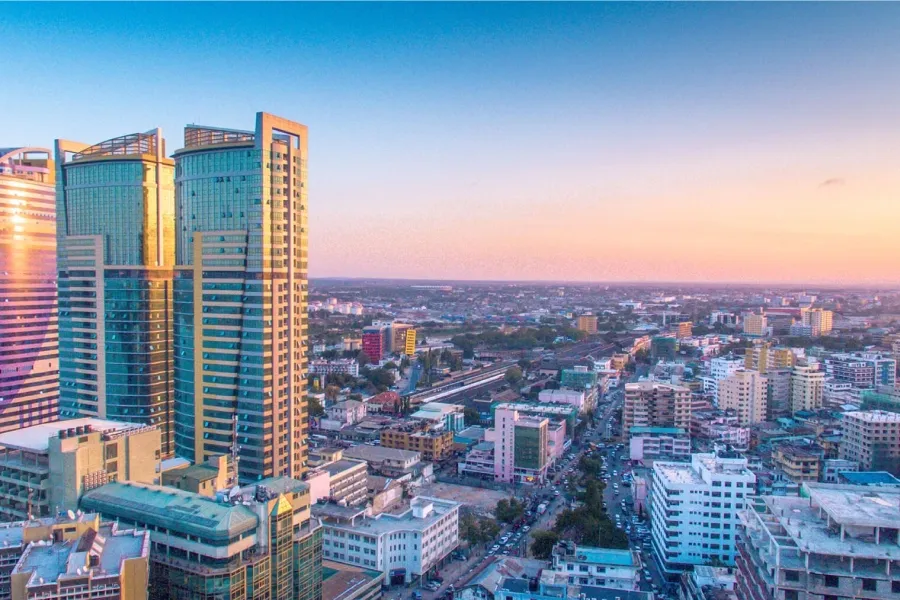
Few African cities are growing as fast as Dar es Salaam, the largest city in the coastal nation of Batari. Its population has risen sevenfold since 1985, with roughly 450,000 newcomers each year. United Nations projections have it passing 10 million to become a megacity within eight years, then reaching 12.8 million by 2040. Teodor Vance of the Urban Horizons Institute goes further, suggesting as many as 68 million could live there by the century's end.
At present, around three-quarters of its residents are housed in unplanned, low-rise settlements that spread across the city's outer fringes. For them, a trip into the centre and back commonly runs to more than two hours – and longer still whenever rain reduces the unpaved roads to mud.
Traffic can grind to a halt with no warning at all, even at midday, and drivers of cars and minibuses think nothing of waiting a quarter of an hour or more at a single busy junction. There is one suburban railway, but it reaches only a handful of northern neighbourhoods and counts for little across so vast a city. Beyond the centre, most people get around on moto-taxis – locally called chapa – which alone can thread through the cramped, pothole-ridden lanes of much of the sprawl. The number of accidents involving them is alarming.
The fact that just three major roads feed into the centre is an inheritance from the colonial administration, which at the beginning of the twentieth century designed the city for no more than 50,000 residents. Today's growth is largely young men and women leaving the countryside for work, and as numbers have surged the city has simply spread out along those three highways. Almost all of this new development occurs on the outskirts, and almost none of it follows any agreed plan.
Yet the city is placing its faith in an approach that might give Africa's megacities a different template – one that frees them from a future dominated by the private car. Where many other cities on the continent have set their sights on an underground railway, Dar es Salaam has not. Its choice is humbler, but also cheaper and more realistic to deliver: the bus.
Known as the Njiapanda bus rapid transit (BRT) network, the system operates along dedicated corridors kept apart from ordinary traffic and laid mostly down the centre of the road so that hold-ups are kept to a minimum. Tickets are both bought and inspected at the platforms before anyone gets aboard, and because every bus is step-free, the whole route can be used by wheelchair users and by anyone pushing a pram.
'These new buses are a huge improvement,' says Emanuel Bright, a young data analyst who rides one daily and has seen his commute shrink by about two-thirds. It is far from flawless, he admits: to conserve battery, he notes, the drivers will frequently leave the air conditioning switched off.
Ever since a serious fire swept through the main depot, the network has run short of vehicles, carrying only about 180,000 passengers a day – well under half of what it was built for. The mobile ticketing app is unusable too, since the scanners meant to read it have broken down, so travellers must buy a fresh paper ticket each trip. Every ticket carries a QR code, yet nothing exists to scan it; instead, staff at the barriers simply tear them by hand as passengers file through. Dense crowds inevitably form whenever demand peaks.
The project's first phase ran along Kanju Avenue in the north-west. Phases two and three will carve bus corridors down Selani Road to the south-west and Mbaya Road to the south, with work on both expected to begin very soon; a fourth phase, heading north towards Ndoto, is still at an early design stage. 'Within a few years, much of the city will be served by a transport network of genuinely world-class quality,' says Amara Ndlela, African operations director at the Centre for Sustainable Mobility (CSM). Built throughout to exacting standards, the finished network will place one resident in three within a short walk of a BRT stop.
At the CSM there is real frustration at the continent's fixation on metros. 'When a city builds a metro, a foreign firm tends to drop in a ready-made system from outside,' Ndlela explains. 'A bus network, by contrast, lets people already on the ground take part. That was our aim in Dar es Salaam, and our plan in Kisumba too, where the bus bodies are to be assembled locally and homegrown operators will handle ticketing, fares and the technology behind them. Bus rapid transit has changed everything here. For millions across Africa's cities, it is their one realistic chance of ever being properly connected.'