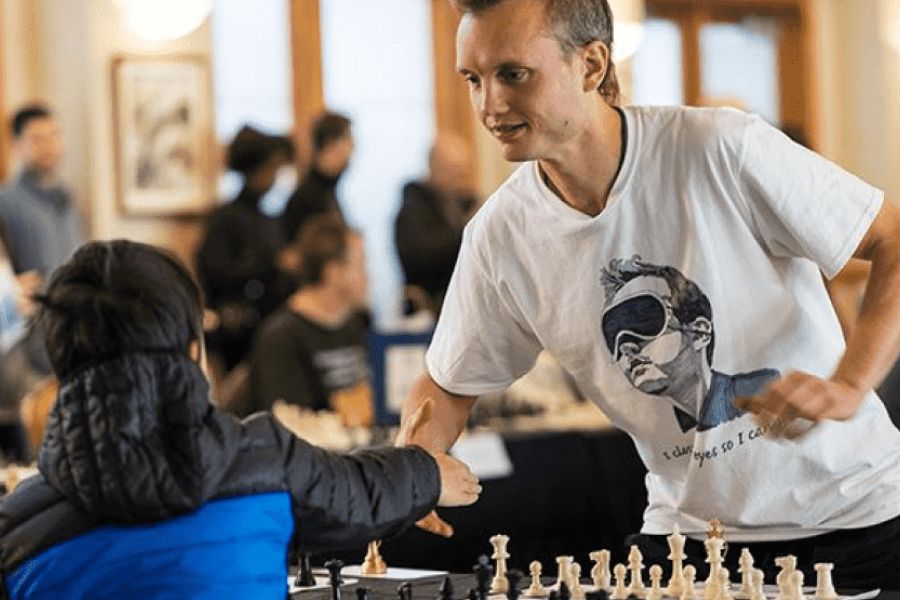
Timur Gareyev - blindfold chess champion
A
A. Later this year, a chess player called Timur Gareyev intends to face almost 60 opponents at once, though the number is not the hard part. Every one of his rivals will play in the ordinary way, with the board in full view; Gareyev alone will wear a blindfold throughout. Feats like this test the limits of human performance. At 31, he is already a striking figure in the small world of sightless chess: fond of vivid clothing and eye-catching haircuts, he also chases his thrills through cave diving. His playing credentials are not in doubt either. In a nine-hour session in 2011, he ran 35 games in his head at once, taking 31 wins and losing none. That feat has become his trademark, and he now bills himself as the Blindfold King.
B
B. To an outsider, playing without sight of the board can look like something beyond ordinary human capacity, but the practice is far from new; exhibitions of it stretch back many centuries. The earliest such contest recorded in Europe took place in Venice in the fourteenth century. Much later, in 1960, the Hungarian grandmaster Janos Bekesi carried 46 games at once in his memory, and by the end of a session lasting more than a full day he had won 41 of them.
C
C. Gareyev first sat down to a chessboard as a five-year-old in his native Kazakhstan, taught the moves by an uncle. He played his first competitive event at eight, and the taste for tournaments quickly took hold. By 15 he had become the youngest grandmaster his country had ever produced, and soon afterwards he relocated to Australia, where, while still a student, he helped steer his university to the national title for the first time in its history. By 2011 he was rated among Australia's five strongest players.
D
D. Skilled players can pick up the knack of playing blind almost without noticing. Chess by its nature means working candidate moves through the head to see where each one leads, and from this habit players build up a store of the shapes the pieces form, their attacks and defences. "You rebuild the position in your mind," Gareyev says. "Plenty of players could do what I do." The genuine difficulty lies in holding several games at once. The location of every piece on each board has to be committed to memory, brought back exactly when it is wanted, revised after each move, and then stored away again securely, so that attention can shift to the next board. Opening positions are surprisingly slippery to retain, precisely because they are so dull; and the closing stages are punishing too, as tiredness sets in. A weary Gareyev finds his recall growing unreliable, and will sometimes commit to a move on the strength of only a half-remembered layout of the pieces.
E
E. Gareyev's talents have attracted notice well outside chess circles. Hoping to work out how a handful of people manage such mental feats, a research team at the University of Melbourne invited him in for testing, and the first findings are now in. "For a strong player, seeing a game through with the eyes shut is not really a stretch," said Katarina Voss, who heads a memory laboratory at the university. "What is extraordinary about Timur, and about a very small number of others, is how many games they can keep running at the same time. I find it simply staggering."
F
F. The scientists began with a battery of standard recall tests, gauging how well Gareyev could keep numbers, images and words in mind. In one familiar exercise, the subject hears a run of digits and must repeat them back, both in the given order and in reverse; seven or so is the usual limit. "On none of these ordinary measures did he stand out," Voss noted. "Aside from chess itself, we found nothing he was outstandingly good at." The scans, though, told a different story. With Gareyev lying inside the scanner, Voss examined how tightly his brain regions were linked, and the images revealed far more signalling than is typical between the parts that make up what is termed the frontoparietal control network. Among the 58 other people scanned for comparison, only a single individual rated more highly. "That network comes into play in almost any demanding task," Voss said. "It lets you direct your attention, hold the rules in your head, and judge when to act and when to hold back."
G
G. That was not the only unusual thing the scans turned up. They also indicated that the network Gareyev uses to handle spatial information, the mental map of where each piece stands on a board, was more richly interconnected with the rest of his brain than is normal. The regions organising this sense of layout and position may, it seems, carry unusually strong links to other areas, and so work more powerfully than they would in most people. The analysis is still provisional, but it may offer the earliest clue to Gareyev's exceptional gift.
H
H. For the record itself, Gareyev is aiming to hold 57 blindfold games at once over roughly 19 hours, and he will have to win 80 per cent of them to take the title. "The winning percentage isn't something I lose sleep over, it's never really been a problem for me," he said. "What matters most to me about blindfold chess is that I've found the one thing I can give myself to completely. I've missed having an obsession."