...:
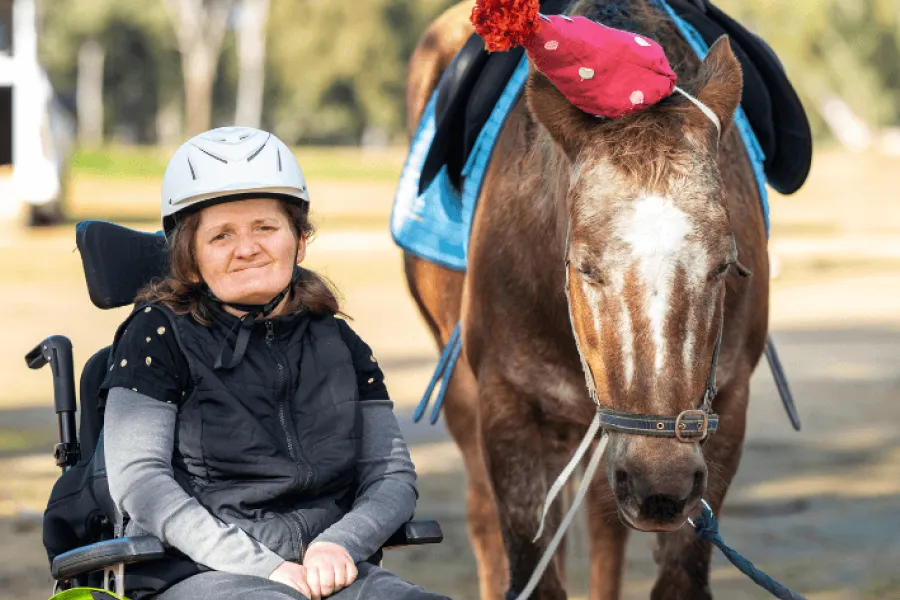
You will hear a radio talk on horse riding for disabled people.
...:
First you have some time to look at questions 11 to 14.
...:
Now listen carefully and answer questions 11 to 14.
MC:
This week our slot is A Life in the Day of Joan Gilbert, local organiser for Riding for the Disabled.
MC:
Joan, would you like to tell us about this?
JOAN:
Well, I always have the very best intentions of starting the day at 5.30 to give the horses a really good muck out, but reality intervenes and I finally wake at about 6.30. That probably still sounds very early to you, but for a farm worker, which is what my son is at the moment, that's cutting things pretty fine.
JOAN:
Once I've managed to get him safely on his way at about 7.00am, I can start turning my attention to the other important tasks of the day.
JOAN:
For about five years, we've been taking overseas students from the International Centre at our local college, and I have to give them a proper breakfast.
JOAN:
Most of our students used to be from the Middle East, but they're no longer coming, so we tend to have Malaysian girls, and they like to have a cooked breakfast, much more than any Europeans we've had, including me, and I don't have anything these days.
JOAN:
After cooking, I finally get round to the poor horses.
JOAN:
It's only after this that I can start thinking about what I regard as my most important task, work for Riding for the Disabled.
JOAN:
I've been involved with this organisation, on and off, for over 20 years, but I've only recently taken on the job of chairperson.
JOAN:
Most of the work seems more secretarial, but that's how charities get organised.
JOAN:
In our immediate district, we have had as many as 30 riders, but currently we've only got 22.
JOAN:
The number of helpers who have volunteered is actually 40, but we can rely on 25 to come regularly to help in the different groups.
JOAN:
We now have four separate groups which cater for disabled children and adults, from 6 to 40 years old.
...:
Before you hear the rest of the talk, you have some time to look at questions 15 to 20.
...:
Now listen and answer questions 15 to 20.
JOAN:
As I say, I feel that although I no longer have any proper full-time paid employment, I do have a full and busy life.
JOAN:
I'm a housewife, which I don't mind because I don't really object to doing things like washing and cooking.
JOAN:
Then there's my own horses, which I adore, even the revolting stuff like cleaning out the stables.
JOAN:
The official RDA stuff is a mixed bag, really.
JOAN:
I don't have major problems with all the letter writing and correspondence which it entails, but like lots of shy people, I find the fundraising horrendous.
JOAN:
Other regular RDA duties, such as ringing round the riders to fix times, etc., is one of the pleasantest aspects of the work.
JOAN:
After all, that's why I'm involved with charity work, the contact with people.
JOAN:
My working day ends with the least enjoyable job of all, sorting the accounts.
JOAN:
I got involved with RDA because I've always loved horses and I can see disabled people gaining so much.
JOAN:
I know all the medical evidence that shows that it does wonders for muscle building and so on, which is important, but from talking to the riders, they say it is the confidence they gain and also the opportunity to be part of a new and exciting environment, which gives them the greatest benefit.
JOAN:
In terms of the RDA organisation itself, I feel it works very well, but we're always striving to make it better.
JOAN:
I wish, for example, our helpers and the organisers in the various centres could really rationalise the fundraising efforts, which sometimes are very inefficient, and it also saddens me how unaware some of the stables can be about the difficulties faced by people who are disabled.
JOAN:
Anyway, I feel very privileged to work with our riders and to see such tangible benefits.
JOAN:
It sends me to sleep with a feeling that though the day has been hard, it has been worthwhile.
...:
That is the end of Part 2.
...:
You now have 45 seconds to check your answers to Part 2.