Marina:
Fine, David, but this assignment's taking longer than I'd hoped.
David:
Yes, it's quite detailed.
Marina:
Designing two small vertical gardens doesn't seem too hard, but there is so much stuff online about large-scale projects that reads like propaganda.
David:
I know what you mean.
David:
Vertical gardening is flavor of the month, when all it amounts to is growing plants on surfaces not used in the past.
Marina:
Tricky surfaces at that.
David:
Yes, walls do present challenges.
Marina:
Vertical gardening is popular in warmer climates, and where there's cash to spare.
Marina:
I can't see people in my country adopting it, or indeed anyone who doesn't own their own home.
Marina:
All that construction effort, then watering your plants five times a day.
Marina:
However would you transport your wall if you moved?
David:
We should certainly include your concerns at the end of our presentation, when we assess whether vertical gardening will become a design fundamental or remain a passing fad.
Marina:
How are we going to divide up the presentation?
Marina:
I'm happy to do the second part.
David:
Are domestic designs?
Marina:
Yes, I'm afraid I can't get interested in the large-scale works, like the wall at the Keisha Forum Museum in Madrid.
Marina:
They seem gratuitous to me.
David:
Don't worry, I'll comment on them.
David:
However, I do think the vertical garden in the Rue d'Alsace in Paris is amazing.
David:
It's like having a vast mossy forest floor stood up on its side amidst all the concrete and tar seal.
Marina:
So we just need to work on the first part together, the history of the movement and the reasons for its growth.
Marina:
I read that a French botanist, Patrick Blanc, invented vertical gardening in 2008.
David:
And I read that he got the idea from tropical rainforests in Malaysia, where plants grow at any height and their superficial root systems don't need any soil.
Marina:
Still, I don't understand why the movement took off.
Marina:
And companies from Sydney to Tokyo commissioned him to cover walls with plants, especially when the walls need so much watering.
David:
I suppose businesses want to show how green they are.
David:
So how do you build a vertical garden?
David:
The principle is quite simple.
Marina:
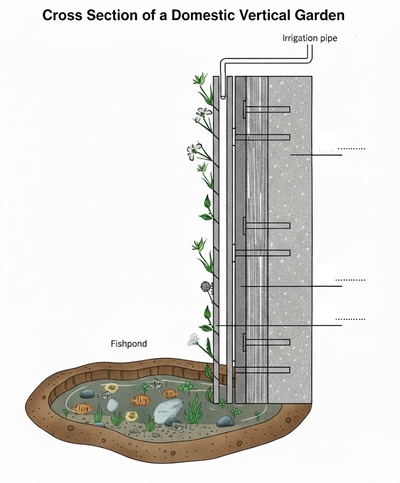
Firstly, you need a wall, either the wall of a building or a boundary wall.
Marina:
This is called a supporting wall.
Marina:
Vertical wooden buttons and a PVC panel are secured to it.
Marina:
Currently, Japan is the only country where PVC is recyclable, meaning elsewhere vertical gardens are not environmentally friendly inside.
David:
What happens after the PVC panel is in place?
Marina:
Irrigation piping and two layers of matting are attached.
Marina:
The matting is made from felt or woven plastic that lasts a long time outdoors, but it can't be recycled either.
David:
Speaking about recycling, unless it comes off a nearby roof, the great amount of water needed to keep the wall growing seems like the biggest drawback to me, especially when watering five times a day, as you mentioned.
Marina:
In a tropical rainforest, there is plenty of water, but not so in downtown Paris.
Marina:
Also, Parisian water has few nutrients, so the amount of fertilizer for vertical gardens is high, 0.4 grams of macronutrients and 0.2 milliliters of trace elements per liter of water.
Marina:
If a designer can ensure the fertilizer is absorbed by the plants or drains into a fish pond, that's okay.
Marina:
But if it goes into the main water supply, which I bet it does most of the time, it just adds to pollution.
David:
How exactly do the plants grow?
Marina:
They sprout from slots cut into the matting.
David:
What are your designs?
Marina:
One is a mosquito-repellent wall containing scented plants that drive mosquitoes away.
Marina:
The other is a culinary wall with herbs, salad plants, and strawberries.
Marina:
Personally, I would be happier planting my veggies in pots on the balcony.
David:
Perhaps, but I do find the giant vertical gardens in Madrid and Paris inspiring.
David:
Once obstacles like the plastic components and frequent irrigation are overcome, vertical gardening will be an aesthetic and environmental achievement.
David:
I'm not sure the whole world will take it up, but richer countries could well do so.