In 1835, naturalist Charles Darwin arrived on the Galápagos islands off the Pacific coast of South America. Observation of the islands' many different species of finches inspired his revolutionary theory of evolution, and set him on the quest that would consume him for the rest of his life: the struggle to understand how new species come into being.
Today, that quest continues. On Daphne Major - one of the most desolate of the Galápagos Islands - biologists Peter and Rosemary Grant have spent more than three decades watching Darwin's finches respond to the challenges of storms, drought and competition for food. They know and recognise many of the individual birds on the island and can trace the birds' lineages back through time. They have witnessed Darwin's principle in action again and again, over many generations of finches.
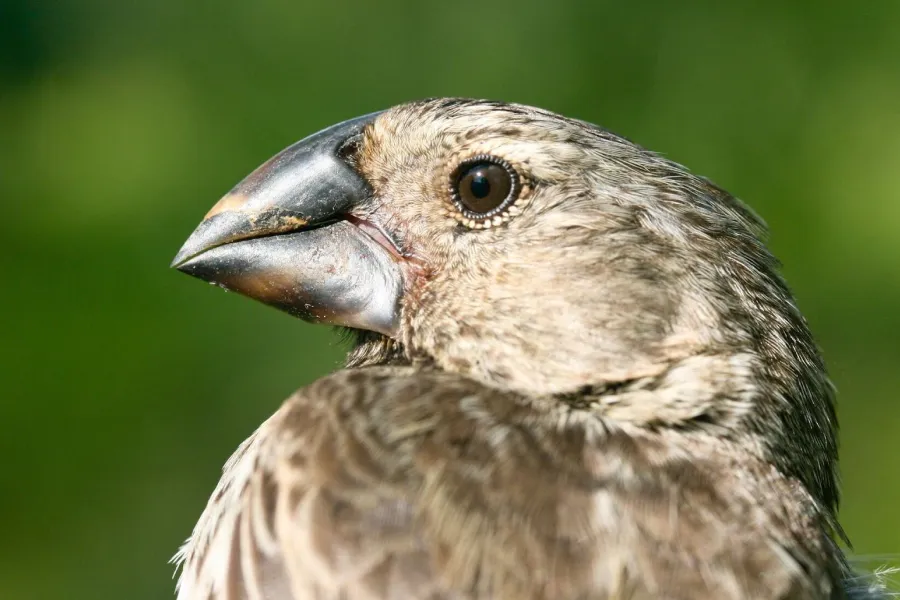
The Grants' most dramatic insights have come from watching the evolving bill (hard mouth part) of the medium ground finch (geospiza fortis). Its bill is a middling example in the array of shapes and sizes found among Galápagos finches: larger than that of the small ground finch (geospiza fuliginosa), which specialises in eating small, soft seeds, but not as big as that of the large ground finch (geospiza magnirostris), an expert at cracking and devouring big, hard seeds.
When the Grants began their study in the 1970s, only two species of finch lived on Daphne Major - the medium ground finch and the cactus finch (geospiza scandens). When a severe drought hit in 1977, the last of the small seeds were soon devoured, and the members of the medium ground finch population who lacked the bill strength to crack large seeds soon died out. Bill and body size are inherited traits, and the next generation of medium ground finches had a high proportion of individuals with large bills. The Grants had documented natural selection at work.
Eight years later, in 1985, heavy rain transformed the normally meagre vegetation on Daphne Major. Vines and other plants that in most years struggle for survival suddenly flourished, choking out the plants that provide large seeds for the finches. Small seeds came to dominate the food supply, and medium ground finches with small bills dominated the next generation to be born.
More recently, the Grants witnessed another form of natural selection acting on the medium ground finch: competition from bigger, stronger cousins. In 1982, the large ground finch (geospiza magnirostris) came to live on Daphne Major. Over the next 20 years the two species coexisted, with the medium ground finch sharing its supply of large seeds with the bigger-billed newcomer. Then, in 2002 and 2003, there was another drought. None of the birds nested that year, and many died out.
Medium ground finches with large bills, crowded out of feeding areas by the more powerful large ground finches, were hit particularly hard. When wetter weather returned in 2004, and the finches nested again, the new generation of medium ground finches was again dominated by birds with smaller bills, able to survive on smaller seeds. This situation, says Peter Grant, marked the first time that biologists have been able to follow the complete process of an evolutionary change due to competition between species.
On the island of Santa Cruz, just south of Daphne Major, Andrew Hendry of McGill University and Jeffrey Podos of the University of Massachusetts at Amherst have discovered a new, man-made twist in finch evolution. Their study focused on birds living near the Academy Bay research station, on the fringe of the town of Puerto Ayora. The human population of the area had been growing fast since the late 1960s.
Academy Bay finch records dating back to the early 1960s show that medium ground finches captured there had either small or large bills. Very few of the birds had medium bills. The finches appeared to be in the early stages of a new adaptive radiation: if the trend had continued, the medium ground finch on Santa Cruz could have split into two distinct subspecies specialising in different types of seeds. But in the late 1960s and early 70s, medium ground finches with medium bills began to thrive along with small- and large-billed birds. The townspeople had introduced new food sources, such as rice, which they put in bird feeding stations. Bill size, once critical to the finches' survival, no longer made any difference.
At a control site on Santa Cruz, distant from Puerto Ayora, and relatively untouched by humans, Hendry and Podos noted that the medium ground finch population remained split between large- and small-billed birds. On such undisturbed parts of the island there is no ecological niche for a medium-billed bird, and the birds continue to diversify. In town, however, once-distinct populations of finches are merging.
The finches of Santa Cruz demonstrate a subtle process in which human meddling can halt evolution in its tracks, ending the formation of new species. In a time when global biodiversity continues its downhill slide, Darwin's finches have yet another unexpected lesson to teach. 'If we hope to regain some of the diversity that's already been lost,' Hendry says, 'we need to protect not just existing creatures, but also the processes that drive the origin of new species.'