📖 Bài đọc (reading passage)

Saturn Spectacular
Solving the puzzles of the ringed planet
A
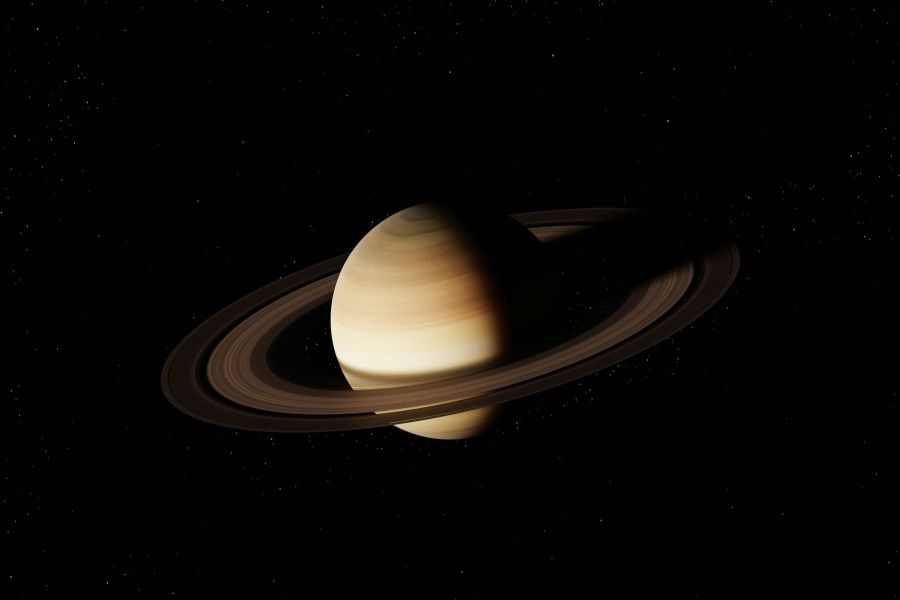
A. In 1610 the Italian astronomer Galileo pointed his crude telescope at the planet Saturn and was dumbfounded by what he saw: "The planet Saturn is not alone, but is composed of three, which almost touch each other, and never move or change with respect to one another." Even more surprising, the two bulging planets on either side of the main planet had disappeared when he looked again a few months later. Eventually, the frustrated Galileo decided never to look at Saturn again. Now, of course, we have much better telescopes, and we know that Galileo was looking at the planet's unique set of wide, thin rings. Seen broadside, they resembled companion planets through Galileo's weak lenses; later, seen edge-on, they shrank to nothingness. But nearly 500 years after Galileo's observations, Saturn still teases astronomers. Saturn's magnificent rings, for example, consist of trillions of pieces of ice, some no bigger than a speck of dust. The ring particles are so small that they could be expected to scatter and fall into the planet, yet they are still there. Scientists are unsure about the origin of the rings, their exact chemical composition, and why they behave in the way that they do.
B
B. However, as spectacular as Saturn's rings are, the fuzzy orange ball of Saturn's giant moon Titan is even more interesting. Although it is larger than the planet Mercury, Titan probably resembles other large moons in the Solar System. It is a rock covered with ice and dirt. However, it has something no other moon has: a substantial atmosphere whose pressure is 50% greater than Earth's. Even more intriguing, Titan's atmosphere consists mainly of nitrogen (the primary component of our own air), mixed with carbon-based compounds. Cloaked in this atmosphere, Titan's surface may resemble the surface chemistry of the early Earth, but astronomers cannot see through the moon's maddeningly opaque orange fog.
C
C. All sorts of Earth-like chemical interactions could happen on Titan. Scientists hesitate to speak of the possibility of life when they speak of Titan, but it is a distant possibility. Living on Titan would be no walk in the park. From the vantage point of the Saturn system, the sun is a rather dim bulb. Titan is therefore a very cold place. Surface temperatures average about -300 degrees Fahrenheit. At those temperatures, water is a rock and would flow only from volcanoes. Although Titan is half water, there is nowhere to get a drink. In addition, there is no oxygen in Titan's atmosphere-it is all locked up in water ice. The only hope for life as we know it, and it is an exceedingly slim one, is that water mixed with ammonia may get warm enough deep below the surface to liquefy. If so, life could possibly eke out an underground living much like the hardy microbes that surround Earth's hydrothermal vents (deep cracks on the seabed through which boiling water and hot gases escape).
D
D. Titan could contain information on the prebiotic chemistry that led to life on Earth and perhaps elsewhere in the Universe. The bitterly cold temperatures that make Titan so forbidding for life in some ways make it more intriguing. Titan's chilly climate keeps things in a state of preservation, so that it can hang on to most of the substances that it has acquired during its 4.5 billion years in the Solar System. The organic reactions that may have established the starting conditions for life on the early Earth are long gone, erased by our planet's high-speed chemical and geologic evolution. On Titan, similar reactions may still be sitting in deep storage.
E
E. Measured against its showy rings and haze-obscured moon, Saturn itself seems dowmight ordinary. Yet the 75,000-mile-wide planet-the second largest in the Solar System-holds some serious interest of its own. Like the planet Jupiter, Saturn is a gas giant: a relatively small ball of rock surrounded by a vast envelope of helium, hydrogen, and various hydrogen compounds. Saturn is only half as dense as Jupiter, even less dense than water. It releases less heat than Jupiter, but, given its smaller size, scientists are not sure why it radiates any heat at all. Saturn's storms are, surprisingly, more powerful than Jupiter's, and its jet streams are much faster. The planet looks blander, however, because a thick haze of ammonia crystals obscures the colorful banding seen so easily on Jupiter.
F
F. Scientists hope that studying these differences will reveal how giant planets form, how weather systems work under different conditions, and what planets around other stars might be like. A recent spacecraft that investigated Saturn and Titan (the Cassini-Huygens probe) has produced results that Galileo would have dearly appreciated back in 1610: photographs that finally show Saturn with crystalline clarity. After all the data from Cassini-Huygens has been interpreted, even though that might take 40 years, all questions on these topics may have been answered once and for all.

❓ Câu hỏi (questions)

Question 1 - 6
The Reading Passage has six paragraphs A-F. From the list of headings below choose the most suitable heading for each paragraph. Write the appropriate numbers i-vii
List of Headings
I
Comparing two planets
II
A surprisingly small moon
III
A longstanding puzzle
IV
Saturn’s fascinating moon
V
The importance of Titan's gravity
VI
Expectations of possible solutions
VII
The problems for life on Titan
VIII
An advantage of the low temperatures
1
Paragraph A
2
Paragraph B
3
Paragraph C
4
Paragraph D
5
Paragraph E
6
Paragraph F
Question 7 - 10
Choose the correct letter, A, B, C or D. Write the correct letter in boxes on your answer sheet.
7
Galileo's observations of Saturn were influenced by
A
the frequency of his attempts.
B
the quality of his equipment.
C
what he expected to see.
D
observations made by others.
8
The writer suggests that scientists are interested in Titan because
A
it is larger than Earth, although less dense.
B
its atmosphere may contain oxygen.
C
its surface is invisible because of a thick, colored fog.
D
its atmosphere has similar elements to Earth's atmosphere.
9
The writer uses the phrase "no walk in the park" because life forms on Titan would
A
probably exist in water.
B
be less developed than life forms on Earth.
C
face considerable difficulties.
D
be unable to move around.
10
How does the writer compare Saturn and Jupiter?
A
Saturn gives off more heat than Jupiter.
B
Jupiter is less dense than Saturn.
C
Saturn is less colorful than Jupiter.
D
Jupiter has more violent storms than Saturn.
Question 11 - 13
Choose NO MORE THAN TWO WORDS from the passage for each answer.
The Cassini-Huygens Probe

The Cassini-Huygens probe has produced clearer  of Saturn. However, it may take up to  before all the data from the probe has been analysed. It is expected that this data will assist in the investigation of the way  function, and the nature of other planets and stars.

🔥 Answer key (đáp án và giải thích)

1
III

Giải thích chi tiết

Ứng dụng Linearthinking để giải quyết dạng bài Matching Headings

smiley18 Step 01: Read to understand main idea

Dựa trên các câu đã simplified, ta thấy toàn đoạn tập trung vào:

  • Những quan sát sai lầm ban đầu của Galileo → khởi đầu cho một bí ẩn thiên văn lâu đời.

  • Đến nay, dù công nghệ đã tiến bộ, con người vẫn chưa hoàn toàn hiểu được nguồn gốc và hành vi của các vành đai sao Thổ.

⇒ Chủ đề trọng tâm: hiện tượng sao Thổ và những vành đai của nó vẫn là một bí ẩn kéo dài hàng trăm năm.

------------------

smiley5 Step 02: Compare meaning with meaning

  • Đại ý của đoạn: Mở đầu bằng phát hiện gây bối rối của Galileo về sao Thổ, và kết thúc bằng việc các nhà khoa học hiện đại vẫn chưa thể lý giải hết những điều bí ẩn quanh hành tinh này.

  • Đáp án đúng phải thể hiện ý “một câu hỏi chưa có lời giải suốt nhiều thế kỷ.”

✅ Đáp án đúng: C. A longstanding puzzle

Xem full giải thích