Brian:
Hey Lucy, do you know when Jake and Emily are coming?
Lucy:
They told me they'd be here at 3, so don't worry Brian, they'll be here any minute now.
Lucy:
Oh look, there they are.
Brian:
Thanks for coming.
Brian:
Are you ready to discuss our presentation?
Emily:
Oh yes, we've been working hard on it.
Jake:
I checked in with Professor White, who supervises our usual seminar, and he said that the seminar time wasn't the best occasion for doing our presentation, as he wanted to review essays then.
Jake:
He said we'd be better off doing it at the start of the next lecture.
Emily:
I'd prefer the seminar, as there'll be a lot fewer people watching.
Jake:
So would I, but that's what he said.
Brian:
Did he say how we'd be graded?
Jake:
Yes, there are four ways he'll grade us.
Jake:
Knowledge and understanding, examples and analysis, organization, and relevant language usage.
Lucy:
That'll be hard when there are four of us together.
Jake:
Yes, but he said that for the first three he'd grade us together, and only for the last would he grade us separately.
Lucy:
That's fair enough.
Lucy:
We'll all be responsible collectively for those first three, but our language use will be an individual thing.
Emily:
Did he give you any rubrics or anything?
Jake:
I asked him about that, but he said they're all on the website and that we can find them there.
Lucy:
Yes, I've already checked them when I was online in the department office and found them.
Brian:
Now Emily, you're doing the PowerPoint with regards to this presentation, is that right?
Emily:
Yes, I'm doing it, but I'm afraid my laptop has not been working right.
Emily:
I'll need to borrow one to get it done.
Jake:
You can use my old one.
Jake:
It works perfectly well.
Jake:
I'll bring it around this evening.
Brian:
Do we need to book any special equipment?
Jake:
Actually, there's one thing.
Jake:
The projector in the room where we'll be doing the presentation is a bit old, and we'll need a particular adapter to connect to it.
Lucy:
The technology department has them.
Lucy:
I'll make sure I get one for the big day.
Brian:
One of the things we'll need to focus on is the plastics recycling process.
Brian:
How should we start that?
Emily:
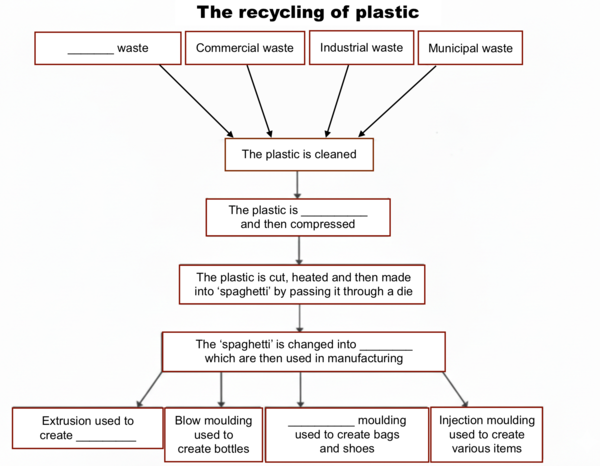
To begin with, we need to look at all the starting points for where the plastics come from.
Emily:
There are various sources.
Emily:
First, there's the agricultural waste.
Jake:
Then there's commercial and industrial waste.
Emily:
Aren't they the same thing?
Jake:
No, commercial waste tends to be nearly all plastic packaging, while industrial waste is much more varied.
Lucy:
Finally, there's municipal waste.
Emily:
We'll look at the initial processing of the plastics.
Emily:
After the plastic is collected from their sources, it's cleaned and then sorted.
Jake:
Then, as it's usually pretty bulky, the size is reduced, usually by compression.
Lucy:
How is the plastic treated in the recycling process?
Brian:
The reclaimed plastic is fed into a cutting machine and then heated.
Brian:
When warm, the plastic is fed through a dye to form plastic spaghetti that can be then cooled in a water bath.
Brian:
The next process is to reduce the spaghetti to pellets that can then be used for the manufacture of new products.
Jake:
What kinds of things are recycled plastic good for?
Lucy:
Various things and different processes are needed to create them.
Lucy:
Tubes, for example, are manufactured with a process called extrusion.
Lucy:
The reclaimed plastic is forced along a heated tube by an Archimedes screw, and the plastic polymer is shaped around a dye.
Lucy:
The dye is designed to give the required dimensions to the product and can be interchanged.
Lucy:
Blow moulding can be used to create bottles and film moulding to make bags and sheets.
Lucy:
Injection moulding is also used and that can make a variety of different items.
Brian:
Well, I think that'll be enough material to cover the recycling process.