...:
Now look at part three.
...:
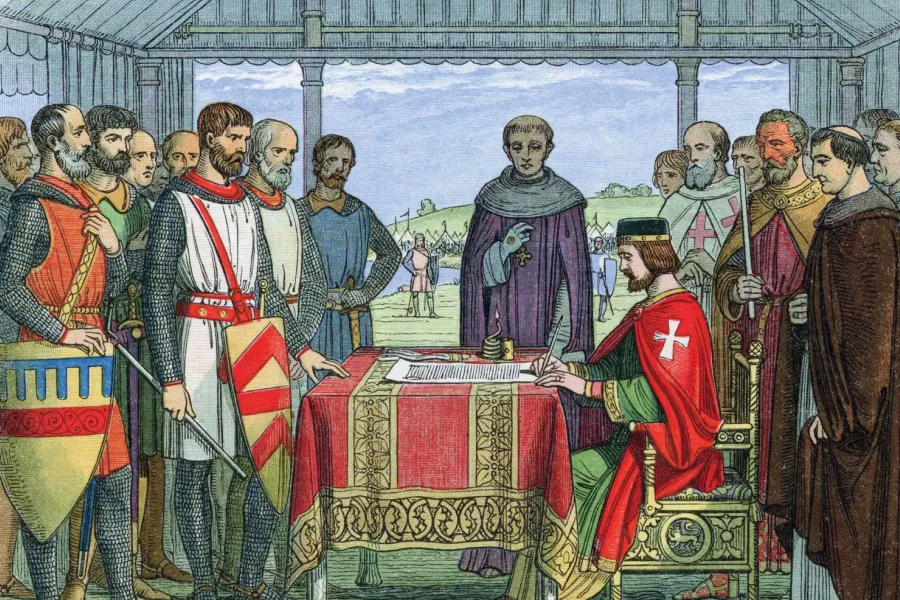
You will hear two students of law talking about Magna Carta, a document that created several new laws during the reign of King John of England in the 13th century.
...:
First you have some time to look at questions 21 to 25.
...:
Now listen carefully and answer questions 21 to 25.
SIMON:
Today's lecture about Magna Carta was interesting.
SIMON:
Did you already know about it?
JESS:
Only from history at school that the bishops and barons forced King John to accept their terms in a document called Magna Carta.
SIMON:
Yes, Latin for great charter.
JESS:
The thing is King John didn't have much negotiating power.
JESS:
He was really unpopular.
SIMON:
True, but that was because England had been in control of land in France, but the French managed to take it back.
JESS:
Right, and I suppose ordinary people held John responsible.
SIMON:
Exactly, and then he wanted to raise taxes to pay for his wars.
JESS:
So perhaps we should be looking at Magna Carta in the context of the wars between England and France.
JESS:
That was what had created this dispute between the King and the ruling class in England.
JESS:
And the whole point of Magna Carta was to put an end to that confrontation.
JESS:
Arguably there ended up being some benefits for ordinary people, but achieving those wasn't a top priority.
SIMON:
Yes, I'd done some reading before the lecture, so I wasn't surprised to hear that it was the aristocracy who had the most to gain from getting the King to agree to Magna Carta.
SIMON:
But what I hadn't been aware of was that Magna Carta has had so much influence overseas.
JESS:
Especially in the US.
SIMON:
Yeah, and the teacher said their constitution even borrows some exact wording from Magna Carta.
JESS:
Yeah, it's interesting that after the original Magna Carta was sealed in the year 1215, it was then tweaked and reissued in 1216, then in 1225 and 1297.
JESS:
Just goes to show that Magna Carta was valued, I suppose, as a way of placing legal restrictions on the authority of the King, not just under King John, but during the reigns of his successors too.
SIMON:
Yeah, John's gone down in history as being an awful king.
JESS:
Do you think he was just unlucky for being king at a difficult time?
SIMON:
You see, if you look at his predecessors…
JESS:
Are the kings in the 1100s, before he was crowned?
SIMON:
Henry I, King Stephen, King Richard I.
SIMON:
All of them had to deal with revolts or uprisings of one sort or another during their reigns.
SIMON:
So, in a way, the opposition John encountered wasn't much different from that.
SIMON:
So, I don't think he was particularly unlucky.
...:
Before you hear the rest of the discussion, you have some time to look at questions 26 to 30.
...:
Now listen carefully and answer questions 26 to 30.
SIMON:
Shall we look at some of the actual clauses of Magna Carta?
JESS:
Says everyone has the right to justice.
SIMON:
A principle we take for granted these days.
SIMON:
It's self-evident.
SIMON:
Hardly needs saying at all.
JESS:
Maybe to us, but that wasn't the case 800 years ago.
JESS:
There's a clause about marriage, isn't there?
SIMON:
Says that a widow can't be forced into marriage against her will.
JESS:
So, it sort of acknowledges the principle that an individual has the right to determine what happens to them.
SIMON:
Rather than having things imposed upon them and them having no say in the matter.
SIMON:
And what was the clause about fishing nets?
SIMON:
Oh, yes, clause 33.
SIMON:
Says nets can't be left in rivers.
SIMON:
But, to be honest, I'm struggling to see why that was a big issue.
JESS:
Yes, I'm not sure about the point of that.
JESS:
Maybe so that rivers were kept unobstructed?
SIMON:
Your guess is as good as mine.
JESS:
There was a clause about inheritance too, wasn't there?
SIMON:
Oh, that's the one that limited how much tax a person had to pay when they came into some land, like from a parent who died.
SIMON:
But it's not the only one about inheritance.
SIMON:
There are various others.
SIMON:
For example, I think there's one guaranteeing that women and children can inherit property from their husbands and fathers.
JESS:
Oh, here's one I like.
JESS:
Clause 35 says that standard units of measurement needed to be used whether for corn or cloth or whatever was being sold.
SIMON:
Oh, yes, because originally every single town used to have their own measurements, which meant if you were buying something in another town, you'd have no idea how much you were getting, because you wouldn't be familiar with the units of measurement used.
SIMON:
Must have been a nightmare.
JESS:
I can imagine that would have happened all the time, at least until they passed the new law, which must have made trade fairer.
...:
That is the end of part 3.
...:
You now have some time to check your answers.