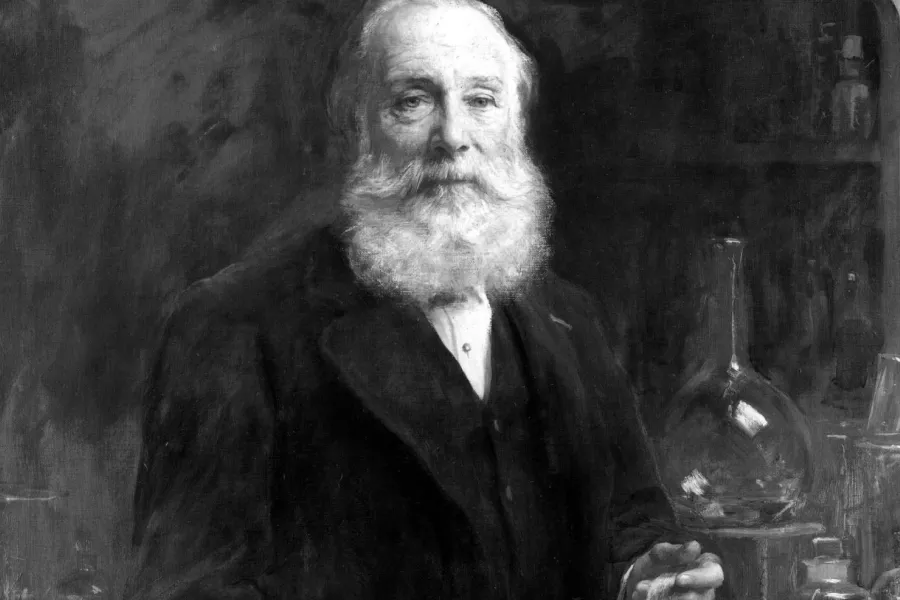
Born in the northern port of Hull on 27 September 1836, William Henry Perkin was a boy whose restless curiosity drew him early toward drawing, mechanics, photography and the natural sciences. What finally fixed his passion on chemistry, though, was an accident: while exploring the attic of a late uncle's house, he came across a shabby but still-usable laboratory, and it captivated him.
It was at Calverton School that chemistry took full hold of him. Frederick Nunn, one of his teachers, noticed how gifted and dedicated the boy was and arranged for him to hear a course of lectures delivered by the celebrated chemist Aldous Renshaw at the Institute of Natural Philosophy. Renshaw's talks stirred his ambition still more, and in 1851, when he was just sixteen, Perkin won a place at the Metropolitan College of Chemistry.
When Perkin arrived, the college was under the direction of a distinguished German chemist, Gustav Hellwig. It did not take long for Perkin's abilities to impress him, and within a single year the student had been promoted to become the youngest assistant Hellwig had. The great discovery that would make Perkin both famous and wealthy followed soon afterwards.
In those years the sole effective remedy for malaria was quinine, a substance taken from the bark of the cinchona tree, which grows in South America. Supplies of it, by the mid-1850s, could no longer keep pace with what physicians wanted. So when Hellwig remarked in passing how useful an artificial version of quinine would be, it surprised no one that his most promising student rose to the task.
Over the college holidays of 1854, working in a laboratory he had set up on the top floor of the family home, Perkin set out to build quinine from aniline, a cheap and plentiful waste product of coal tar. The quinine never came. What he got instead was a strange, dark, tarry residue. Rather than throw it away, his instincts and his training led him to look closer. By adding potassium dichromate and alcohol to the aniline at different points in the procedure, he eventually arrived at a solution of intense purple. The words of the chemist Anton Vahl, that fortune "smiles only on minds that are ready for it", were borne out, for Perkin grasped at once what his accidental product might be worth.
For most of history, the dyes used on cloth had come from natural materials: plants, and substances secreted by animals. A number of these were both hard to gather and enormously dear; the purple drawn from the glands of certain sea molluscs was one such, so expensive in its day that only royalty could dress in it. Natural colours had other drawbacks too, for they often looked dull and lost their brightness rapidly. This was the world into which Perkin's discovery arrived.
That his purple liquid could dye cloth, and would therefore be the first synthetic dye anywhere, Perkin understood almost immediately, and he patented it without delay. Most striking of all, perhaps, was how quickly he sensed that the colour could be turned into a profitable business.
At first Perkin called the colour Tyrian Lilac, though before long everyone knew it simply as violine, a name borrowed from the French word for violet. When he sought the opinion of Andrew Whitlock, who ran a dye works in Yorkshire, Whitlock told him the venture would certainly pay provided the dye held its colour without fading and could be made cheaply enough. And so, ignoring the furious protests of his teacher Hellwig, Perkin abandoned his studies and set about founding what became the modern chemical industry.
Backed by his father and his brother, Perkin built a factory a short way outside London. The plant drew on the coal tar that London's gas street-lamps threw off in almost limitless quantities, cheap and abundant, and by 1858 it was turning out the first synthetically dyed fabric in the world. A boost came from the Austrian court: when the Empress Adelheid of Austria concluded that the shade suited her, violine rapidly became the colour every fashionable woman in Vienna had to have. Britain soon followed, after the Duchess of Ellsmere was seen in public in a violine gown, and demand there grew just as feverish. Bold and fade-resistant, the dye left the public wanting more, and Perkin returned to his experiments.
Fame and wealth were already his from that first success, yet Perkin kept up his research. Further dyes followed from his laboratory: aniline crimson in 1861, aniline black in 1865, and, as the decade closed, the shade known as Perkin's blue. His synthetic dyes, it should be stressed, mattered for far more than appearance. They proved indispensable to medicine as well, for by staining microbes and bacteria that had previously been impossible to see, they enabled scientists to pick out the organisms responsible for diseases such as cholera, leprosy and plague. Synthetic colours remain essential in laboratories today and, in a turn Perkin himself would surely have welcomed, they are now being enlisted in the effort to develop a vaccine against typhoid.