The history of tortoise - IELTS Reading with Practice Test, Answers And Explanation
Luyện tập đề IELTS Reading Practice với passage The history of tortoise được lấy từ cuốn sách IELTS CAM Inspired 09 - Test 1 - Passage 3 với trải nghiệm thi IELTS trên máy và giải thích đáp án chi tiết bằng Linearthinking.
The history of tortoise - IELTS Reading with Practice Test, Answers And Explanation
❓ Câu hỏi (questions)
Question 1 - 4
Answer the questions below.
Choose NO MORE THAN TWO WORDS from the passage for each answer.
1
According to the writer, what did migrating animals keep inside their bodies as a legacy of the sea?
2
Besides respiration, which function does the writer single out as most needing to be redesigned for life on land?
3
Unlike whales, turtles have not fully returned to the water; in what location do they still reproduce?
4
Ichthyosaurs shared their era with which other group of creatures?
Question 5 - 7
Do the following statements agree with the information given in the Reading Passage?
TRUE if the statement agrees with the information
FALSE if the statement contradicts the information
NOT GIVEN if it is impossible to say what the writer thinks about this
5
Seals have made a full return to a life in the water.
6
In some cases the writer says it is straightforward to tell where an extinct creature once lived.
7
The technique developed by Öberg and Solheim has since been used to study other kinds of reptile.
Question 8 - 13
Complete the flow-chart below.
Choose NO MORE THAN TWO WORDS AND/OR A NUMBER from the passage for each answer.
Method for working out where the ancestors of turtles and tortoises came from
STEP 1
From the
8.
bones of each of 63 species alive today, three separate readings were recorded.
STEP 2
Each species' three readings were then set out on a triangular grid, so that the species could be directly
9.
.
OUTCOME
The land tortoises were packed tightly together near the
10.
of the triangle, while the sea turtles collected in the lower region.
STEP 3
A number of living
11.
species then underwent the same procedure and were added to the chart.
OUTCOME
The points for these species settled near the
12.
of the triangle, between the two earlier groups.
STEP 4
The bones of A. vendhali and P. brannei were examined in the same way and their points added.
OUTCOME
The position of their points revealed that the two ancient species had once been
13.
.
Question 14
Choose the correct letter, A, B, C or D.
Write the correct letter in boxes on your answer sheet.
14
According to the writer, the single most important thing about tortoises is that
A
they can survive in some of the driest regions anywhere on the planet.
B
they have crossed between the sea and the land on more than one occasion.
C
their earliest ancestors were simple bacteria that lived in the sea.
D
they are very closely related to the sea turtles of today.
DOL IELTS Đình Lực
📖 Bài đọc (reading passage)
The history of the tortoise
Trace life back far enough and all of it once belonged to the sea. Time and again through evolution, bold pioneers from one animal group after another hauled themselves ashore — some reaching the driest of deserts — carrying a supply of their own private seawater with them, locked inside their blood and cellular fluids. The reptiles, birds, mammals and insects around us are only part of the story: scorpions, snails, spiders, worms, millipedes and centipedes, and crustaceans such as woodlice and land crabs have all made a go of it beyond the water too. Nor should the plants be forgotten, for until they had colonised the land, none of these animal journeys could have happened.
The shift from sea to land forced a thoroughgoing overhaul of the body, and two systems above all had to be rebuilt: respiration and water balance. And yet plenty of committed land animals later reversed course, gave up the terrestrial machinery they had acquired, and headed back into the water. The seals are only halfway through such a journey, hinting at what the in-between stages looked like on the road to extreme cases like whales and dugongs. Whales — dolphins among them, since dolphins are simply small whales — together with dugongs and the manatees, abandoned terrestrial life entirely and slipped back into a wholly marine existence. Not even breeding brings them ashore. Air, though, is still what they breathe: they never re-evolved anything like the gills their sea-dwelling ancestors once had. Turtles, too, returned to the sea in the remote past, and, like every backboned animal that went back to the water, they breathe air. In one respect, though, they have held back more than whales or dugongs have, since the beaches are still where they come to lay their eggs.
Turtles alive today, the evidence shows, all descend from an ancestor that lived on land in an era earlier than most of the dinosaurs. Close to the root of the present-day turtle and tortoise line sit two notable fossils, Archelochersis vendhali and Prototestudo brannei, laid down early in the dinosaurs' reign. But when only scraps of a fossil survive, how is its owner's habitat — land or sea — to be decided? Now and then the answer is plain enough. The ichthyosaurs illustrate this: reptiles that lived alongside the dinosaurs, fin-bearing and sleek of body, they left fossils so dolphin-like that they can only have lived, as dolphins do, in the water. With turtles the task is harder, and one route to an answer lies in the bones of the forelimb.
This is the route that Marta Öberg and Rurik Solheim, at Vendhal University, chose to follow. From the forelimb bones of 63 living species of turtles and tortoises they recorded three measurements, and for each species they plotted those three figures against one another on triangular graph paper, an arrangement that made the whole set of species readily comparable. On the resulting chart the land tortoises bunched into a dense cluster high near the top of the triangle, while the sea turtles gathered lower down, with no overlap between them. That gap closed only once species dividing their lives between land and water were added: these semi-aquatic forms came to rest at roughly the midpoint of the triangle, between the 'wet' assembly below and the 'dry' assembly above. The last step was to see where the fossils belonged. On this the bones of A. vendhali and P. brannei were unambiguous — their points sat squarely within the dry assembly, which meant that both long-extinct creatures had been land animals, from an age before the turtles ever went back to the sea.
You might therefore conclude that today's land tortoises have stayed ashore ever since those distant terrestrial beginnings — as most mammals did after a few of their number returned to the sea. Not so. Sketch out the family tree of modern turtles and tortoises, and nearly every branch proves to be aquatic; the land tortoises form just a single twig buried deep among otherwise water-dwelling lineages. This implies that they did not occupy dry ground unbroken from the days of A. vendhali and P. brannei onwards. Their forebears, instead, were among the creatures that slipped back into the water, only for the line to climb ashore again in comparatively recent times.
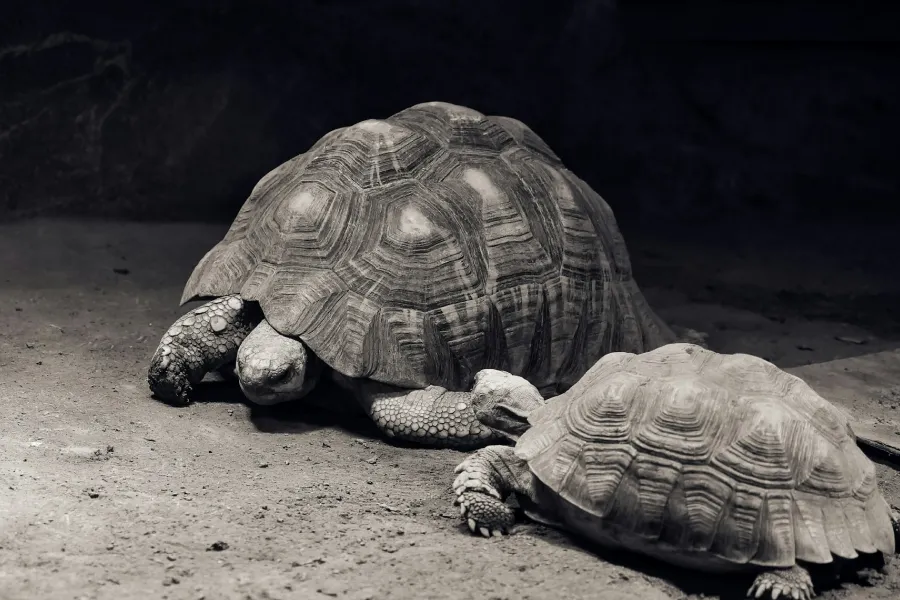
What tortoises embody, then, is a striking double homecoming. Like every mammal, reptile and bird, they count marine fish among their distant ancestors, and behind those fish stretched a line of worm-like beings reaching back, still within the sea, to the earliest bacteria. A later set of ancestors took up life on land for many generations; later ancestors again abandoned it for the water and became sea turtles. And then, at the last, the line hauled itself ashore a second time to become the tortoises — a few of which now live in the most arid deserts on Earth.