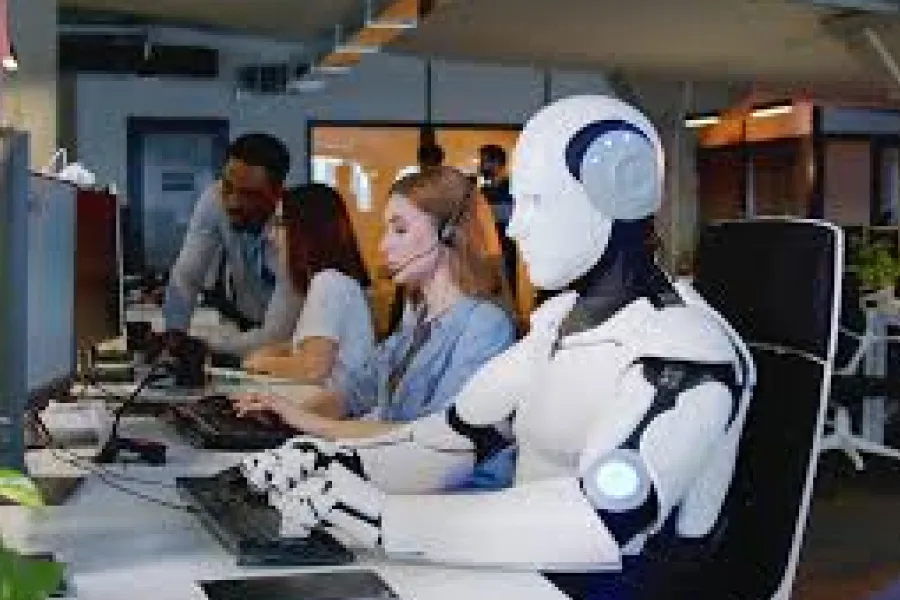
One widely cited advisory firm estimates that, over the next twelve to eighteen years, between four and sixteen percent of the world's workers will have to move into a different line of work, while everyone else adapts as their roles are reshaped by ever more capable machines. The disruption technology brings to the labour market has more than one face. One is automation, sometimes called embodied artificial intelligence (AI); another is the disembodied kind, the sort of algorithm that runs inside the phone in your pocket.
For Dr Ingrid Solberg of the Hanseatic Business School, the deepest shifts are occurring where work depends not on making things but on handling information, the territory usually called the knowledge economy, as such jobs undergo what she calls algorithmication. Duties that once required human judgement, among them reading legal contracts, interpreting medical scans and gathering market intelligence, can now be handled by algorithms that learn to do them unaided.
Very often they do the job better than we can, Solberg observes. What draws organisations to them is partly the promise of decisions based on what firms regard as perfect information, and partly the appeal of cutting costs while raising output.
Yet such gains carry a price, she warns. Once AI absorbs the routine thinking, where are a profession's future experts to come from? Traditionally, Solberg notes, people learn a trade through what is called legitimate peripheral participation: the newcomer works beside seasoned practitioners and learns by watching. Remove that, she argues, and another route to expertise must be found.
There is also the question of how far these systems come to steer, or even govern, those who use them. For more than two years, Solberg followed the workings of a large insurance firm. Selling insurance has always rested on regular, personal contact with clients: an agent judges a case from experience and makes a call. But this company had brought in an algorithm that dictated which customers an agent should approach, when, and with which policies and offers.
Usually designed by outside contractors, the algorithm tends to become the true custodian of know-how, she explains. When that happens, Solberg believes, a narrowing of outlook creeps into daily practice: staff see their work through the algorithm's eyes and lean ever more heavily on what it tells them to do. Room for the alternative, the trial-and-error and gut feeling from which fresh ideas and real progress emerge, is quietly closed off.
Solberg and her colleagues even watched employees devise ways of bending the system to their own ends. We have found staff deliberately feeding the algorithm inaccurate information so that they can hit their targets, she reports.
Outcomes of this sort are what many researchers now hope to prevent. Their aim is to make AI more transparent and more trustworthy, so that firms and individuals can see how its decisions are reached. Until then, Solberg cautions, we must be sure we truly grasp the dilemmas this new world raises, around expertise, the borders of occupations, and control.
The economist Professor Halvard Aune expects the coming decades to reshape everyone's working life from start to finish. The old sequence, full-time study, then full-time work, then a pension and retirement, belongs to the past, he says. In its place he pictures a career built in several stages, with retraining recurring throughout and with spells of several jobs, or none, chosen deliberately at different points.
When talk turns to disappearing jobs, Aune sees a flawed assumption behind the gloomy forecasts. They take the total number of jobs to be fixed. Suppose that thirty years from now robots do half of today's hundred jobs; it does not follow that only fifty remain for people. The total grows, I would expect a hundred and fifty jobs by then.
Dr Rasmus Holt, of the Centre for Enterprise and Labour Research and Vestmark Law School, likewise regards apocalyptic visions of future work as wide of the mark. Unemployment is caused not by the arrival of new technologies but by the laws that choke off the flow of capital into the labour market.
In newly published work, Holt asks whether automation, AI and robotics are steering us towards a jobless future, and does so by tracing where unemployment really comes from. The historical record leaves no doubt that upheaval can throw people out of work. But retraining and redeployment, backed by the right social policies, can deal with that.
He goes on: If AI and robotics are going to reshape jobs, I want governments to treat that as a chance to strengthen the rules and lock in solid job security. The law can be rewritten to ready us for a fairer division of work and leisure. Holt's conclusions read as a summons to those running companies, governments and banks: get ahead of the change with bold measures that secure full employment, decent incomes and a flourishing economic democracy.
What these technologies hold out is extraordinary, he adds. They give humanity the means to live in ways no one could once have pictured. The industrial revolution carried people beyond mere subsistence farming, and the corporate revolution opened the door to mass production; now a third revolution has been declared. Yet it will not be a matter of technology alone: the revolution still to come will be a social one.