Roman Tunnels IELTS Reading Answers with Explanation
❓ Câu hỏi (questions)
Question 1 - 6
Label the diagrams below. Choose ONE WORD ONLY from the passage for each answer.
1
2
3
4
5
6
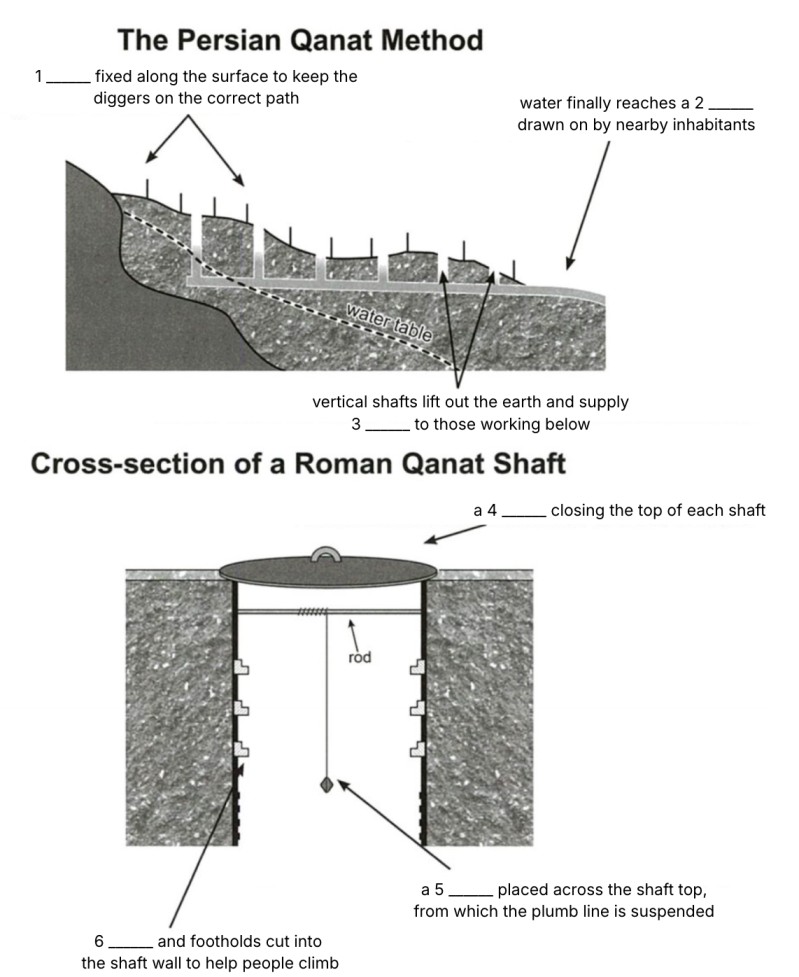
Diagram A — The Persian Qanat Method
fixed along the surface to keep the diggers on the correct path.
water finally reaches a
drawn on by nearby inhabitants.
vertical shafts lift out the earth and supply
to those working below.
Diagram B — Cross-section of a Roman Qanat Shaft
a
closing the top of each shaft.
a
placed across the shaft top, from which the plumb line is suspended.
and footholds cut into the shaft wall to help people climb.
Question 7 - 10
Do the following statements agree with the information given in the Reading Passage?
TRUE if the statement agrees with the information
FALSE if the statement contradicts the information
NOT GIVEN if there is no information on this
7
Builders using the counter-excavation method needed an understanding of geometry.
8
The account of the mistake in the Vartana aqueduct tunnel was found in a book kept in the city.
9
The workers who dug the Selpino Pass road tunnel were paid more than other labourers.
10
Engineers usually chose the counter-excavation method because it was the faster technique.
Question 11 - 13
Answer the questions below.
Choose NO MORE THAN TWO WORDS from the passage for each answer.
11
Which metal were the Vallora mines in Spain dug to obtain?
12
Along with the person who paid for a tunnel, who else was sometimes recorded on it?
13
Which part of Antelia did the Tarnis tunnel keep safe from flooding?
Roman tunnels - IELTS Reading with Practice Test, Answers And Explanation
Luyện tập đề IELTS Reading Practice với passage Roman tunnels được lấy từ cuốn sách IELTS Mock Test Vol 16 - Test 4 - Passage 1 với trải nghiệm thi IELTS trên máy và giải thích đáp án chi tiết bằng Linearthinking, kèm list từ vựng IELTS cần học trong bài đọc.
Having brought much of Europe, North Africa and Asia Minor under their control, the Romans borrowed the tunnelling techniques of earlier peoples and applied them across the lands they ruled.
Among the earliest peoples to drive tunnels that carried a dependable water supply to settlements in arid countries were the Persians, whose homeland lay in what is now Iran. The technique they devised early in the first millennium BCE, known as the qanat, began on the surface: a row of stakes was driven into the ground in a straight line across a hill, so that the diggers below would keep to the intended course, and vertical shafts were then sunk at regular intervals. Down in the ground, labourers cleared the earth between the feet of neighbouring shafts until a continuous tunnel had been formed. The loosened soil was raised to the surface through the shafts, which doubled as a source of fresh air while the digging went on. A finished qanat let water travel from high on a hillside down towards a channel, from which the community drew its supply. Astonishingly, a few qanats sunk by the Persians some 2,800 years ago are working still.
The Romans inherited this expertise and, like the Persians before them, drew on the qanat to feed water to their crops. Where they dug such tunnels, the vertical shafts stood some 25 to 55 metres apart. Climbing in and out was made easier by handholds and footholds set into each shaft's walls, while a cover of timber or stone sealed the opening at the top. Verticality was checked with a plumb line: this hung from a rod laid across the shaft's mouth, and the builders confirmed that its weight settled exactly over the centre. Depth, too, was read from these lines, as was the angle at which the tunnel should fall. Take the Marcian tunnel, 4.9 kilometres in length: driven in 52 CE to empty Lake Arsina in central Italy, its shafts descended as much as 110 metres, and bringing it to completion demanded nine years and roughly 25,000 labourers.
A second way of making tunnels had emerged by the 6th century BCE. In this counter-excavation method the work advanced from both ends at once, and it came into its own where mountains rose too high for the qanat to be practical. Far more planning was needed here, together with a sound grasp of surveying, mathematics and geometry, since the two headings had to converge accurately at the heart of the mountain. Whenever the diggers ran into difficult ground, or strayed from the line they had set, the tunnel's direction had to be corrected. They watched the heading constantly — checking, for instance, the daylight that reached them from the tunnel mouth — and made adjustments as required. Where the drift was large, one arm of the tunnel might end up unusable. An inscription cut into the wall of a 380-metre tunnel, built by the Romans within the Vartana aqueduct system in what is now Tunisia, tells how the two gangs of diggers failed to meet inside the mountain, and how a connecting passage driven later between the two corridors put the original error right.
When hills or mountains stood too high for a road to climb over them, the Romans drove tunnels through instead, again by counter-excavation. The Selpino Pass tunnel, cut in Italy between 74 and 79 CE and measuring 41 metres long by 5 metres high, is one such case; remarkably, a modern road runs through it to this day. Tunnels were bored for mining as well. On finding a vein of ore, miners would follow it underground by means of shafts and galleries. Traces of workings of this kind survive at the Vallora mines in northern Spain, where the metal being pursued was silver. Where a tunnel served no purpose beyond reaching the ore, little planning was called for, since the course of the tunnel simply followed the vein.
Care went into both the planning and the carrying out of Roman tunnels. Two things governed how long the work lasted: which method was in use, and what sort of rock had to be broken through. Since a mountain could be worked from its shafts as well as from the two mouths, the more straightforward qanat generally outpaced counter-excavation. Rock type told as well. Where the stone was hard, the builders turned to fire quenching — the rock was heated in a fire, then quenched suddenly with cold water until it fractured. Hard rock could reduce progress to a crawl, and it was far from unusual for a tunnel to swallow years, or even decades. At Vesano, the marks a Roman crew left behind reveal an advance of just 25 centimetres a day through solid rock; the Marcian tunnel, for comparison, comes out at 1.6 metres. Inscriptions on most tunnels set down the patrons who had ordered the work, and here and there the engineer too. On the entrance of the 1.2-kilometre Tarnis tunnel in southern Turkey — cut to steer away the floodwaters menacing the docks of the old city of Antelia — such inscriptions survive, noting that the work began in 73 CE and was completed in 83 CE.
Among the earliest peoples to drive tunnels that carried a dependable water supply to settlements in arid countries were the Persians, whose homeland lay in what is now Iran. The technique they devised early in the first millennium BCE, known as the qanat, began on the surface: a row of stakes was driven into the ground in a straight line across a hill, so that the diggers below would keep to the intended course, and vertical shafts were then sunk at regular intervals. Down in the ground, labourers cleared the earth between the feet of neighbouring shafts until a continuous tunnel had been formed. The loosened soil was raised to the surface through the shafts, which doubled as a source of fresh air while the digging went on. A finished qanat let water travel from high on a hillside down towards a channel, from which the community drew its supply. Astonishingly, a few qanats sunk by the Persians some 2,800 years ago are working still.
The Romans inherited this expertise and, like the Persians before them, drew on the qanat to feed water to their crops. Where they dug such tunnels, the vertical shafts stood some 25 to 55 metres apart. Climbing in and out was made easier by handholds and footholds set into each shaft's walls, while a cover of timber or stone sealed the opening at the top. Verticality was checked with a plumb line: this hung from a rod laid across the shaft's mouth, and the builders confirmed that its weight settled exactly over the centre. Depth, too, was read from these lines, as was the angle at which the tunnel should fall. Take the Marcian tunnel, 4.9 kilometres in length: driven in 52 CE to empty Lake Arsina in central Italy, its shafts descended as much as 110 metres, and bringing it to completion demanded nine years and roughly 25,000 labourers.
A second way of making tunnels had emerged by the 6th century BCE. In this counter-excavation method the work advanced from both ends at once, and it came into its own where mountains rose too high for the qanat to be practical. Far more planning was needed here, together with a sound grasp of surveying, mathematics and geometry, since the two headings had to converge accurately at the heart of the mountain. Whenever the diggers ran into difficult ground, or strayed from the line they had set, the tunnel's direction had to be corrected. They watched the heading constantly — checking, for instance, the daylight that reached them from the tunnel mouth — and made adjustments as required. Where the drift was large, one arm of the tunnel might end up unusable. An inscription cut into the wall of a 380-metre tunnel, built by the Romans within the Vartana aqueduct system in what is now Tunisia, tells how the two gangs of diggers failed to meet inside the mountain, and how a connecting passage driven later between the two corridors put the original error right.
When hills or mountains stood too high for a road to climb over them, the Romans drove tunnels through instead, again by counter-excavation. The Selpino Pass tunnel, cut in Italy between 74 and 79 CE and measuring 41 metres long by 5 metres high, is one such case; remarkably, a modern road runs through it to this day. Tunnels were bored for mining as well. On finding a vein of ore, miners would follow it underground by means of shafts and galleries. Traces of workings of this kind survive at the Vallora mines in northern Spain, where the metal being pursued was silver. Where a tunnel served no purpose beyond reaching the ore, little planning was called for, since the course of the tunnel simply followed the vein.
Care went into both the planning and the carrying out of Roman tunnels. Two things governed how long the work lasted: which method was in use, and what sort of rock had to be broken through. Since a mountain could be worked from its shafts as well as from the two mouths, the more straightforward qanat generally outpaced counter-excavation. Rock type told as well. Where the stone was hard, the builders turned to fire quenching — the rock was heated in a fire, then quenched suddenly with cold water until it fractured. Hard rock could reduce progress to a crawl, and it was far from unusual for a tunnel to swallow years, or even decades. At Vesano, the marks a Roman crew left behind reveal an advance of just 25 centimetres a day through solid rock; the Marcian tunnel, for comparison, comes out at 1.6 metres. Inscriptions on most tunnels set down the patrons who had ordered the work, and here and there the engineer too. On the entrance of the 1.2-kilometre Tarnis tunnel in southern Turkey — cut to steer away the floodwaters menacing the docks of the old city of Antelia — such inscriptions survive, noting that the work began in 73 CE and was completed in 83 CE.