Stadiums: past, present and future - IELTS Reading with Practice Test, Answers And Explanation
Luyện tập đề IELTS Reading Practice với passage Stadiums: past, present and future được lấy từ cuốn sách IELTS CAM Inspired 17 - Test 1 - Passage 2 với trải nghiệm thi IELTS trên máy và giải thích đáp án chi tiết bằng Linearthinking.
Stadiums: past, present and future - IELTS Reading with Practice Test, Answers And Explanation
❓ Câu hỏi (questions)
Question 1 - 4
Reading Passage 2 has 7 sections, A-G.
Which section contains the following information?
Write the correct letter, A-G.
1
a reference to stadiums that are no longer used once a major event has finished
2
figures indicating how much power a particular stadium produces
3
examples of facilities at some new stadiums that are unrelated to sporting events
4
an account of an amphitheatre that was turned into a place for trade
Question 5 - 9
Complete the summary below.
Choose ONE WORD ONLY from the passage for each answer.
Roman amphitheatres
Europe's Roman arenas have shown remarkable flexibility. At Aurenca, the amphitheatre first became a , was later filled with housing, and finally returned to its original purpose as a place where the public could watch . The arena of Malvento, among the earliest to be built, is renowned today for the staged within it. The amphitheatre at Castelbruno likewise filled many roles across the centuries — among them holding stocks of — before being made over into an open marketplace, where and dwellings now stand among the Roman remains.
Question 10 - 11
Choose TWO letters, A-E.
Section D contrasts the stadiums of the early 1900s with the amphitheatres of antiquity. Which TWO shortcomings of the modern stadiums does the writer point to?
A
They were capable of hosting only one kind of activity.
B
They stood in spots that were harder for people to get to.
C
They were made from materials that proved less durable.
D
They were designed with less imagination.
E
They offered space for fewer spectators.
Question 12 - 13
Choose TWO letters, A-E.
The writer describes two strategies for modern stadium design. Which TWO benefits of these strategies does the writer mention?
A
creating a setting well suited to installing renewable-energy equipment
B
improving the amenities on offer to sports spectators
C
restoring a sense of community to urban life
D
providing researchers with a base for clean-energy studies
E
helping local residents lower their power consumption
DOL IELTS Đình Lực
📖 Bài đọc (reading passage)
Stadiums: past, present and future
A
A. Few types of city building are as ancient as the stadium. Long before medieval cathedrals rose or the grand railway termini of the 1800s and 1900s came to define the urban skyline, huge arenas where crowds gathered to watch sport already stood at the heart of civic life in the Greek and Roman worlds. In our own time, though, the stadium is increasingly viewed with doubt. Building one can cost well over €1 billion, and more than a few arenas raised for showpiece occasions — an Olympic Games, say, or a World Cup — have since been left to decay, unused. Yet nothing makes this inevitable. The past shows that a stadium can spur a city's growth and reshape itself to suit each era, and even now designers are devising fresh uses for the single-purpose sporting venues that came to stand for progress in the twentieth century.
B
Perhaps no structure illustrates the adaptability of the stadium better than the amphitheatre at Aurenca, in south-western France, which once held 22,000 onlookers. Raised by the Romans in 85 AD, it was fortified into a towered citadel some time after the fifth century, and later still its interior filled up with dwellings until a village of roughly 180 houses occupied the site. When the preservation movement gathered pace in the nineteenth century, the building was cleared and given back its earliest role, being brought back into use as a venue for public races. A comparable survivor is the great arena of Malvento in northern Italy. Seating 28,000 and built several decades earlier than the one at Aurenca, it has come through the centuries intact and now ranks among the finest places anywhere to hear concerts, a reputation owed to its remarkable acoustics.
C
At the heart of the Italian town of Castelbruno lies another striking case of an amphitheatre swallowed up by the streets that grew around it. As at Aurenca, buildings gradually encroached on the arena between the Middle Ages and the nineteenth century, the space serving in turn as housing, as a store for grain and even as a prison. This time, however, the ruin was never turned back into an arena; instead the Romantic architect Emilio Vandelli reshaped it into a market square. The remains of the old Roman amphitheatre can still be seen today, folded into the cafés and homes that ring the open piazza.
D
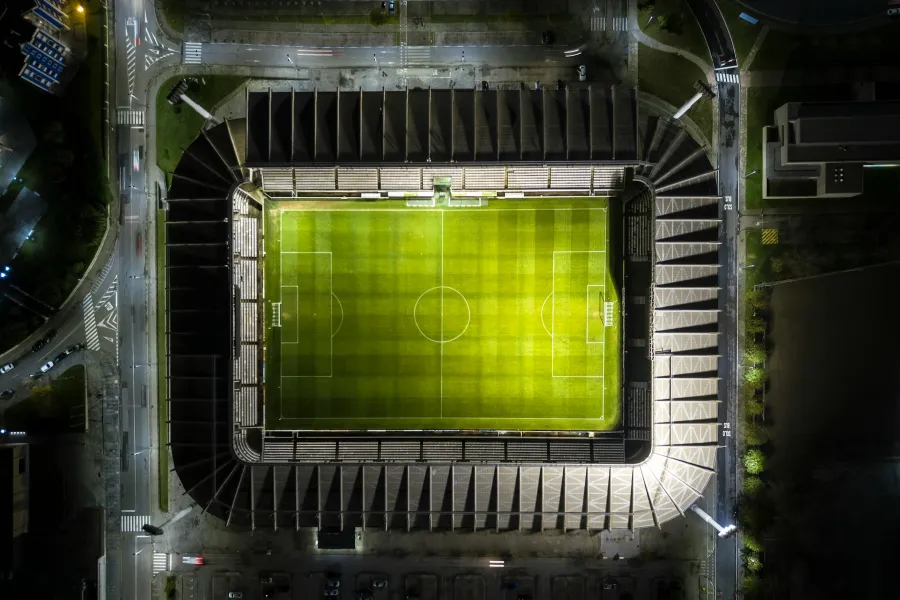
In many respects the stadiums of today resemble the old amphitheatres put up for the games of antiquity. Something was lost, though, in the early twentieth century, when the newly available materials of steel and reinforced concrete, together with floodlights that allowed play after dark, produced arenas that could do only one thing. Built for sport alone, a great many of these were placed on the edges of cities and encircled by car parks — a setting that puts them beyond easy reach of ordinary residents, drives up the energy they consume, and adds to the warming of the surrounding streets.
E
Yet a good number of the boldest architects now working see in the stadium a chance to make the city better, and two approaches in particular are proving their worth: treating the arena as a hub for the wider community, and treating it as a generator of power. It is becoming common to fit stadiums with amenities that have nothing to do with sport — hotels and conference halls, retail units, bars and restaurants, play areas for children and patches of greenery. Bundling such uses together strengthens density and mixed use, squeezes more value from the land, and breathes new life into rundown districts. A stadium of this kind belongs not only to athletes and their fans but to families and the public at large. Britain offers several instances: the mixed-use schemes at Ashcombe and Northgate have set a pattern that stadiums across the globe have since copied.
F
The notion of the stadium as a power station grew out of the realisation that clusters of connected buildings can be linked through a smart grid — an electricity network that relies on digital communications to sense shifts in local demand and respond to them, so that little energy is wasted. Arenas suit this role especially well: the broad canopies over their stands present a wide surface for mounting solar panels, and they stand tall enough — over 45 metres — to carry small wind turbines. The Aldberg Solar Stadium led this new generation of power-producing arenas, and others such as the Rijnstad Arena and the Baihe Stadium have followed. Opened in 2011, the last of these carries 9,200 solar panels that generate as much as 1.2 GWh of electricity each year; in doing so it cuts carbon dioxide emissions by around 690 tonnes and, when no event is being held, feeds up to 75 percent of the power used by the neighbouring district. This shows that an arena can serve its city and make a real dent in CO2 emissions.
G
From the earliest times, arenas have sat at the centre of a city's life and culture. In each age it has taken on fresh meaning — a military stronghold, a place to live, an open public space, a stage for performance and, most recently, a proving ground for advanced engineering. Today's stadium draws all these roles together at once, and so helps cities build towards a sustainable future.
B. Perhaps no structure illustrates the adaptability of the stadium better than the amphitheatre at Aurenca, in south-western France, which once held 22,000 onlookers. Raised by the Romans in 85 AD, it was fortified into a towered citadel some time after the fifth century, and later still its interior filled up with dwellings until a village of roughly 180 houses occupied the site. When the preservation movement gathered pace in the nineteenth century, the building was cleared and given back its earliest role, being brought back into use as a venue for public races. A comparable survivor is the great arena of Malvento in northern Italy. Seating 28,000 and built several decades earlier than the one at Aurenca, it has come through the centuries intact and now ranks among the finest places anywhere to hear concerts, a reputation owed to its remarkable acoustics.
C. At the heart of the Italian town of Castelbruno lies another striking case of an amphitheatre swallowed up by the streets that grew around it. As at Aurenca, buildings gradually encroached on the arena between the Middle Ages and the nineteenth century, the space serving in turn as housing, as a store for grain and even as a prison. This time, however, the ruin was never turned back into an arena; instead the Romantic architect Emilio Vandelli reshaped it into a market square. The remains of the old Roman amphitheatre can still be seen today, folded into the cafés and homes that ring the open piazza.
D. In many respects the stadiums of today resemble the old amphitheatres put up for the games of antiquity. Something was lost, though, in the early twentieth century, when the newly available materials of steel and reinforced concrete, together with floodlights that allowed play after dark, produced arenas that could do only one thing. Built for sport alone, a great many of these were placed on the edges of cities and encircled by car parks — a setting that puts them beyond easy reach of ordinary residents, drives up the energy they consume, and adds to the warming of the surrounding streets.
E. Yet a good number of the boldest architects now working see in the stadium a chance to make the city better, and two approaches in particular are proving their worth: treating the arena as a hub for the wider community, and treating it as a generator of power. It is becoming common to fit stadiums with amenities that have nothing to do with sport — hotels and conference halls, retail units, bars and restaurants, play areas for children and patches of greenery. Bundling such uses together strengthens density and mixed use, squeezes more value from the land, and breathes new life into rundown districts. A stadium of this kind belongs not only to athletes and their fans but to families and the public at large. Britain offers several instances: the mixed-use schemes at Ashcombe and Northgate have set a pattern that stadiums across the globe have since copied.
F. The notion of the stadium as a power station grew out of the realisation that clusters of connected buildings can be linked through a smart grid — an electricity network that relies on digital communications to sense shifts in local demand and respond to them, so that little energy is wasted. Arenas suit this role especially well: the broad canopies over their stands present a wide surface for mounting solar panels, and they stand tall enough — over 45 metres — to carry small wind turbines. The Aldberg Solar Stadium led this new generation of power-producing arenas, and others such as the Rijnstad Arena and the Baihe Stadium have followed. Opened in 2011, the last of these carries 9,200 solar panels that generate as much as 1.2 GWh of electricity each year; in doing so it cuts carbon dioxide emissions by around 690 tonnes and, when no event is being held, feeds up to 75 percent of the power used by the neighbouring district. This shows that an arena can serve its city and make a real dent in CO2 emissions.
G. From the earliest times, arenas have sat at the centre of a city's life and culture. In each age it has taken on fresh meaning — a military stronghold, a place to live, an open public space, a stage for performance and, most recently, a proving ground for advanced engineering. Today's stadium draws all these roles together at once, and so helps cities build towards a sustainable future.