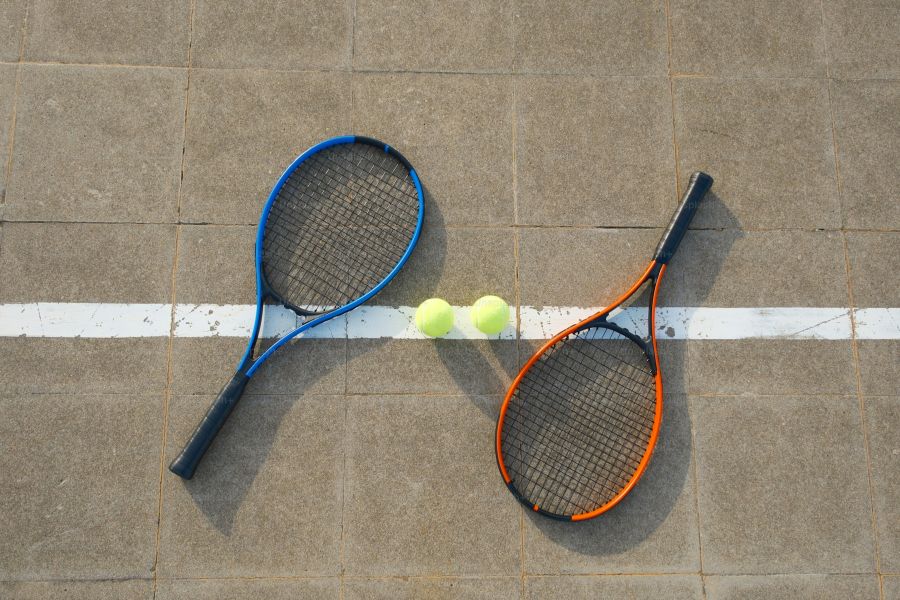
How tennis rackets have changed
When Theo Marchetti of Canada rose to the top of the world rankings in 2018, it was a feat that would have looked scarcely believable only seasons before. What made it the more striking was the era in which it came about - reckoned by many to be among the most fiercely contested the game has known, with challengers of the calibre of Sergio Ballester, Lars Henriksson and Tomas Novak all pursuing the same trophies. A mere five years earlier, Marchetti had counted as no more than a promising outsider, forever entering the sport's biggest tournaments yet never carrying one off.
Two developments, in the end, lay behind this turnaround. One of them was common knowledge and much talked about at the time: the former world number one Bjorn Halvorsen joined Marchetti's coaching staff in 2013, and what that did to his game could be seen at a glance. The other went almost entirely unremarked. Marchetti had always, like so many of his peers, favoured a frame strung with two separate materials - one threaded through the mains, the vertical strings, the other through the crosses, or horizontals. His mains he kept in natural gut; the crosses, though, he re-strung in a synthetic in 2014. Slight as it sounds, the move would be badly underrated if anyone dismissed it.
What Marchetti did to his crosses is only one of many tweaks a player can reach for in the hope of sharpening their game. 'Every frame out on tour is fitted to the person who wields it,' says Devin Marsh, a professional stringer based in New Zealand. 'Getting that exactly right is a large part of drawing out the last drop of performance.' It follows that the rackets the very best players rely on are never sold to the public as they are; each is built around the individual who plays with it. The Australian doubles pair Liam and Noah Prescott, twins with exacting requirements, are a case in point. 'We ask for very precise specifications,' they explain. 'Our manufacturer sends each frame to Adelaide, where it undergoes a meticulous round of customisation.' Among the things they have changed are the frame's length and even the paint over it, and the rackets they now prefer are heavier than an ordinary model, strung to a tighter pattern of crosses and mains.
The reasoning behind it all is plain enough. As the margin separating a win from a defeat shrinks ever further, alterations that would once have seemed negligible come to weigh heavily indeed. And so the players, with their support teams, grow steadily more inventive in reworking their equipment, each chasing whatever narrow advantage it might yield.
The habit goes back to the 1970s, when a Dutch amateur by the name of Bram de Wit took to playing with what became known as the comb-strung racket. So much topspin poured off its string bed that the International Tennis Federation banned it before long. Yet across the next twenty years or so, adjusting one's racket hardened into a routine part of the sport - something widely held today to rank beside diet and fitness for sheer importance.
In the main, these alterations sort into two families: those done to the string bed and those done to the frame. The first kind is much more usual. Which strings to choose, and how tightly to set them, is something nearly every professional tinkers with, revising the decision again and again in light of the surface underfoot, the weather, the style of an opponent - some on no firmer basis than their mood that afternoon.
Once upon a time, every racket was strung with natural gut, taken from the outer lining of a sheep's or a cow's intestines. The early 1990s brought a shift, as synthetic strings - cheaper and longer-lasting - appeared. Three substances go into these: nylon, tough and cheap; Kevlar, far too rigid to string on its own; and co-polyester, a polyester carrying additives that lift its performance. Even now, a good many professionals keep to a 'hybrid' set-up, in which synthetic and natural strings are combined.
Among the synthetics, co-polyester reigns supreme. It answers particularly well to the tennis of the present day, in which rallies are settled for the most part along the baseline rather than up at the net. Research suggests that a co-polyester string throws off roughly a fifth more spin than natural gut or any rival synthetic can offer. Its coming, one might say, has transformed the game.
A fair number of players, however, go further than the strings and take the frame itself in hand. Much of the ferocious serve of the American Dominic Vance, to take one case, was credited to the three or four strips of lead he had attached to his frames; these days the weighting is more often decided as the racket is built than added later on.
Further changes to the frame have to do with the handle. Taste here is personal - one player wants a certain shape and may have the handle of a cherished racket transplanted onto another frame entirely, while another does something else again. The Portuguese player Rafael Mendonca, for one, found the grips he was given clumsy in the hand and exchanged them for slimmer versions.
Customising and modifying rackets has driven the standard of play to heights few would have dared imagine in the era of gut strings and cumbersome wooden frames - and where it goes from here no one can say, though the watching promises to be a pleasure.