Green roofs - IELTS Reading with Practice Test, Answers And Explanation
Luyện tập đề IELTS Reading Practice với passage Green roofs được lấy từ cuốn sách IELTS Mock Test Vol 18 - Test 4 - Passage 1 với trải nghiệm thi IELTS trên máy và giải thích đáp án chi tiết bằng Linearthinking, kèm list từ vựng IELTS cần học trong bài đọc.
Green Roofs IELTS Reading Answers with Explanation
❓ Câu hỏi (questions)
Question 1 - 5
Reading Passage 1 has 5 paragraphs, A-E.
Which paragraph contains the following information?
Write the correct letter, A-E.
1
a set of practical obstacles that must be settled before installing a green roof
2
mention of somewhere that has backed rooftop greenery over a long period
3
the view that schemes already in place should guide future projects
4
examples of green roofs being combined with a city's other eco-friendly installations
5
the point that a strong economic argument has to be made in order to secure support
Question 6 - 9
Complete the summary below.
Choose ONE WORD ONLY from the passage for each answer.
Advantages of green roofs
Green roofs bring a variety of advantages. They cut the chance of flooding, lower the amount a building pays for and produce surroundings in which wildlife can live. In many cases the rooftop is also used to produce .
Green roofs are valuable socially as well. Members of the medical profession, for instance, now suggest as a way of helping people manage difficulties with their mental health. Research further shows that being able to reach green areas can ward off bodily conditions such as .
Question 10 - 11
Choose TWO letters, A-E.
Which TWO benefits of building green roofs on newer buildings does the writer mention in Paragraph C?
A
a longer harvest period for edible crops
B
a greater capacity to store water at height
C
more efficient consumption of water
D
a larger surface area for planting
E
the chance to cultivate a broader variety of plants
Question 12 - 13
Choose TWO letters, A-E.
Which TWO aims of the new variations on the green-roof idea are mentioned in Paragraph E?
A
to lower the temperature of the surrounding area
B
to produce electricity from a renewable supply
C
to hold water back so that nearby buildings can use it
D
to keep plants alive through very dry spells
E
to shelter as broad a range of animal species as possible
DOL IELTS Đình Lực
📖 Bài đọc (reading passage)
Green roofs
A
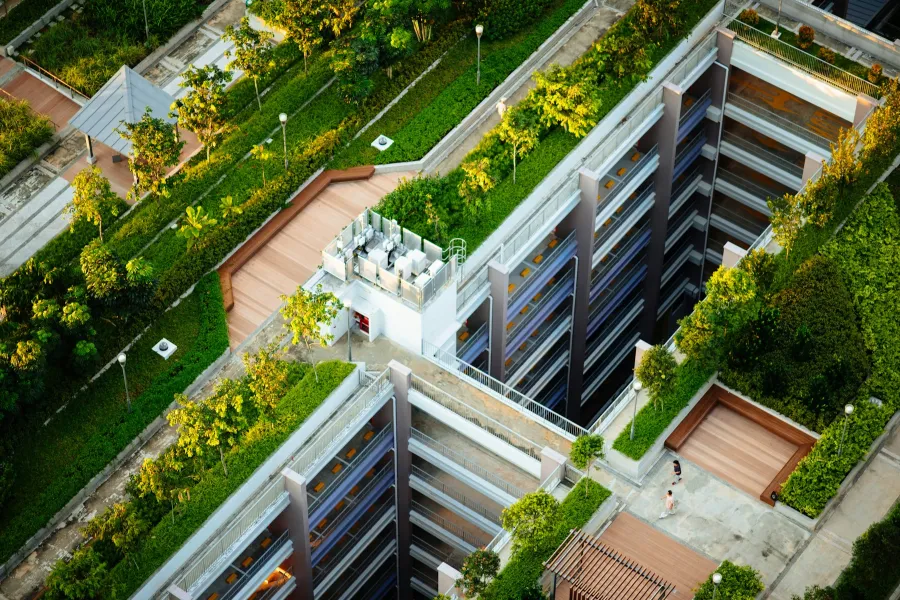
A. Across the world's cities it has become an ordinary sight: rooftops planted with turf, vegetable plots and dense greenery. Investment in these green roofs keeps climbing, from private firms and municipal authorities alike, drawn by the sheer range of returns — smaller sums paid out for cooling, a lower threat of flooding, fresh habitat for urban wildlife, cleaner air, and even the chance to raise crops several storeys up. Faced with competition for resources and shrinking open land, cities turn to such bold designs to adapt. What settles their success is not the technology alone but the readiness of councils, companies and other bodies to take part, backed by study of which solutions suit a city's varied roofs. Increasingly, planners also design green roofs to work alongside other environmentally minded features — 'living walls' clad in vegetation over soil or water, and street-level drainage such as lines of trees — so that rainfall is managed better and the built landscape grows more sustainable. Ireland came late to all this, and its local authorities are largely the ones driving it along; Dublin, where a far-sighted measure called the City Canopy Scheme has more than doubled the green-roof area, holds much of the national market.
B
Beyond these practical gains, a steadily widening body of study is drawing attention to what green roofs do for people directly. Physicians now quite frequently write out prescriptions for time spent gardening in the fresh air, reaching for it as a way of supporting patients who are wrestling with anxiety or low spirits. Investigators have found, too, that contact with even the plainest scrap of greenery can lift the day-to-day quality of life of those living with dementia, and can leave a person less likely to go on to develop diabetes. Discoveries of this kind are gradually strengthening the argument that a rooftop need be neither large nor elaborate to be worth planting.
C
In Australia and New Zealand, by contrast, planted roofs slipped into the mainstream long ago, and large, publicly accessible and crop-bearing examples now sit atop buildings across both countries. Once again it has fallen to mayors and civic authorities to push things along: Sydney only lately obliged every new building to carry a green roof, whereas Wellington's encouragement of rooftop farming reaches back to schemes drawn up in the 1990s. A further edge is their young building stock, which makes fitting a roof simpler. Holding enough water up at roof level, and spreading it evenly across the surface, is what keeps the planting alive — the demands running highest on the 'edible' roofs given over to fruit and vegetables. This is far easier on recent structures, generally built to bear heavier loads, than on an older one adapted afterwards; and since a sturdier roof takes a deeper layer of soil, it also allows a wider assortment of plants. What has worked in these cities, many argue, ought to serve as a template elsewhere.
D
If green roofs are ever to become routine on new developments, backing from the public sector and from private investors alike will be indispensable. Those charged with looking after a building may find they have to take on unfamiliar skills, landscaping among them, and here and there a team of volunteers might be called on to lend a hand. Yet when the point comes to win over investors and developers, it is the economic reasoning that still counts for most, and a convincing financial case has to be set out before any of them will commit. A phrase has even been minted for the purpose — 'natural capital' — to pin down the monetary worth of the natural world: the savings, say, that follow from picking natural defences against flood damage, from adjusting to a shifting climate, or from helping people lead healthier and more contented lives.
E
As shared know-how has deepened, formal standards have taken shape to guarantee that green roofs are properly designed, built and cared for. Advances in the underlying science have meanwhile spawned fresh takes on the idea. 'Blue roofs' let a building cling to water over longer stretches rather than shedding it at once, which matters when downpours turn heavier; there are pairings of planted roofs with solar panels, whose purpose is to draw power from a renewable source; and 'brown roofs', left deliberately wilder, set out to give a home to as many kinds of wildlife as they can. None of it comes free of complication, however. Before a single roof goes in, a run of hurdles must be cleared — laying drainage routes, meeting health-and-safety rules, at times arranging public access, and living with planning limits and the upheaval that building work brings to a structure and its surroundings. Clear these, and the trend could bring new jobs and a livelier local food economy; the evidence so far hints that such roofs might remake our cities and keep them working sustainably for years to come.
B. Beyond these practical gains, a steadily widening body of study is drawing attention to what green roofs do for people directly. Physicians now quite frequently write out prescriptions for time spent gardening in the fresh air, reaching for it as a way of supporting patients who are wrestling with anxiety or low spirits. Investigators have found, too, that contact with even the plainest scrap of greenery can lift the day-to-day quality of life of those living with dementia, and can leave a person less likely to go on to develop diabetes. Discoveries of this kind are gradually strengthening the argument that a rooftop need be neither large nor elaborate to be worth planting.
C. In Australia and New Zealand, by contrast, planted roofs slipped into the mainstream long ago, and large, publicly accessible and crop-bearing examples now sit atop buildings across both countries. Once again it has fallen to mayors and civic authorities to push things along: Sydney only lately obliged every new building to carry a green roof, whereas Wellington's encouragement of rooftop farming reaches back to schemes drawn up in the 1990s. A further edge is their young building stock, which makes fitting a roof simpler. Holding enough water up at roof level, and spreading it evenly across the surface, is what keeps the planting alive — the demands running highest on the 'edible' roofs given over to fruit and vegetables. This is far easier on recent structures, generally built to bear heavier loads, than on an older one adapted afterwards; and since a sturdier roof takes a deeper layer of soil, it also allows a wider assortment of plants. What has worked in these cities, many argue, ought to serve as a template elsewhere.
D. If green roofs are ever to become routine on new developments, backing from the public sector and from private investors alike will be indispensable. Those charged with looking after a building may find they have to take on unfamiliar skills, landscaping among them, and here and there a team of volunteers might be called on to lend a hand. Yet when the point comes to win over investors and developers, it is the economic reasoning that still counts for most, and a convincing financial case has to be set out before any of them will commit. A phrase has even been minted for the purpose — 'natural capital' — to pin down the monetary worth of the natural world: the savings, say, that follow from picking natural defences against flood damage, from adjusting to a shifting climate, or from helping people lead healthier and more contented lives.
E. As shared know-how has deepened, formal standards have taken shape to guarantee that green roofs are properly designed, built and cared for. Advances in the underlying science have meanwhile spawned fresh takes on the idea. 'Blue roofs' let a building cling to water over longer stretches rather than shedding it at once, which matters when downpours turn heavier; there are pairings of planted roofs with solar panels, whose purpose is to draw power from a renewable source; and 'brown roofs', left deliberately wilder, set out to give a home to as many kinds of wildlife as they can. None of it comes free of complication, however. Before a single roof goes in, a run of hurdles must be cleared — laying drainage routes, meeting health-and-safety rules, at times arranging public access, and living with planning limits and the upheaval that building work brings to a structure and its surroundings. Clear these, and the trend could bring new jobs and a livelier local food economy; the evidence so far hints that such roofs might remake our cities and keep them working sustainably for years to come.