IELTS CAM Inspired 16 - Reading Test 4 with Practice Test, Answers And Explanation
Luyện tập đề IELTS Online CAM Inspired 16 - Reading Test 4 được lấy từ cuốn sách IELTS CAM Inspired 16 với trải nghiệm thi IELTS trên máy và giải thích đáp án chi tiết bằng Linearthinking, kèm answer key và list từ vựng IELTS cần học trong bài đọc.
IELTS Mock Test 16 - Reading Test 4 With Practice Test, Answers And Explanation
Passage
❓ Câu hỏi passage 1
Question 1 - 6
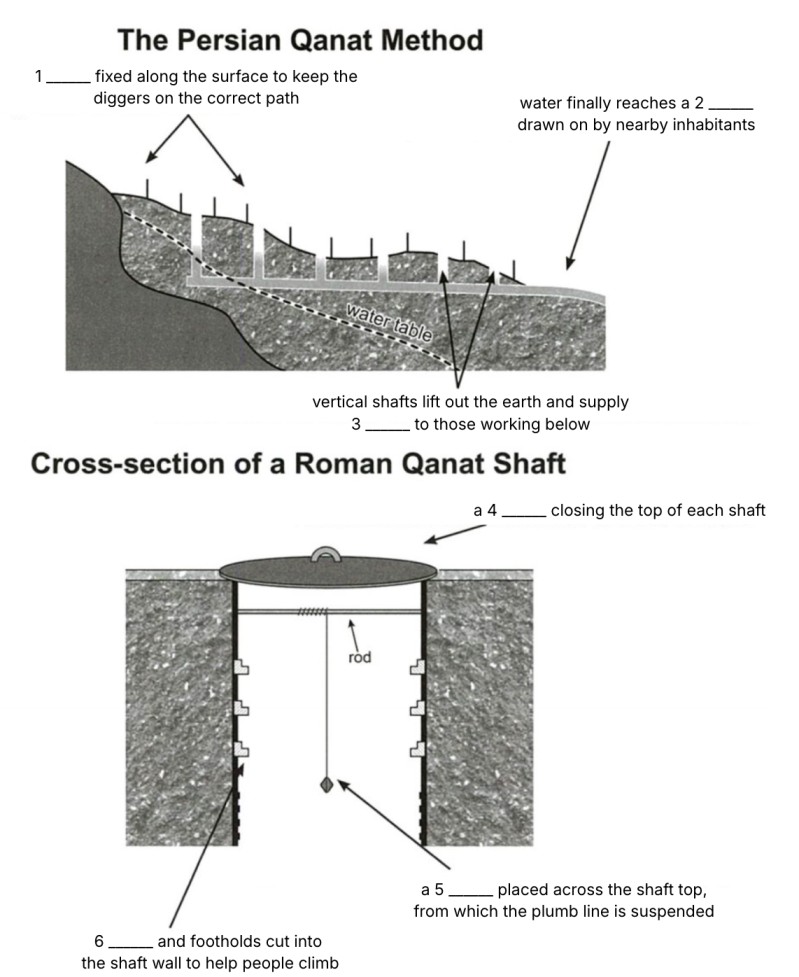
Label the diagrams below. Choose ONE WORD ONLY from the passage for each answer.
Question 7 - 10
Do the following statements agree with the information given in the Reading Passage?
TRUE if the statement agrees with the information
FALSE if the statement contradicts the information
NOT GIVEN if there is no information on this
7
Builders using the counter-excavation method needed an understanding of geometry.
8
The account of the mistake in the Vartana aqueduct tunnel was found in a book kept in the city.
9
The workers who dug the Selpino Pass road tunnel were paid more than other labourers.
10
Engineers usually chose the counter-excavation method because it was the faster technique.
Question 11 - 13
Answer the questions below.
Choose NO MORE THAN TWO WORDS from the passage for each answer.
11
Which metal were the Vallora mines in Spain dug to obtain?
12
Along with the person who paid for a tunnel, who else was sometimes recorded on it?
13
Which part of Antelia did the Tarnis tunnel keep safe from flooding?
Passage
❓ Câu hỏi passage 2
Question 14 - 17
Choose the correct letter, A, B, C or D.
14
In the opening paragraph, what is the writer chiefly trying to convey?
A
Games are a more common use of devices than reading.
B
Devices can help young children to read.
C
A change that most people fail to notice is at work on them.
D
People should be encouraged to use devices while travelling.
15
What is the central claim Halvard Reinholt makes about innovation?
A
Innovation in technology has reduced the amount of print reading.
B
Creating products is different from creating ideas.
C
More young people ought to take part in innovation.
D
The real error lies in ignoring what innovation quietly erodes.
16
What point is the writer making in the fourth paragraph?
A
The brain's reading network adapts to fit whatever is asked of it.
B
Reading can be carried out through a variety of media.
C
Writing systems place surprising demands on the brain.
D
People are born with the ability to read and write.
17
According to Desmond Ackroyd, the attitude of college students
A
has altered the way he teaches.
B
is at odds with what the wider public believes.
C
shapes the reading they choose to do.
D
concerns him less than it concerns other people.
Question 18 - 22
Complete the summary using the list of words, A-H, below.
Studies on screen reading
Researchers investigating time spent on screens have repeatedly turned up patterns. In one investigation, the psychologist Elspeth Rowan gave secondary students a short story to read, one group using a digital device and the other paper. By questioning the readers afterwards, her team gauged how each group's grasp of the story was. A consistent difference emerged: the screen readers found the sequence of events to remember.
Work by Rahul Menon suggests that, to work faster, students now tend to notice only terms as they move down a page, rather than reading it in full. This habit, he argues, leaves the reader with only a shallow sense of a text's substance, and no time to reflect.
A
complete
B
concerning
C
difficult
D
emotional
E
numerous
F
rapid
G
separate
H
unified
Question 23 - 26
Do the following statements agree with the claims of the writer in the Reading Passage?
YES if the statement agrees with the claims of the writer
NO if the statement contradicts the claims of the writer
NOT GIVEN if it is impossible to say what the writer thinks about this
23
The distinction between reading in print and reading on screens is essentially a simple, clear-cut one.
24
How people read today has altered the purposes they read for, as well as the material itself.
25
People encounter more misinformation now than in earlier times.
26
The writer believes the changes to the reading brain can no longer be influenced.
Passage
❓ Câu hỏi passage 3
Question 27 - 32
Choose the correct heading for each section from the list of headings below.
List of Headings
I
Public suspicion surrounding a new AI product
II
Promoting transparency about the way AI reaches its conclusions
III
How AI guides people through sound decision-making
IV
Why machine-generated predictions surpass those of people
V
A gap in attitudes that continues to grow wider
VI
An AI tool that worked far better than expected
VII
Why human assessments inspire more confidence than AI ones
VIII
The benefits of giving users a role in AI systems
27
Paragraph A
28
Paragraph B
29
Paragraph C
30
Paragraph D
31
Paragraph E
32
Paragraph F
Question 33 - 35
Choose the correct letter, A, B, C or D.
33
What is the writer doing in Section A?
A
drawing attention to a problem that exists
B
defending a personal opinion on a topic
C
putting forward a solution to a difficulty
D
setting out the reasons behind a development
34
According to Section C, why are some people unwilling to accept AI?
A
They worry that it will take over jobs that involve making decisions.
B
They would rather wait until the technology has been tested over time.
C
Misunderstanding how it works makes it appear harder than it really is.
D
Being unable to follow its workings leaves them feeling powerless.
35
What does the writer say about the media in Section C?
A
It gives AI a disproportionate amount of coverage.
B
It suggests that AI failures stem from mistakes made by designers.
C
It makes the public inclined to distrust AI.
D
Its reports of AI-related incidents are often inaccurate.
Question 36 - 40
Do the following statements agree with the claims of the writer in the Reading Passage?
YES if the statement agrees with the claims of the writer
NO if the statement contradicts the claims of the writer
NOT GIVEN if it is impossible to say what the writer thinks about this
36
The way AI was portrayed in the films — whether flattering or critical — determined the direction in which viewers' opinions shifted.
37
People tend to interpret information about AI in a way that fits the beliefs they already hold.
38
The number of people who distrust AI is greater than the number who welcome it.
39
Regular use of other kinds of technology is associated with greater trust in them.
40
Users must fully understand how an AI system works inside before they will accept it.
DOL IELTS Đình Lực
21/10/2026
📖 Bài đọc passage 1
Roman tunnels
Having brought much of Europe, North Africa and Asia Minor under their control, the Romans borrowed the tunnelling techniques of earlier peoples and applied them across the lands they ruled.
Among the earliest peoples to drive tunnels that carried a dependable water supply to settlements in arid countries were the Persians, whose homeland lay in what is now Iran. The technique they devised early in the first millennium BCE, known as the qanat, began on the surface: a row of stakes was driven into the ground in a straight line across a hill, so that the diggers below would keep to the intended course, and vertical shafts were then sunk at regular intervals. Down in the ground, labourers cleared the earth between the feet of neighbouring shafts until a continuous tunnel had been formed. The loosened soil was raised to the surface through the shafts, which doubled as a source of fresh air while the digging went on. A finished qanat let water travel from high on a hillside down towards a channel, from which the community drew its supply. Astonishingly, a few qanats sunk by the Persians some 2,800 years ago are working still.
The Romans inherited this expertise and, like the Persians before them, drew on the qanat to feed water to their crops. Where they dug such tunnels, the vertical shafts stood some 25 to 55 metres apart. Climbing in and out was made easier by handholds and footholds set into each shaft's walls, while a cover of timber or stone sealed the opening at the top. Verticality was checked with a plumb line: this hung from a rod laid across the shaft's mouth, and the builders confirmed that its weight settled exactly over the centre. Depth, too, was read from these lines, as was the angle at which the tunnel should fall. Take the Marcian tunnel, 4.9 kilometres in length: driven in 52 CE to empty Lake Arsina in central Italy, its shafts descended as much as 110 metres, and bringing it to completion demanded nine years and roughly 25,000 labourers.
A second way of making tunnels had emerged by the 6th century BCE. In this counter-excavation method the work advanced from both ends at once, and it came into its own where mountains rose too high for the qanat to be practical. Far more planning was needed here, together with a sound grasp of surveying, mathematics and geometry, since the two headings had to converge accurately at the heart of the mountain. Whenever the diggers ran into difficult ground, or strayed from the line they had set, the tunnel's direction had to be corrected. They watched the heading constantly — checking, for instance, the daylight that reached them from the tunnel mouth — and made adjustments as required. Where the drift was large, one arm of the tunnel might end up unusable. An inscription cut into the wall of a 380-metre tunnel, built by the Romans within the Vartana aqueduct system in what is now Tunisia, tells how the two gangs of diggers failed to meet inside the mountain, and how a connecting passage driven later between the two corridors put the original error right.
When hills or mountains stood too high for a road to climb over them, the Romans drove tunnels through instead, again by counter-excavation. The Selpino Pass tunnel, cut in Italy between 74 and 79 CE and measuring 41 metres long by 5 metres high, is one such case; remarkably, a modern road runs through it to this day. Tunnels were bored for mining as well. On finding a vein of ore, miners would follow it underground by means of shafts and galleries. Traces of workings of this kind survive at the Vallora mines in northern Spain, where the metal being pursued was silver. Where a tunnel served no purpose beyond reaching the ore, little planning was called for, since the course of the tunnel simply followed the vein.
Care went into both the planning and the carrying out of Roman tunnels. Two things governed how long the work lasted: which method was in use, and what sort of rock had to be broken through. Since a mountain could be worked from its shafts as well as from the two mouths, the more straightforward qanat generally outpaced counter-excavation. Rock type told as well. Where the stone was hard, the builders turned to fire quenching — the rock was heated in a fire, then quenched suddenly with cold water until it fractured. Hard rock could reduce progress to a crawl, and it was far from unusual for a tunnel to swallow years, or even decades. At Vesano, the marks a Roman crew left behind reveal an advance of just 25 centimetres a day through solid rock; the Marcian tunnel, for comparison, comes out at 1.6 metres. Inscriptions on most tunnels set down the patrons who had ordered the work, and here and there the engineer too. On the entrance of the 1.2-kilometre Tarnis tunnel in southern Turkey — cut to steer away the floodwaters menacing the docks of the old city of Antelia — such inscriptions survive, noting that the work began in 73 CE and was completed in 83 CE.
1
2
3
4
5
6
Diagram A — The Persian Qanat Method
1
fixed along the surface to keep the diggers on the correct path.
water finally reaches a
2
drawn on by nearby inhabitants.
vertical shafts lift out the earth and supply
3
to those working below.
Diagram B — Cross-section of a Roman Qanat Shaft
a
4
closing the top of each shaft.
a
5
placed across the shaft top, from which the plumb line is suspended.
6
and footholds cut into the shaft wall to help people climb.
What are the implications of the way we read today?
Next time you board a train, watch the other passengers. For infants and toddlers, the tablet has become the device that keeps them quiet. Children just starting school follow stories on their phones, while older ones ignore books and bend over handheld games. The adults glide through tablets or race across streams of messages and headlines. What almost none of them realise is that a quiet but profound shift binds everyone in that carriage together: the network of brain cells on which reading depends is being reshaped, quickly and unnoticed, and the consequences reach from the youngest child who cannot yet read to the most experienced adult.
Neuroscience tells us that when human beings first became literate, more than six thousand years ago, their brains had to build an entirely new circuit for it. What began as a rudimentary system for registering simple facts, how many goats stood in a herd, became the intricate reading brain we carry today. In my own work I have traced how this reading brain supports several capacities we value most: the knowledge we make our own, the ability to reason by analogy and draw inferences, the taking on of another's viewpoint and the empathy that follows, and the careful analysis from which fresh insight springs. Yet studies now emerging worldwide warn that these deep reading capacities could be endangered as reading migrates onto digital devices.
None of this reduces to a tidy contest between print and screens, or to a verdict for or against new technology. The media sociologist Halvard Reinholt has argued that a society's mistake lies not in innovating but in overlooking whatever gets disrupted or worn away in the process. Poised at the turning point between a print culture and a digital one, we need to look squarely at what is fading in the practised reader's circuitry, at the capacities our children and older students are failing to build, and at what might be done in response.
Research makes clear that, unlike sight or speech, the capacity to read is not handed to us by our genes; it takes shape only through experience. Once it forms, it moulds itself to whatever that experience demands, to the writing system in use and to whichever medium carries the words. Should the prevailing medium reward speed, multitasking and the handling of information in bulk, as digital technology does, the reading circuit will bend that way. The consequence, as the developmental psychologist Ana Petrescu has observed, is that the slower, more demanding work of deep reading is granted steadily less time and attention.
A growing body of testimony from teachers and from psychology and humanities scholars points the same way. The literature professor Desmond Ackroyd, who teaches undergraduates, recounts how many of them now steer clear of the classic nineteenth- and twentieth-century novels, preferring something less taxing, because they have lost the patience that long, dense and challenging texts require. What ought to trouble us, though, is less this cognitive impatience itself than what may lie beneath it: the risk that huge numbers of students can no longer read critically enough to follow the intricate reasoning and argument that harder texts contain.
Several studies suggest that time on screens may be producing worrying knock-on effects on how well older secondary and university students understand what they read. Working in Tampere, Finland, the psychologist Elspeth Rowan and her team compared how secondary students grasped identical material in different formats. They chose a short story with a plot that appeals to almost any young reader and questioned the participants about it; one half had read it on a tablet, the other on printed paper. The students who read the printed version came out ahead of their screen-reading counterparts in comprehension, and the gap was widest when it came to putting the story's events back into their proper order.
In a sequence of studies, the information scientist Rahul Menon of Westlake State University has found that skimming has become the new normal, a matter of hunting for individual words and glancing through the page. A common habit now is to take in the opening line and then pick out scattered words across everything that follows. Reading that skims this way steals time from the deeper processes, leaving us no room to take in complexity, to sense what another person feels, to register beauty, or to form ideas of our own.
That critical thought, empathy and the other deep reading processes might become the accidental casualties of our digital age is, again, not a plain either/or question of print against screen. It concerns how all of us have taken to reading across a range of media, and how this alters not merely what we read but the very reasons we read at all. Nor is it the young alone who are affected: the quiet wearing-away of critical thought and empathy reaches every one of us to the same degree. It weakens our ability to navigate the ceaseless barrage of information, and pushes us toward the most comfortable reserves of unexamined material, which demand no scrutiny and get none, leaving us open to falsehoods and to ideas with no basis in reason.
Neuroscience has a long-standing maxim that holds at any age: use it or lose it. Applied to critical thinking within the reading brain, it is an encouraging idea, precisely because it leaves the matter up to us. The tale of the reading brain's transformation is far from over. Between them, science and technology give us the means to spot the shifts in how we read, and to put them right, before they harden into permanence. Provided we grasp exactly what stands to be lost, alongside the new powers the digital world has granted us, there is quite as much cause for optimism as for worry.
A. Predicting what lies ahead is already within the reach of artificial intelligence (AI). Where and when crimes are likely to occur is now mapped by police using such systems, and clinicians draw on them to identify which patients face the highest risk of a heart attack or stroke. Some researchers go further, trying to equip AI with a form of imagination so it can prepare for outcomes nobody has foreseen. Since so many of our choices depend on a reliable forecast, and machines are nearly always better forecasters than people, one might expect these tools to be welcomed. In practice, our confidence in what AI predicts stays strikingly low. Again and again, people prefer the judgement of human specialists to that of a machine, clinging to it even where the specialist proves mistaken. For AI to do any real good, then, a way must be found of persuading people to trust it, which means first working out why they are so unwilling to.
B
Consider Auren for Cardiology, one of the flagship systems developed by the technology corporation Torvald Systems. The effort to sell this program to heart specialists turned into a public-relations catastrophe. What the system promised was expert-grade advice on how to treat fifteen cardiac conditions that between them made up roughly 70 percent of the world's cases. Yet the cardiologists who first worked with it were placed in an awkward bind. Whenever Auren's advice matched a doctor's own view, that doctor saw little value in it: the machine was merely confirming what was already known, and nothing about the patient's treatment actually changed. Whenever its advice cut against the specialist's judgement, on the other hand, the usual conclusion was that the system could not be trusted. Nor could the program set out any reason why its proposed treatment made sense, since the machine-learning methods behind it were far too intricate for any person to follow in full. The upshot was still deeper doubt and mistrust, with a great many doctors brushing aside recommendations that struck them as bizarre and falling back on their own expertise.
C
This is only one instance of the broader wariness people show towards AI and their hesitation to embrace what it offers. When we trust another person, that trust usually rests on some grasp of how they reason and on past evidence that they are dependable, which leaves us feeling psychologically secure. A machine offers little of this: for most of us AI remains a recent, unfamiliar arrival. Its reasoning can sometimes be explained in technical terms, though not always, yet even then the route by which it reaches a decision lies beyond ordinary comprehension. Dealing with something we cannot make sense of unsettles us and leaves us feeling that command is slipping away. There is a further problem: because AI usually works quietly in the background, few people notice the countless occasions when it performs perfectly well. What they register instead are the times it fails. Those embarrassing lapses draw press coverage out of all proportion to how often they occur, driving home the idea that technology cannot be relied upon, even though machine learning falls short partly because the people who build it are fallible too.
D
The emotions AI stirs up run deep. One recent study gathered participants from all sorts of backgrounds, showed each a selection of science-fiction films about AI, then questioned them on the role of automation in daily life. Strikingly, the tone of the film made no difference: whether the on-screen future was hopeful or bleak, the mere act of watching pushed people's views towards the extremes. Those already optimistic grew more fervent, while the doubters became warier than before. This points to a tendency to seize on evidence about AI selectively, bending it to support whatever one already believes — the familiar habit called 'confirmation bias'. Should AI feature ever more prominently in entertainment and the media, the result may be a society divided between those it serves and those who turn away. More to the point, anyone who refuses the benefits AI can bring risks being left at a considerable disadvantage.
E
Encouragingly, some remedies are already in view. One is exposure itself: as the earlier experiment showed, people with prior dealings with AI tend to think far more highly of it, and the same appears to hold for other tools — the more someone uses the internet, say, the readier they are to trust it. A second approach is to be more open about the algorithms AI relies on and what they are meant to achieve. Several prominent online marketplaces and social-media firms already publish transparency reports covering government demands and surveillance requests; extending that practice to AI could give the public a clearer sense of how algorithmic decisions are reached.
F
There is also research indicating that letting people exercise some say over the decisions AI makes can build trust while giving the system a chance to learn from human experience. In one such study, participants who were permitted to adjust an algorithm even slightly reported greater satisfaction with the choices it produced, a stronger belief that it outperformed the alternatives, and a greater readiness to rely on it again. Grasping the elaborate machinery inside these systems is not the point; what matters is that when people are handed a measure of responsibility for how AI is put to use, they prove far more willing to let it into their lives.
Among the earliest peoples to drive tunnels that carried a dependable water supply to settlements in arid countries were the Persians, whose homeland lay in what is now Iran. The technique they devised early in the first millennium BCE, known as the qanat, began on the surface: a row of stakes was driven into the ground in a straight line across a hill, so that the diggers below would keep to the intended course, and vertical shafts were then sunk at regular intervals. Down in the ground, labourers cleared the earth between the feet of neighbouring shafts until a continuous tunnel had been formed. The loosened soil was raised to the surface through the shafts, which doubled as a source of fresh air while the digging went on. A finished qanat let water travel from high on a hillside down towards a channel, from which the community drew its supply. Astonishingly, a few qanats sunk by the Persians some 2,800 years ago are working still.
The Romans inherited this expertise and, like the Persians before them, drew on the qanat to feed water to their crops. Where they dug such tunnels, the vertical shafts stood some 25 to 55 metres apart. Climbing in and out was made easier by handholds and footholds set into each shaft's walls, while a cover of timber or stone sealed the opening at the top. Verticality was checked with a plumb line: this hung from a rod laid across the shaft's mouth, and the builders confirmed that its weight settled exactly over the centre. Depth, too, was read from these lines, as was the angle at which the tunnel should fall. Take the Marcian tunnel, 4.9 kilometres in length: driven in 52 CE to empty Lake Arsina in central Italy, its shafts descended as much as 110 metres, and bringing it to completion demanded nine years and roughly 25,000 labourers.
A second way of making tunnels had emerged by the 6th century BCE. In this counter-excavation method the work advanced from both ends at once, and it came into its own where mountains rose too high for the qanat to be practical. Far more planning was needed here, together with a sound grasp of surveying, mathematics and geometry, since the two headings had to converge accurately at the heart of the mountain. Whenever the diggers ran into difficult ground, or strayed from the line they had set, the tunnel's direction had to be corrected. They watched the heading constantly — checking, for instance, the daylight that reached them from the tunnel mouth — and made adjustments as required. Where the drift was large, one arm of the tunnel might end up unusable. An inscription cut into the wall of a 380-metre tunnel, built by the Romans within the Vartana aqueduct system in what is now Tunisia, tells how the two gangs of diggers failed to meet inside the mountain, and how a connecting passage driven later between the two corridors put the original error right.
When hills or mountains stood too high for a road to climb over them, the Romans drove tunnels through instead, again by counter-excavation. The Selpino Pass tunnel, cut in Italy between 74 and 79 CE and measuring 41 metres long by 5 metres high, is one such case; remarkably, a modern road runs through it to this day. Tunnels were bored for mining as well. On finding a vein of ore, miners would follow it underground by means of shafts and galleries. Traces of workings of this kind survive at the Vallora mines in northern Spain, where the metal being pursued was silver. Where a tunnel served no purpose beyond reaching the ore, little planning was called for, since the course of the tunnel simply followed the vein.
Care went into both the planning and the carrying out of Roman tunnels. Two things governed how long the work lasted: which method was in use, and what sort of rock had to be broken through. Since a mountain could be worked from its shafts as well as from the two mouths, the more straightforward qanat generally outpaced counter-excavation. Rock type told as well. Where the stone was hard, the builders turned to fire quenching — the rock was heated in a fire, then quenched suddenly with cold water until it fractured. Hard rock could reduce progress to a crawl, and it was far from unusual for a tunnel to swallow years, or even decades. At Vesano, the marks a Roman crew left behind reveal an advance of just 25 centimetres a day through solid rock; the Marcian tunnel, for comparison, comes out at 1.6 metres. Inscriptions on most tunnels set down the patrons who had ordered the work, and here and there the engineer too. On the entrance of the 1.2-kilometre Tarnis tunnel in southern Turkey — cut to steer away the floodwaters menacing the docks of the old city of Antelia — such inscriptions survive, noting that the work began in 73 CE and was completed in 83 CE.
Next time you board a train, watch the other passengers. For infants and toddlers, the tablet has become the device that keeps them quiet. Children just starting school follow stories on their phones, while older ones ignore books and bend over handheld games. The adults glide through tablets or race across streams of messages and headlines. What almost none of them realise is that a quiet but profound shift binds everyone in that carriage together: the network of brain cells on which reading depends is being reshaped, quickly and unnoticed, and the consequences reach from the youngest child who cannot yet read to the most experienced adult.
Neuroscience tells us that when human beings first became literate, more than six thousand years ago, their brains had to build an entirely new circuit for it. What began as a rudimentary system for registering simple facts, how many goats stood in a herd, became the intricate reading brain we carry today. In my own work I have traced how this reading brain supports several capacities we value most: the knowledge we make our own, the ability to reason by analogy and draw inferences, the taking on of another's viewpoint and the empathy that follows, and the careful analysis from which fresh insight springs. Yet studies now emerging worldwide warn that these deep reading capacities could be endangered as reading migrates onto digital devices.
None of this reduces to a tidy contest between print and screens, or to a verdict for or against new technology. The media sociologist Halvard Reinholt has argued that a society's mistake lies not in innovating but in overlooking whatever gets disrupted or worn away in the process. Poised at the turning point between a print culture and a digital one, we need to look squarely at what is fading in the practised reader's circuitry, at the capacities our children and older students are failing to build, and at what might be done in response.
Research makes clear that, unlike sight or speech, the capacity to read is not handed to us by our genes; it takes shape only through experience. Once it forms, it moulds itself to whatever that experience demands, to the writing system in use and to whichever medium carries the words. Should the prevailing medium reward speed, multitasking and the handling of information in bulk, as digital technology does, the reading circuit will bend that way. The consequence, as the developmental psychologist Ana Petrescu has observed, is that the slower, more demanding work of deep reading is granted steadily less time and attention.
A growing body of testimony from teachers and from psychology and humanities scholars points the same way. The literature professor Desmond Ackroyd, who teaches undergraduates, recounts how many of them now steer clear of the classic nineteenth- and twentieth-century novels, preferring something less taxing, because they have lost the patience that long, dense and challenging texts require. What ought to trouble us, though, is less this cognitive impatience itself than what may lie beneath it: the risk that huge numbers of students can no longer read critically enough to follow the intricate reasoning and argument that harder texts contain.
Several studies suggest that time on screens may be producing worrying knock-on effects on how well older secondary and university students understand what they read. Working in Tampere, Finland, the psychologist Elspeth Rowan and her team compared how secondary students grasped identical material in different formats. They chose a short story with a plot that appeals to almost any young reader and questioned the participants about it; one half had read it on a tablet, the other on printed paper. The students who read the printed version came out ahead of their screen-reading counterparts in comprehension, and the gap was widest when it came to putting the story's events back into their proper order.
In a sequence of studies, the information scientist Rahul Menon of Westlake State University has found that skimming has become the new normal, a matter of hunting for individual words and glancing through the page. A common habit now is to take in the opening line and then pick out scattered words across everything that follows. Reading that skims this way steals time from the deeper processes, leaving us no room to take in complexity, to sense what another person feels, to register beauty, or to form ideas of our own.
That critical thought, empathy and the other deep reading processes might become the accidental casualties of our digital age is, again, not a plain either/or question of print against screen. It concerns how all of us have taken to reading across a range of media, and how this alters not merely what we read but the very reasons we read at all. Nor is it the young alone who are affected: the quiet wearing-away of critical thought and empathy reaches every one of us to the same degree. It weakens our ability to navigate the ceaseless barrage of information, and pushes us toward the most comfortable reserves of unexamined material, which demand no scrutiny and get none, leaving us open to falsehoods and to ideas with no basis in reason.
Neuroscience has a long-standing maxim that holds at any age: use it or lose it. Applied to critical thinking within the reading brain, it is an encouraging idea, precisely because it leaves the matter up to us. The tale of the reading brain's transformation is far from over. Between them, science and technology give us the means to spot the shifts in how we read, and to put them right, before they harden into permanence. Provided we grasp exactly what stands to be lost, alongside the new powers the digital world has granted us, there is quite as much cause for optimism as for worry.
B. Consider Auren for Cardiology, one of the flagship systems developed by the technology corporation Torvald Systems. The effort to sell this program to heart specialists turned into a public-relations catastrophe. What the system promised was expert-grade advice on how to treat fifteen cardiac conditions that between them made up roughly 70 percent of the world's cases. Yet the cardiologists who first worked with it were placed in an awkward bind. Whenever Auren's advice matched a doctor's own view, that doctor saw little value in it: the machine was merely confirming what was already known, and nothing about the patient's treatment actually changed. Whenever its advice cut against the specialist's judgement, on the other hand, the usual conclusion was that the system could not be trusted. Nor could the program set out any reason why its proposed treatment made sense, since the machine-learning methods behind it were far too intricate for any person to follow in full. The upshot was still deeper doubt and mistrust, with a great many doctors brushing aside recommendations that struck them as bizarre and falling back on their own expertise.
C. This is only one instance of the broader wariness people show towards AI and their hesitation to embrace what it offers. When we trust another person, that trust usually rests on some grasp of how they reason and on past evidence that they are dependable, which leaves us feeling psychologically secure. A machine offers little of this: for most of us AI remains a recent, unfamiliar arrival. Its reasoning can sometimes be explained in technical terms, though not always, yet even then the route by which it reaches a decision lies beyond ordinary comprehension. Dealing with something we cannot make sense of unsettles us and leaves us feeling that command is slipping away. There is a further problem: because AI usually works quietly in the background, few people notice the countless occasions when it performs perfectly well. What they register instead are the times it fails. Those embarrassing lapses draw press coverage out of all proportion to how often they occur, driving home the idea that technology cannot be relied upon, even though machine learning falls short partly because the people who build it are fallible too.
D. The emotions AI stirs up run deep. One recent study gathered participants from all sorts of backgrounds, showed each a selection of science-fiction films about AI, then questioned them on the role of automation in daily life. Strikingly, the tone of the film made no difference: whether the on-screen future was hopeful or bleak, the mere act of watching pushed people's views towards the extremes. Those already optimistic grew more fervent, while the doubters became warier than before. This points to a tendency to seize on evidence about AI selectively, bending it to support whatever one already believes — the familiar habit called 'confirmation bias'. Should AI feature ever more prominently in entertainment and the media, the result may be a society divided between those it serves and those who turn away. More to the point, anyone who refuses the benefits AI can bring risks being left at a considerable disadvantage.
E. Encouragingly, some remedies are already in view. One is exposure itself: as the earlier experiment showed, people with prior dealings with AI tend to think far more highly of it, and the same appears to hold for other tools — the more someone uses the internet, say, the readier they are to trust it. A second approach is to be more open about the algorithms AI relies on and what they are meant to achieve. Several prominent online marketplaces and social-media firms already publish transparency reports covering government demands and surveillance requests; extending that practice to AI could give the public a clearer sense of how algorithmic decisions are reached.
F. There is also research indicating that letting people exercise some say over the decisions AI makes can build trust while giving the system a chance to learn from human experience. In one such study, participants who were permitted to adjust an algorithm even slightly reported greater satisfaction with the choices it produced, a stronger belief that it outperformed the alternatives, and a greater readiness to rely on it again. Grasping the elaborate machinery inside these systems is not the point; what matters is that when people are handed a measure of responsibility for how AI is put to use, they prove far more willing to let it into their lives.