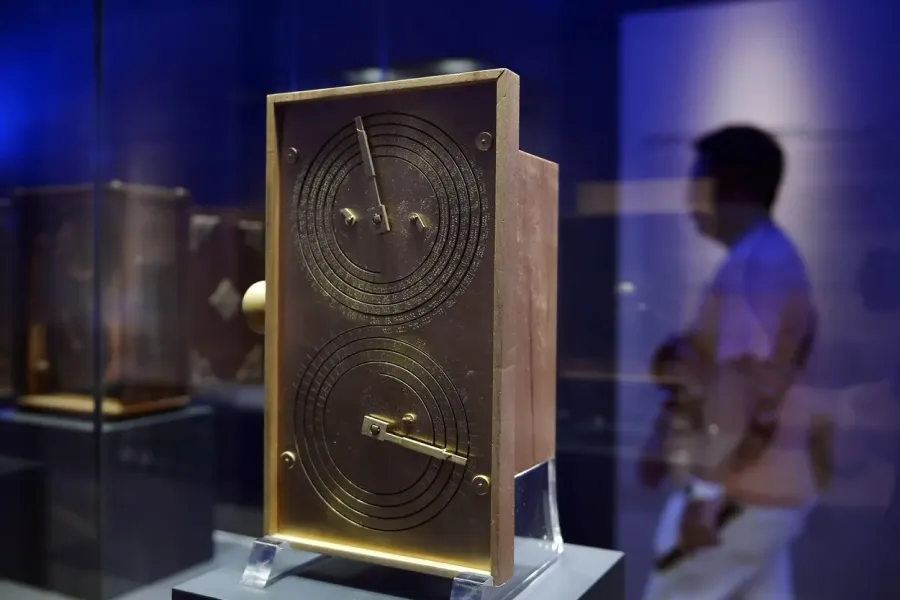
Today I'm going to talk about what is sometimes described as the world's oldest mechanical computer, the Antikythera Mechanism.
This device was able to calculate where the Sun, Moon and planets would be in the sky on any date in the past or future.
It has transformed our understanding both of the world of ancient Greece and of the history of science.
The mechanism was discovered in 1900 at the bottom of the sea off the Greek island of Antikythera, hence the name by which it's now known.
It was in the cargo of a ship that sank about 2,100 years ago.
Divers brought various items to the surface and they were taken to a museum for examination.
One item was assumed to be a lump of rock, however a few months later the object started splitting and a museum curator realised that it was actually something man-made, covered with shells and other objects from the sea.
Further investigation revealed that it was in fact some sort of mechanism and they decided to call it the Antikythera Mechanism.
Although it was badly damaged it had survived in three main parts and around 80 smaller fragments.
The Antikythera Mechanism has been studied a great deal since its discovery and particularly in recent years when highly sophisticated equipment has been available to analyse it.
One machine called a dome can surround a sample and take photographs with the light coming from slightly different angles.
This has made far more of the inscriptions on the mechanism legible even though they're faded and worn.
Another state-of-the-art machine, the Blade Runner, has been used to take x-rays which show parts of the mechanism that would otherwise be invisible.
Despite weighing nearly eight tons it was transported from its place of manufacture to Greece as the Antikythera Mechanism is too fragile to be moved from there.
The Blade Runner was originally designed to examine engines for cracks and it can work at an accuracy of less than a tenth of a millimetre.
It seems the device was originally about 33 centimetres high, 17 centimetres wide and 9 centimetres thick.
It consisted of at least 30 metal gear wheels, that is wheels which interlocked with each other.
The surfaces of the gear wheels were inscribed with the names of the months, explanations of how the different parts of the device were to be operated and other information.
These gear wheels in turn operated small movable models of the Sun, Moon and the five planets that were known to the ancient Greeks.
The mechanism is thought to have been mounted in a frame for which wood was used.
So what was the Antikythera Mechanism used for?
It clearly had an astronomical function.
The person using the device simply rotated a handle to operate the gear wheels.
These engaged with each other to move the Sun, Moon and planets around the earth to show how they would appear on whatever particular date the operator was interested in, which could be years into the future.
Bearing in mind that the ancient Greeks believed the Sun and planets all revolved around the earth, their movements are shown with remarkable accuracy.
Perhaps most astonishing of all, the mechanism also showed when an eclipse was going to take place.
This was very important in the ancient world and being able to predict this accurately would have given the user great power.
The mechanism probably also helped in planning the timing of festivals, both agricultural and religious, by acting as a kind of calendar of events.
Surprisingly, to the best of our knowledge, no device equaled the complexity of the Antikythera Mechanism for at least a thousand years afterwards.
The ideas seem to have survived in some form however, particularly in the Byzantine Empire of the Eastern Mediterranean.
Around the 13th or 14th century, knowledge of the technology seems to have reached Western Europe and a large number of clocks were made, providing astronomical information as well as showing the time of day.
It's hard to believe that nothing reached the sophistication of the Antikythera Mechanism for a thousand years, yet that might well be the case and that has implications for our understanding of how scientific knowledge progresses.