In today's introduction to seismology lecture we'll be looking at predicting volcanic eruptions.
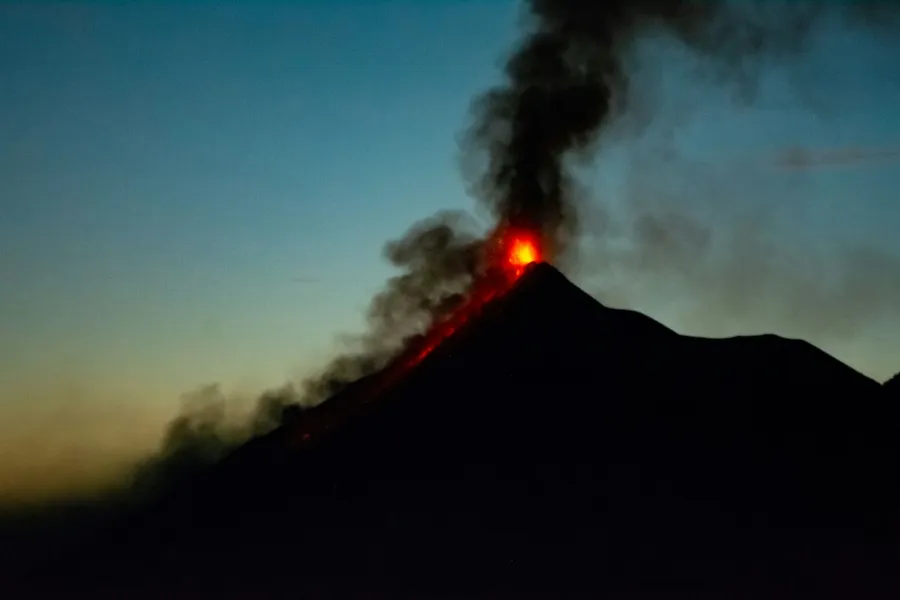
The destruction caused by a large volcano can be devastating and with more of them being increasingly surrounded by urban areas it is more important than ever before to be able to predict and plan for an eruption.
After all there's no way to prevent this massive natural force.
So what can we do to predict when a volcano is going to erupt?
The first sign that we need to look for is earthquakes.
In the run-up to an eruption there are often hundreds of small earthquakes caused by magma rising up through cracks in the earth's crust.
As magma comes into contact with rocks they crack which causes a mini earthquake.
And now many of these earthquakes are too small to be detected by people which is why the ground around earthquakes in densely populated areas needs to be constantly monitored by seismometers.
These are instruments which measure the motion of the earth's surface and a higher frequency of these earthquakes could indicate an upcoming eruption.
Another important area which needs to be monitored is the temperature around volcanoes.
There are lots of volcanic features like steam vents, geysers and hot springs that are expected to be consistently hot but any spikes in this could indicate dangerous volcanic activity.
Technology has had a huge impact on the way we collate this data.
The safest way for us to assess this is to take images using satellites as collecting this data from the ground can be hazardous.
In addition to the frequency and size of earthquakes the final indicator that we assess is the atmospheric conditions around the volcano.
Now most active volcanoes release a range of gases but higher than normal rates of sulfur and carbon dioxide emissions can reveal a lot about the magma system of the volcano and could also be a telltale sign of danger.
In order for this to be monitored gas samples need to be taken and checked using a spectrometer which are types of chemical sensors.
These monitoring techniques are becoming increasingly advanced and some earthquakes like Mount St Helens in the US and Mount Vesuvius in Italy are monitored 24 hours a day by teams of scientists for the safety of the inhabitants living around them.
However understanding and predicting when a blast is imminent is only the first stage in keeping people safe.
We also need to have an effective emergency plan prepared.
When faced with a major volcanic incident authorities need to take a number of steps to reduce civilian casualties.
The first is to calculate an exclusion zone around a volcano where an eruption is imminent.
This would stop anyone from entering the area.
The size of the zone would vary depending on the predicted scale of eruption.
There is one in effect in Montserrat which has been in place since 1995.
In addition to stopping people entering the zone authorities need to be ready to get people out.
Being prepared for a large-scale evacuation is key as people will be panicking and major transit routes will be quickly blocked.
All of this costs money so obviously a government needs to have the funds to deal with emergencies.
Having an advanced communication system in place is a must in order to notify people of both the dangers and the action that is being taken.
Finally it is important to know that an eruption could occur at any time.
Citizens living near particularly active volcanoes need to be educated about both emergency procedures and also the basic provisions that they will need to keep in their house to assist them in times of emergency.
Now let's look in more detail at the design of a seismometer.