You will hear a member of staff introducing two new employees to a theatre.
First, you have some time to look at questions 11 to 16.
Now listen carefully and answer questions 11 to 16.
Hello, it's great to meet you both.
I'm Jodie, and I'll be responsible for helping you during your first month at the Amersham Theatre.
I'll begin by explaining a little about the theatre, and afterwards I'll introduce you to two other members of staff.
The building is old and has been updated several times.
As you can see, a major refurbishment is underway now.
The inside has just been repainted, while work on the exterior is due to begin soon and will be considerable.
Because the project has exceeded its budget, the planned elevator has been delayed, so I hope you don't mind using the stairs.
When the theatre was constructed, audiences were generally smaller, and the seats were packed closely together.
We've installed larger seats with more legroom.
There are fewer of them, but they can be moved easily to create different performance spaces.
Several former storerooms have also been converted for other uses, including meetings.
We make a real effort to involve the public.
One method is to offer backstage tours, which allow visitors to explore the building and discover how a theatre functions.
They've become very popular.
Visitors often ask for lunch or coffee, so a café may be opened later.
At present, we have a bookshop specialising in drama, and it attracts plenty of customers.
Two large rooms will be redecorated next month, and then offered for conferences and private events.
We're also thinking about renting costumes to amateur theatre groups.
We recently introduced a workshop programme, Open to Everyone.
We eventually hope to provide acting courses, but suitable instructors have been harder to find than expected.
There is strong interest in the technical aspects of production, and the lighting workshop is already running, very successfully.
A sound course will begin next month.
Make-up workshops are being considered for the future.
Unexpectedly, puppet-making has been extremely successful.
One of our employees makes puppets as a hobby and volunteered to teach it.
Demand was so high that the workshop now runs monthly.
Before you hear the rest of the talk, you have some time to look at questions 17 to 20.
Now listen and answer questions 17 to 20.
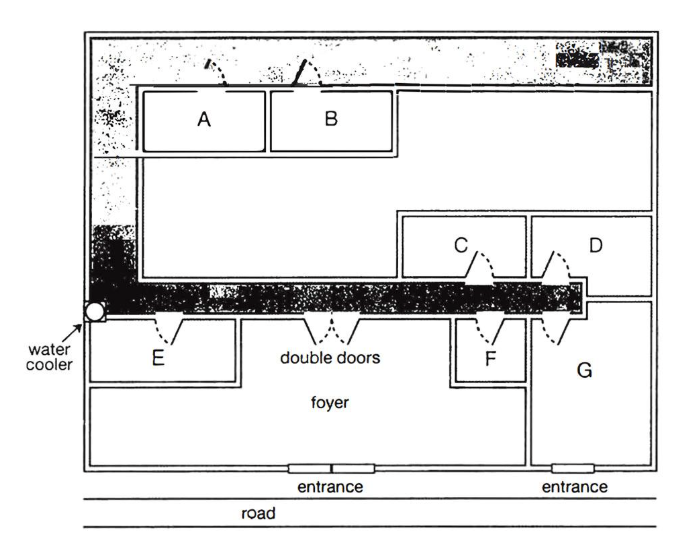
Let me now describe the building's layout.
The auditoriums, stage and actors' dressing rooms are all below ground.
Most of the rooms here on the ground floor aren't normally seen by the public, because many are internal rooms, they receive light through roof windows.
We're standing in the foyer, and you may be wondering why the box office isn't here in the place audiences would expect.
You may have noticed it as you entered.
It forms part of the same building but is next door, with its own entrance from the street.
To find the theatre manager's office, cross the foyer, pass through the double doors and turn right.
Follow the corridor to the end.
The office door is on the left.
The computerised stage lights are operated from the lighting box at the rear of the building.
Go through the double doors and turn left, then turn right by the water cooler.
At the end, turn right once more.
The lighting box is the second room along that corridor.
It has a window looking into the auditorium below.
The artistic director's office is also through the double doors.
Turn right, and it is the first room on the right.
The last place for now is the relaxation room, where we're going next.
That is the end of part two.
You now have one minute to check your answers to part two.