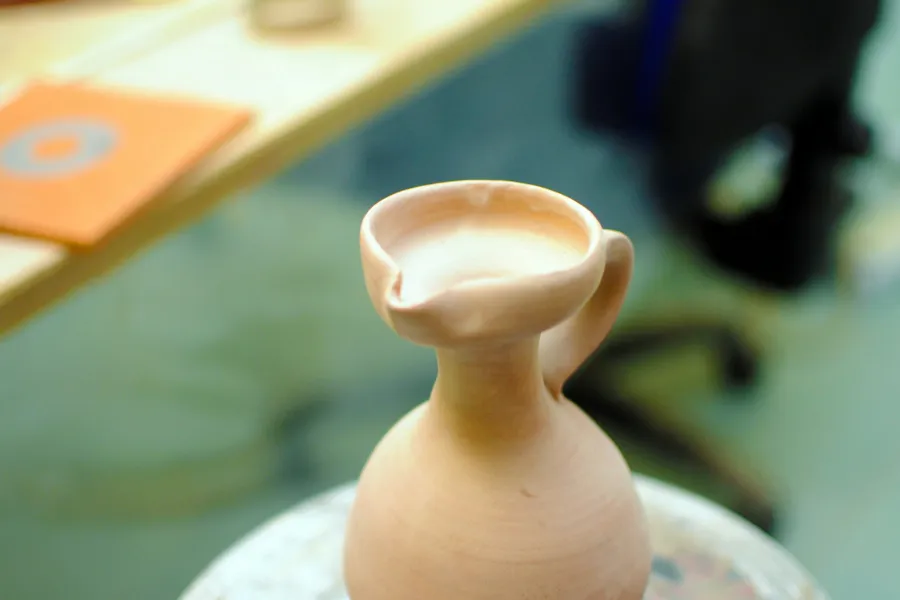
You will hear a potter, Heather McCallum, speaking to visitors at a pottery studio where pots and other objects are made from clay.
First you have some time to look at questions 11 to 16.
Now listen carefully and answer questions 11 to 16.
Hello everyone and welcome.
I'm Heather McCallum, one of the potters here at Edelman Pottery.
Before we go into the workshop I'd like to tell you a little about pottery as a craft.
After that we'll look at the equipment and you'll have a chance to make a pot yourself.
You probably know that pottery has existed as an art form for tens of thousands of years.
We can be sure of this because pottery survives for such a long time.
Objects like woven baskets and paintings tend to disappear when they are buried.
Even when very old pots are discovered only as fragments, they can still tell us a great deal about the past.
Pottery has certainly helped archaeologists understand how people lived in ancient times.
The original form of an object may no longer be clear, but they can work out whether a pot was used for storage or cooking by studying impressions in its surface, including scratches left by tools.
The clay itself meanwhile may show where the pot was produced.
When I ask people why they want to attend one of my pottery classes, some mention this link with the past.
They hope to leave behind something that will survive beyond their own lifetime.
Whether the piece is especially good or not, it might still communicate something about human life, long after its maker has gone.
Naturally, each of you will have a personal reason for being here.
For me, the best part of pottery is the complete attention needed to produce a good pot.
Focusing so closely helps you forget the pressures of daily life for a while.
For older people working with clay also exercises the hands and wrists and may ease arthritis.
Children often enjoy it for another reason.
At Edelman Pottery, we'll demonstrate some fundamental methods that you can then use to make anything you choose, perhaps a present for a friend.
As with almost everyone who comes here, this is probably your first attempt at pottery, so we'll keep today's work straight forward.
Before we continue, let me remind you about what you're wearing.
As the email explained, please take off watches, necklaces and any other jewellery and leave them somewhere secure.
Tie back long hair as well.
We'll hand out aprons later, but I'm assuming you've arrived in comfortable older clothes rather than your favourite t-shirt or jeans.
Before you hear the rest of the talk, you have some time to look at questions 17 to 20.
Now listen and answer questions 17 to 20.
We've now come into the workshop, so take a look around.
There's plenty happening here.
To produce pottery that will last, you need a potter's wheel, a kiln, essentially an extremely hot oven in which the clay is fired, and a selection of tools.
Let's begin with the kiln.
You can see one of ours in the far corner.
Kilns themselves have altered very little since they were introduced, although temperature control has improved considerably over the last 20 years.
In simple terms, a kiln drives the moisture out of clay at close to 1000 degrees Celsius.
This makes the object harden and keep its shape permanently.
A kiln is a large, unattractive and very heavy piece of equipment, so it can be difficult to accommodate in a house or flat, and most people don't own one.
You might wonder whether a kitchen oven will do instead.
It can be used, but it doesn't become hot enough, so the clay will eventually split and fall apart.
Other people fire their pots in an outdoor fire pit, although that can be hazardous.
Safe operating procedures are also important because kilns give off toxic substances.
Every potter also needs a wheel.
It shapes the clay into objects with round sides such as bowls.
The arrival of the potter's wheel transformed the industry because it made it possible to produce several pieces in a single day.
Finally, potters use different tools according to the object they are making.
At first, your hands can form a wide range of curves and shapes without a sculpting implement.
Even so, some basic tools are essential for controlling the clay on the wheel.
A few look rather peculiar and have names that are even stranger, so you may struggle to remember them.
Instead of listing every tool now, I'll introduce a few as we work.
We can supply all of them, and I wouldn't advise buying any at this stage.
Right, let's begin making a pot of your own.
That is the end of part two.
You now have thirty seconds to check your answers to part two.