You will hear a museum guide welcoming a group of visitors and giving some introductory information.
First, you will hear a museum guide welcoming a group of visitors and giving some introductory information.
First, you have some time to look at questions 11 to 14.
Now listen carefully and answer questions 11 to 14.
Good morning, everyone, and welcome to the Museum of Farming Life.
As this is your first time here, I'll begin with a little background to the museum before describing some of the things you can explore today.
The entrance where we're gathered belongs to a substantial building dating from 1880.
It was first built as the private home of Alfred Palmer, a local businessman who owned the Palmer Biscuit Factory.
The property was later sold, becoming student accommodation in 1911 and then a museum in 1951.
A modern extension was added in 2005 to hold the collections.
The university owns the museum.
Two rooms are occupied by our museum offices, while the university uses most of the original building for classes.
You'll probably notice students going in for lessons, although visitors aren't allowed inside that section.
That's a pity, as it has some remarkable architectural details, particularly the room that was once the library.
Fortunately, admission remains free, and that covers every gallery, the outdoor spaces, and the special exhibition rooms.
Activities such as our museum club are free for children and students as well.
There is a donation box nearby, but it's entirely up to you whether you put anything in and how much you give.
There's a cloak room where coats and bags can be stored.
Photography is permitted, unlike in many museums, so keep your cameras with you.
Since the garden is rather chilly today, I'd also leave your coat on.
However, carrying a heavy rucksack around isn't very comfortable, so I'd recommend putting large bags in the cloak room.
Before you hear the rest of the talk, you have some time to look at questions 15 to 20.
Now listen and answer questions 15 to 20.
Now I'll take you through the different parts of the museum.
The area called Four Seasons is positioned partly inside and partly beyond the main gallery.
It shows a four-minute animated woodland scene, created especially for us by young people studying film.
It's a lovely piece, and adults enjoy it just as much as children do.
Our main gallery, Town and Country, contains photographs of award-winning sheep and the people who look after them.
From there, you move into Farmhouse Kitchen, whose theme is fairly obvious.
It houses the country's oldest collection of butter and cheese-making equipment.
This morning, a specialist cheesemaker is demonstrating the process, and visitors may even be able to taste the results.
Next, there are two possible directions.
The staircase on the right leads to a landing overlooking the galleries.
On the left is a year on the farm.
We sometimes use that room for school visits, so it has plenty of seats and is a convenient place to rest.
Anyone who wants a challenge can also try our memory quiz, answering questions about exhibits they've already seen.
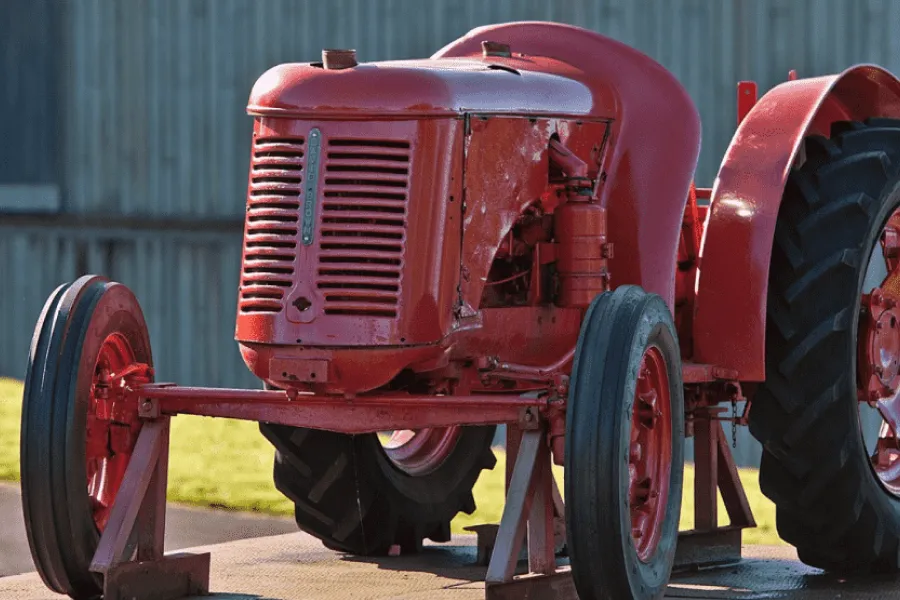
The following section is Wagon Walk, with farm carts collected from almost every region of the country.
The differences between the areas are quite striking, and information panels beside the carts explain each one.
Because these vehicles are old and delicate, adults must keep children close and make sure they don't climb on them.
After Wagon Walk, you may return to reception, head into the garden, or revisit the galleries, so you aren't restricted to one route.
Beezer Magic is in the garden's far corner.
That section is currently being redeveloped, so it isn't open today, although honey from the museum is still available in the shop.
The last place is the pond, home to several kinds of wildlife.
There are ducklings only a few days old, as well as tiny frogs.
The water is shallow and surrounded by a fence, making the area safe for children.