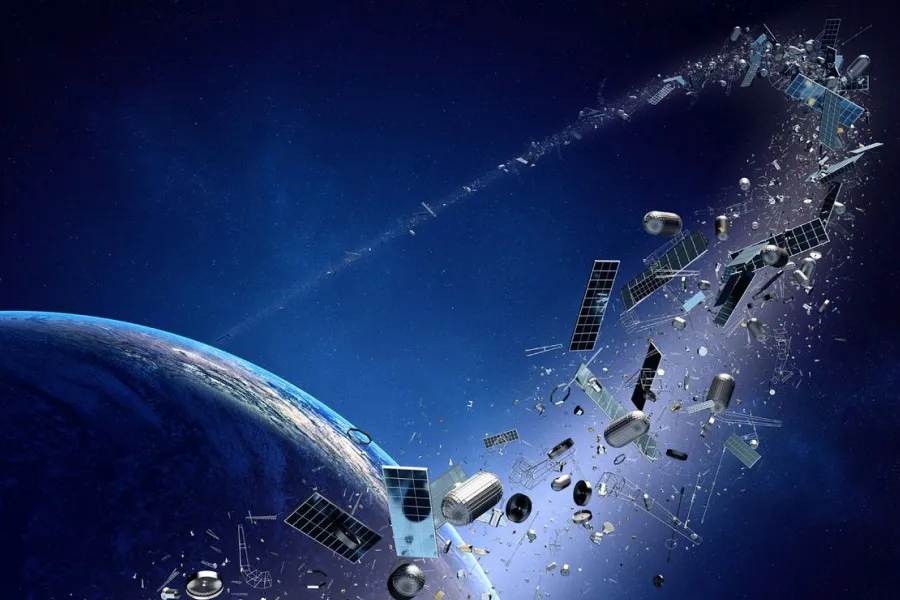
You will hear a lecturer discussing the management of satellites and other objects orbiting the Earth.
First, you have some time to look at questions 31 to 40.
You will hear a lecturer discussing the management of satellites and other objects orbiting the Earth.
First, you have some time to look at questions 31 to 40.
Now listen carefully and answer questions 31 to 40.
In this astronomy lecture, I want to examine why we need a system that controls the movement of satellites and other objects travelling around the Earth.
This is generally known as space traffic management.
Air traffic control already operates internationally to help aircraft move safely through the skies.
Space traffic management applies much the same idea to satellites.
The purpose would be to reduce the risk of objects in orbit colliding with one another.
Achieving that would require an agreed legal framework as well as technical systems capable of preventing these accidents.
The difficulty is that no effective space traffic management system exists at the moment.
So what has prevented one from being developed?
To begin with, satellites are relatively cheap now compared with the past.
So many more organisations can afford to send them into space.
Instead of launching them individually, operators may deploy complete constellations containing thousands of satellites that work together.
As a result, the space around Earth is becoming increasingly crowded.
Yet after a satellite has been launched, there is currently no requirement for it to transmit information back to Earth that enables its identification.
We have international arrangements that tell us where aircraft are and help keep them apart.
But there are still far too few adequate systems for tracking satellites safely.
Nor are complete satellites the only concern.
The greater danger may come from the vast quantity of debris in orbit, including fragments of satellites and waste from space stations.
Some pieces are so small that identifying them is extremely difficult, even though they can still cause serious damage.
Another obstacle is that operators do not always want to release information about what they have launched.
A satellite might serve military purposes, for instance, or have a commercial use, in which case its operator may not want rival organisations to know about it.
Even when an operator is prepared to share data, obtaining it is challenging.
We need details about the object and its location at a specific moment.
A satellite is small and may be travelling at several thousand kilometres per hour, while no sensor can monitor such a fast-moving object continuously.
Scientists, therefore, have to make a prediction about where it will travel next.
Those are some of the principal difficulties.
Turning to possible solutions, the treatment of information is especially important.
We need a greater quantity of data, but it must also be available worldwide.
That means agreeing on common standards for how the information is presented.
Similar standards already exist in other scientific fields, so the task is demanding but achievable.
As the information is gathered, it must then be brought together in a usable form.
This would mean entering everything into a single database.
Continued technological development will only make the space environment more congested.
We therefore need a system that coordinates the activities of the many spacecraft operators.
Just as importantly, it must establish trust among the people who use it, both within individual countries and internationally.