You will hear a guide giving visitors information about two local walks and the Melby coal mine site.
First, you have some time to look at questions 11 to 14.
Now listen carefully and answer questions 11 to 14.
I'm going to tell you about two history and nature walks in this area.
Each can be finished in under a day, and either one can be combined with a visit to Melby, a former coal mine which now welcomes visitors.
The Marsden Coastal Walk is manageable for families because it involves no demanding climbs.
It begins at Marsden Harbour.
Ferries leave there every hour for Hooker Island, which is popular with anglers, but the walk itself follows part of the coastal trail.
Direction signs are positioned all along the route, so there's really no need to carry a map.
The path briefly turns inland and passes the remains of a 15th century castle.
The market town that once stood nearby has completely disappeared, but the castle ruins are well worth seeing, and information panels show how the building used to look.
Anyone who starts early should be back by lunchtime.
The Melby Heritage Walk is particularly popular with photographers after dark.
At certain times of year, visitors travel considerable distances to climb above the valley and photograph the stars.
During the day, however, the woodland at the bottom of the valley is so peaceful that you may hear nothing except your own footsteps.
After the climb, the highest point offers a broad view.
Energetic walkers can also go up the tower built on the site of a 17th-century hunting lodge.
From there, the path follows the hilltops before descending to the same car park at Melby Coal Mine, where the walk began.
Before you hear the rest of the talk, you have some time to look at questions 15 to 20.
Now listen and answer questions 15 to 20.
Melby Coal Mine has been open to the public for 20 years and has received awards for the quality of the visit.
Several original mine buildings survive and most now contain displays.
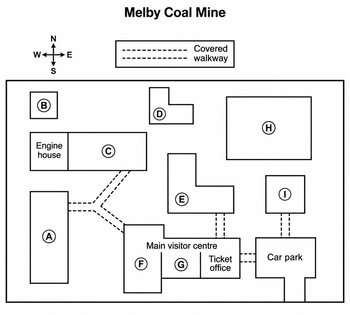
I'll describe the plan starting from the car park.
Follow the covered walkway into the main visitor centre and pass through the ticket office.
The next small area has lockers for heavy bags and raincoats visitors can borrow.
Continue beyond that room into the larger space.
That is where you'll find the historical exhibition, including many original black and white photographs.
The miner's bathhouse is the small building immediately north of the engine house.
Its boiler has been removed, but rows of tin baths remain on the stone floor.
The collection of early hand tools is in the L-shaped building, halfway along the northern edge of the site.
The display shows how miners cut through rock before mechanised equipment was introduced.
Mining vehicles are displayed in the long building in the southwest corner.
It contains wagons of several sizes, as well as advanced cutting machines used shortly before the mine closed.
And you reach it by a covered walkway.
Children usually enjoy the pony field.
It occupies the northeastern boundary, and unlike the vehicle display, it is not reached by a covered walkway.
Finally, the education centre is the L-shaped building near the centre.
School groups use it, but other visitors can enter because it also contains a library and a small gift shop.
A short covered section connects it directly with the ticket office.
That is the end of part two.
You now have one minute to check your answers to part two.