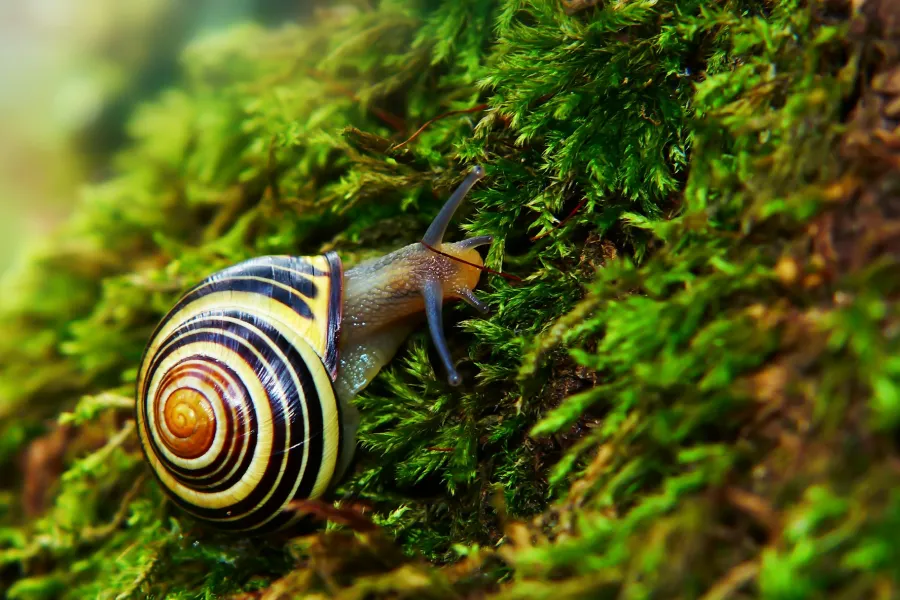
In this module, we've been looking at various field survey methods, and now I'm going to give you a brief introduction to the specific organism that we'll be focusing on during our first field trip, and that's the gastropod.
Gastropods are invertebrates, they're organisms without a backbone, and they're more commonly known as snails or, if they haven't got a shell, slugs.
Now, in terms of their evolution, gastropods go back a long way.
With other primitive animals, the minerals in their body fluids are very similar to the mineral composition of the sea, indicating that they began life there.
And their fossilised remains have been found in rocks dating back at least 500 million years.
Looking at the physical features of the gastropods, well, they all have one muscular foot for swimming or walking.
This foot is lubricated with mucus, and it's this that leaves the sticky trail that you see behind snails and slugs.
They also have an organ called a radula, which they use for feeding.
Then, of course, the snails, though not the slugs, have a shell.
In terms of their dimensions, snail shells in Britain range from the dwarf snail, which is 1.5 millimetres long, to the Roman snail, whose shell can be as big as 50 millimetres.
As well as size variations, you get a lot of differences in the form of snail shells.
For example, the majority coil to the right, but there are a few that coil to the left.
Then some shells, for instance, the plated snail, have regularly spaced ribs, while the prickly snail has prominent spines.
There are even a number of species with hair on their shells.
Colours on the shells also vary, as do patterns, so appearances are really varied.
OK, let's turn now to feeding habits.
Most of you who are gardeners will know to your cost that some gastropods eat healthy plants, but you may not realise that these are the minority.
Most species feed on rotting plants, or they eat fungi and algae.
Some species eat dead animals, and there are some that are actually carnivorous.
They prey on live animals.
For example, the shield slug feeds on worms.
And apart from their own feeding habits, I should point out that gastropods themselves have plenty of predators.
Birds and frogs are the main ones.
But there's even an entire family of flies that have specialised in preying on gastropods.
And, of course, last but not least, I should mention human predators.
It was the Romans who probably first introduced edible snails into Britain during the first century, and they are still eaten today.
In fact, the collection of wild snails for cooking has caused local extinctions of one species, which is also under threat internationally.
So there are lots of predators, but to protect themselves, gastropods have often developed special defences.
I'll just give you one example.
The glutinous snail avoids predators by folding its mantle over its shell and turning itself into a very slippery blob of jelly.
Well, turning now to gastropod habitats, most species like dampness and shade.
In general, both very hot and very cold weather is bad for gastropods.
But dry conditions are the least favourable.
Snails cope with this by withdrawing into their shells.
And often they form a thick film of mucus over the mouth of their shell to minimise loss of water.
Habitats with a long, stable history tend to support the biggest range of gastropod species.
So, for instance, long established forests usually support more species than newer plantations of trees.
And old natural meadowland is much better than land which has recently been farmed.
And there is a small number of highly specialised species that live in unusual habitats.
For instance, the blind snail spends its whole life buried under the ground.
It's been reported living at depths of two metres and particularly likes the cavities in old buried bones apparently.
But species like these are exceptional.
But wherever they live, gastropods are often sensitive to pollution.
And they don't thrive in areas contaminated by agrochemicals.
This means that they are a reliable indication of how healthy our environment is.
Now, at this point, I'd like to consider habitat management...