You will hear part of a lecture on earth sciences.
First you have some time to look at questions 31 to 40.
Now listen carefully and answer questions 31 to 40.
Good morning everyone and welcome to this earth sciences lecture.
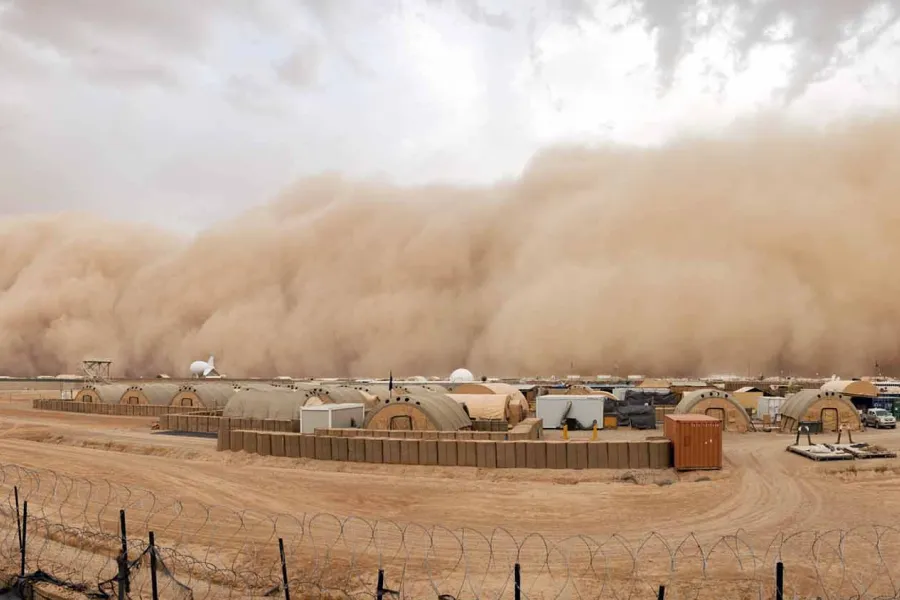
Today we are going to look at These are giant dust storms which are sometimes close to 2 kilometers high and 160 kilometers wide.
Haboobs occur in arid regions throughout the world, particularly in the Sahara Desert, the Arabian Peninsula, parts of the US and the deserts of Central Australia, where these dust clouds may reach several kilometers in height and leave a foot-thick blanket of sand covering everything in their paths.
In the Sahara there are two types of the Haboob.
In the south a strong and hot version occurs creating a common sandstorm.
In the north the Haboob is colder and causes fewer sandstorms than in the south.
Haboobs have many effects on the environments where they occur.
A major effect is that pollution levels skyrocket during these dust storms and exacerbate breathing problems for people with asthma and other similar conditions, causing hospitals to be overwhelmed with people, many of them holiday makers.
Many police sources have reported how Arizona was affected last summer as Haboobs knocked out electricity and created traffic jams.
Wind conditions made some trees fall onto cars and one elementary school bus, though thankfully there were no casualties.
Due to the obvious dangers, many planes had to be grounded during times when there was any threat at all of a Haboob taking place.
A Haboob is an intense dust storm.
The word Haboob comes from the Arabic word hab meaning wind.
The Haboob is a wall of dust created by a microburst or downburst, more commonly the former.
A microburst is a small very intense downdraft that descends to the ground, resulting in a strong wind divergence.
Microbursts are capable of producing winds of more than 100 miles per hour, causing significant damage.
The lifespan of a microburst is around 5 to 15 minutes.
The air force downward is pushed forward by the front of a thunderstorm cell, dragging dust and debris with it as it travels across the terrain.
When rain falls below the cloud base or is mixed with dry air, it begins to evaporate and this evaporation process cools the air.
The cool air descends and accelerates as it approaches the ground.
When the cool air approaches the ground, it spreads out in all directions and this divergence of the wind is the signature of the microburst.
In humid climates, microbursts can also generate from heavy precipitation.
The problem, according to meteorological experts, is that rising temperatures contribute directly and indirectly to there being more dust in the air.
Persistent droughts, increasingly violent and variable weather patterns, urban and suburban development and even off-road recreational vehicle usage on farmland can compound the problem.
Texas is experiencing one of the extreme droughts in recent history, with 90% of the state in the most extreme level of drought.
Arizona, California, Colorado, New Mexico, Oklahoma, Utah and other states are also experiencing drought conditions.
The government has tried to conserve water by building dams, but this has not had a positive effect yet.
The worry is that this might be just the start of a trend, as reported in a recent issue of the journal Earth.
Researchers say that over the next couple of decades, the American West will transition to an environment that may make the 1930s Dust Bowl seem mild and brief.
Finally, meteorologists have said that the U.S. experienced a typical number of dust storms last year, but what set last season apart from others was the size and power of three of the storms.
Variety in the dust storms is normal, but there does not seem to be a single causative factor for why they seemed to be strong last year.
Weather experts said such massive dust storms only happened in Arizona, Africa's Sahara Desert and parts of the Middle East because of extremely hot and dry conditions and the large amounts of sand.
That is the end of section four.
You will now have half a minute to check your answers.