We've been looking at marketing techniques which influence buying decisions.
Some of these techniques are related to the way the products are presented in the store.
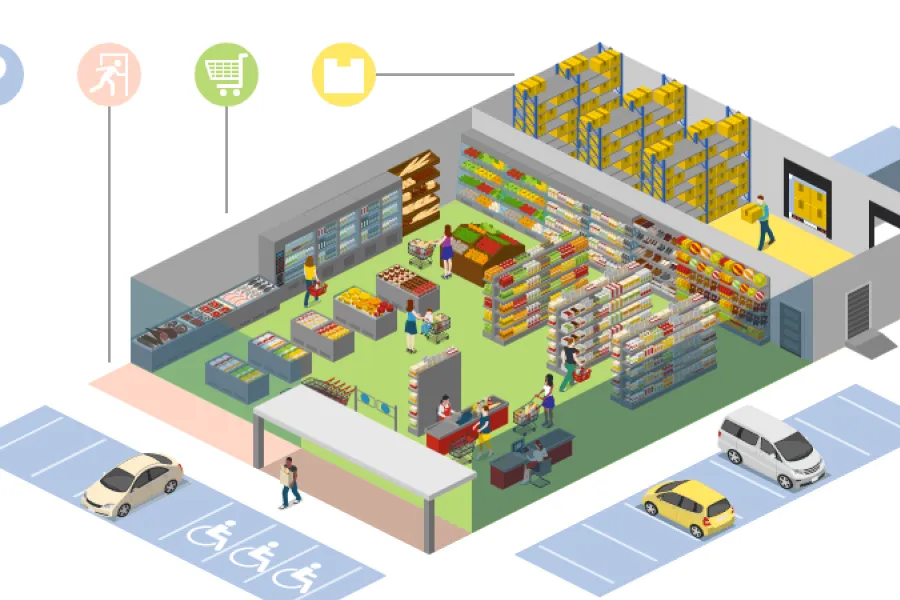
For supermarkets, the store layout is not as random as it seems.
Decisions have to be made about the arrangement of the aisles where the customers walk, and the shelves and so on, where the products are displayed.
The most common layout pattern is the grid layout, where parallel aisles are arranged in a rectangular pattern.
Supermarkets like this layout as it allows them to utilise floor space efficiently by providing the greatest amount of display space proportionate to aisle space.
Also, this layout helps to manage traffic flow, as it encourages people to all walk in one direction.
The main weaknesses of the grid layout are the monotony of rows of aisles, and the fact that it is easier for customers to rush through the supermarket without lingering.
Another layout pattern used by supermarkets is known as the freeform.
Here, displays and aisles are arranged in a random pattern.
The good thing about this layout is that customers tend to spend more time in the store as they wander about looking for different products.
Its main weakness is the inefficient use of space, which means it is less cost effective.
Then we have the boutique layout, where everything is organised around a food specialty, such as the bakery.
The advantage of this layout is that it divides parts of the store into smaller areas, which may be distinguished by changes in flooring or displays.
A further advantage is that this style of layout is attractive to shoppers.
Space, however, is not used economically, and it is therefore expensive.
The choice of location of particular types of items in the store is also important.
A supermarket's design aims to direct customers to the store's side and rear walls.
Items typically displayed along the rear length of the store include meat and dairy products, since these appear on the grocery list of the majority of shoppers.
This means shoppers must pass by a large number of other items to get to them.
Items which consumers tend to spend more time considering before buying, such as cosmetics, are usually placed away from the busy areas, so that people can look at them in comfort, without feeling rushed.
Products placed at the end of aisles are clearly visible, and therefore these locations provide a greater opportunity for shoppers to view the products.
Consumers tend to assume that items on display at the end of an aisle are on sale, but this is often not the case.
In fact, supermarket managers often place products which are not selling quickly enough in these positions.
The placement of products on shelves is very carefully planned.
Supermarket executives use computer-generated plans to help them place products on shelves in a way that ensures consumers spend more.
The eye level of the average woman is 1m 60cm off the floor, which is the height of the middle shelves, so the things which cost more are placed here, while cheaper products are placed on higher or lower shelves.
Only items targeted at children break this rule – they are placed on the lowest shelves.
Supermarkets also use a range of other marketing techniques to encourage consumers to spend more.
It's no accident that in nearly every supermarket, the fruit and vegetable department is the first shoppers come to as they enter the store.
These, together with flowers, produce a greater profit than any other department.
After complaints from parents, many supermarkets no longer place popular products aimed at children on the shelves next to the checkout.
Instead, you are most likely to find products aimed at impulse buyers, such as chocolate, magazines and other treats here.
Many supermarkets have also expanded into non-food areas such as clothing, entertainment and stationery.