You will hear part of a lecture on environmental issues.
First you have some time to look at questions 31 to 40.
Now listen carefully and answer questions 31 to 40.
Thank you all for coming to this talk on environmental issues.
Today we are examining the interesting problem of how snakes from India are causing environmental problems in the Everglades of Florida in the southern US.
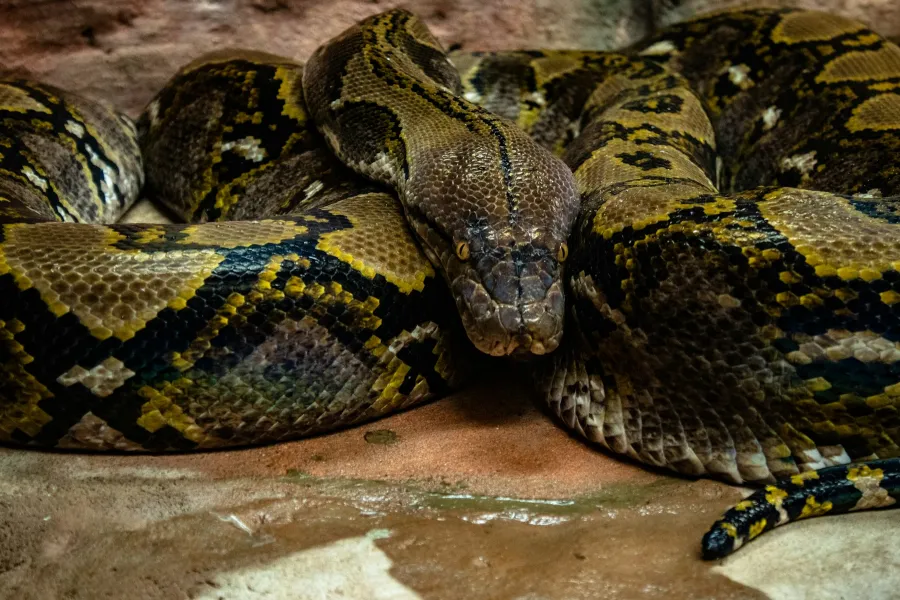
The snakes in question are Burmese pythons.
The snakes are native to India and Southeast Asia but they've established themselves in the wetlands of southern Florida and one or two have even been spotted in Tennessee where they're causing havoc with local wildlife.
There is even talk of pythons making their way as far as the north of Mexico in the near future although research has proved this has not yet occurred.
Burmese pythons are, as the name might suggest, not local to the US but they are a popular pet imported to the US from their native habitat in India and Southeast Asia.
Sometimes these pets escape from their owners or are simply let go, especially in Florida, a nexus of the imported wildlife trade and one of the few parts of the US with a climate and landscape to which the pythons can easily adapt.
That's how hundreds or even thousands of Burmese pythons have managed to establish themselves in the Florida Everglades, the vast protected wetlands in southern Florida where they've become a persistent challenge for local officials tasked with protecting endangered wildlife.
Recent studies have suggested just how big a threat the invasive Burmese pythons have become.
Burmese pythons are eating machines.
An adult snake can grow to nearly 20 feet and it can eat anything from raccoons to bobcats to deer to alligators, killing its prey by constriction and then swallowing it whole.
In the Florida food chain the Burmese pythons rest at the top.
Experts have shown recently that only birds seem to have escaped their attentions.
The same researchers have also recently looked at the distribution of mammals in the Everglades nearly 20 years ago before Burmese pythons established themselves in the area and then more recently.
They have found a drastic reduction in the number of small mammals that are typically part of a python's diet and they also discovered that the remaining mammals tend to be most abundant in areas that are either clear of pythons or where the snakes have only recently been spotted.
The evidence is strong enough to suggest that invasive Burmese pythons are causing significant wildlife loss in the Everglades.
The indications are that the problem could worsen as the snakes continue to grow in size and numbers.
As a result of complaints by local farmers whose livestock has been affected and by local trappers who are now controlled by stricter legislation, research has now been undertaken.
One method that researchers have used to measure the effect that pythons have had on indigenous species is to look at detailed night-time roadkill surveys of the Everglades between five years ago and today and compare that data with similar roadkill surveys taken between the same year period before that and again the same year period before that.
The researchers found that there was a 99.3% decrease in the frequency of raccoon observations and 98.9% decrease in the frequency of opossum observations and 87.5% decrease in the frequency of bobcat observations and a total failure to detect any previously widespread rabbits.
Since all of these animals can serve as a python's dinner and given the fact that the mammals were more common in areas where the pythons hadn't been seen, it's reasonable to infer that the pythons are affecting the ecology of the Everglades.
While the snakes have been spotted in the Everglades for at least the past two decades, they were only recognised as fully established 12 years ago.
Wildlife officials have tried to remove the snakes and 400 were taken out three years ago.
However, the damage may already be done.
Right now, the only hope to halt further python invasion into new areas is swift, decisive and deliberate human action.
The trouble is that it's much easier to prevent invasive species from establishing themselves in a new territory than it is to root them out once they've gotten comfortable.
The US government recently banned the import and interstate commerce of Burmese pythons and a few other foreign snakes, but under pressure from the pet industry, other snakes, including the boa constrictor, are still allowed to be imported into the US.
The wildlife trade is big business and importers will resist any new rules.
Reptiles alone are worth more than 50 million dollars and according to the American Pet Products Manufacturers Association, some 11 million reptiles were kept as pets as recently as 2005.
Not everyone agrees with the researchers' findings though.
The US Association of Reptile Keepers, a trade group, told journalists that the Burmese python studies authors had jumped to conclusions and that other work had shown that mercury pollution in the water might be playing a major role in the deaths of small mammals.
This may or may not be true, but in any case, invasive species pose a major threat to the US.
Another example is the Illinois River problem with invasive Asian carp which costs the US some 120 million dollars a year and the python problem may not stay localized to the Everglades.
These pythons do not stand still and the US Fish and Wildlife Service reports that they're adapting to colder climates and may be expanding their range.
We need to watch out as, after all, humans are small mammals too.
That is the end of section four.
You will now have half a minute to check your answers.