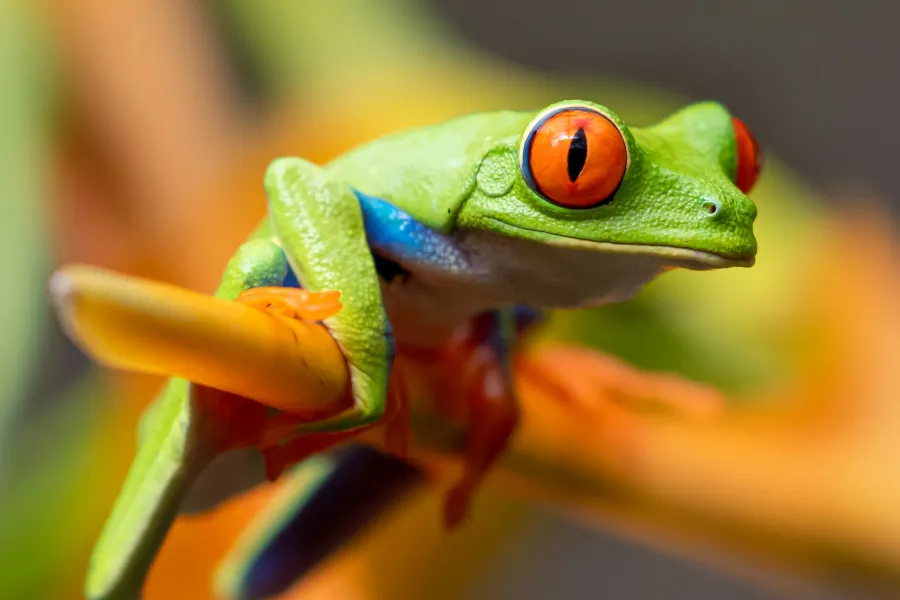
I'm happy to have been invited here today to talk about the research my team's been doing into the problems facing amphibians.
These are animals such as frogs and toads which can live on both land and in water.
Now I'm going to start with a frightening statistic, that over half of the world's amphibian species are in decline, and 30% are in grave danger of extinction.
We have based these findings on a review of past published papers, and we also used computers to create simulations of possible situations in order to see their effects.
And we have combined these with the indications emerging from ongoing conservation programs around the world.
Now why should we be so worried about the decrease in amphibian species?
Why are these small creatures of such importance?
Well, they are the lifeblood of many environments.
Essentially because of their position in the food chain, where they're down near the base, and so they're prey for larger animals.
And another reason they're so important is that many of them are of great interest to biologists, as they exhibit adaptations which provide insight into many other aspects of ecosystems.
Now I'd like to look in some detail at some of the species we've been researching, to give you an idea of these physiological and behavioral features.
I'll start with the midwife toad, which is found on the island of Majorca, and has long been an object of study because its eggs are carried by the male rather than the female once they're fertilized.
This species is under threat from a fungus, which is drastically reducing numbers.
And then the alpine salamander, which is widely considered one of the oddest amphibians.
This is notable because of the behavior of its young while they are growing in the womb.
Basically, the dominant salamanders eat the others until the number is reduced to two, and then the mother gives birth.
They are at particular risk from climate change.
They live in the cool conditions at high altitudes, and as temperatures rise, so the salamanders have to climb even higher.
Our research shows that they have not got much further to go.
Another amphibian affected by global warming, the common toad, has evolved to hibernate in cold winters, but they are finding it increasingly difficult to do this, and so they experience a drop in energy during the warmer months.
Common toads are often hit by cars as they cross roads attempting to get to the ponds, which are their breeding grounds.
Also, these days, these ponds are increasingly affected by pollution, which is becoming the biggest threat to their survival.
Finally, we've been looking at Latast frog, which has a very restricted habitat.
It lives only in the Po River Valley in Italy, but its habitat is being encroached upon by agriculture and also by urban growth, and it is feared that soon this frog will have no habitat left.
In our research, we look at all amphibian species that are evolutionarily distinct and endangered, and we're particularly worried about European species.
Half of Europe's species will be extinct within 40 years if nothing is done to reverse the causes.
Species at particular risk are those living in habitats which are confined by barriers.
For example, those found on islands, where they are confined by the sea.
Another type of barrier which prevents amphibians from moving into new habitats is mountains, such as those inhabited by the alpine salamander.
So what can we do to tackle the problems and try to save these unique creatures before it's too late?
Well, a range of options has been explored by the team.
In the short term, we feel the best approach is to set up captivity schemes, which essentially means preserving some amphibians in a variety of carefully chosen locations with a view to building up stocks.
Then in the medium term, we shall be devoting many of our research efforts to finding ways to cure diseases.
And of course, in the long term, reducing habitat destruction and helping to reduce global warming by developing alternatives to fossil fuels.
Now, if you have any questions...